I’m Khaled. I work with in-house legal teams at Flank on getting agents into live workflows. Everyone agrees you should start with one workflow. Almost no one tells you which.
Last time I argued against trying to map your whole AI future at once. This picks that up and answers the question it left hanging: where to actually start.
🔍 First, you have to see the work
The honest answer is that before you can choose, you have to be able to see what you are choosing between, and most teams can’t. Not because they are disorganised, but because legal work doesn’t turn up as a set of neat, labelled workflows. In a smaller team it turns up as an inbox: requests from sales, procurement, HR, wherever, all blurring into one category in your head, legal stuff, one big pile. In a bigger org it is more structured than that, of course. You might have a commercial contracts team, an employment team, a regulatory or compliance one, each with its own remit. But that structure is organised around subject matter, not around the kind of work being done, and those are not the same thing. Even inside a tidy specialist team, the actual tasks are still all mixed in together.
But that structure is organised around subject matter, not around the kind of work being done, and those are not the same thing.
When you try to break that pile down, the instinct is to sort it by document type. NDAs here, MSAs there, DPAs in the corner. I don’t think that is the most useful cut, though, because what matters more is what you are actually doing to the thing. Take an MSA. One day you are reviewing a counterparty’s version against your positions. Another day you are drafting one from scratch off your own template. Another you are buried in redlines, answering the same objections you answered on the last three deals. Same document, three completely different jobs. Calling all of it “MSA work” hides that.
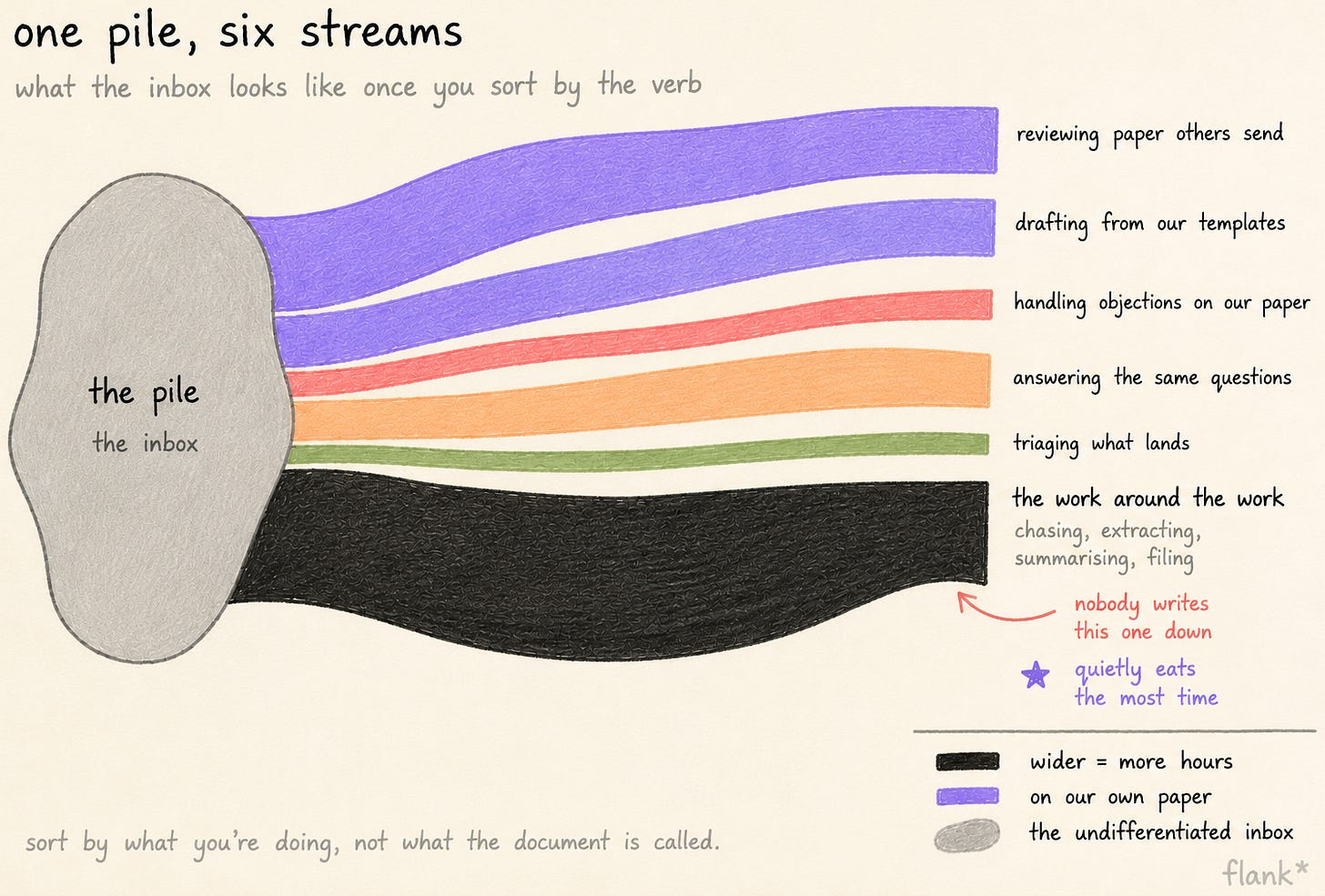
Once you start sorting by the verb rather than the document, the real streams show up. There is reviewing paper other people send you. Drafting from your own templates. Handling the objections that come back on your paper. Answering the same questions the business keeps asking. Triaging whatever lands and sending it to the right person. And then there is the one people almost never count, which is all the work around the work: the chasing, the extracting, the summarising, the filing that sits behind every signed contract. Nobody writes that down as a workflow, so it never really gets dealt with, and in my experience it quietly eats more time than any single document type does.
The point of all this is that you can’t sensibly pick a workflow until you can see them laid out like that. So the first step isn’t choosing at all. It’s untangling.
Same document, three completely different jobs. Calling all of it “MSA work” hides that.
Then, narrow it down
Once they are laid out, you do have to pick one, and there are really two things I would look at.
The first is fairly obvious. Which of these is high volume and low complexity? You are not after the hardest or the most interesting work. You are after the stuff that comes in constantly and mostly follows a pattern, because that is both what an agent handles well and where your team’s hours are actually going.
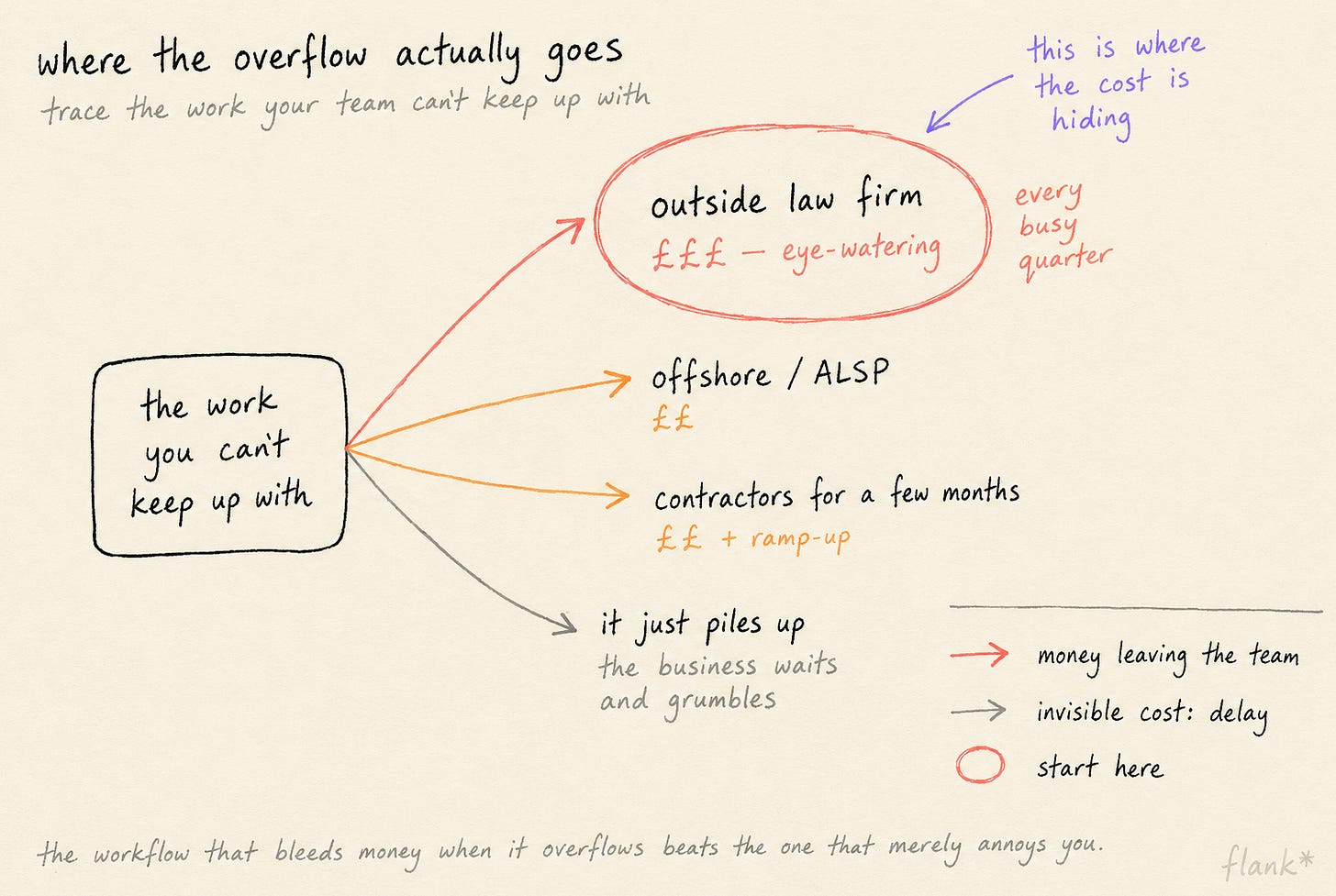
The second is less obvious, and I think it is the more useful of the two. When your team is completely underwater, where does that work actually go? Maybe it goes out to a law firm at eye-watering rates. Maybe offshore, or to an ALSP. Maybe you pull in contractors for a few months. Or maybe it just piles up while the business waits and grumbles. Wherever it ends up, follow it. That is where the cost is hiding. A workflow that quietly bleeds money to outside counsel every busy quarter is a far better place to start than the one that is merely irritating you day to day.
So now you have a shortlist: high volume, rules-based, and expensive when it overflows. There is one more trap to watch for, which is that the workflow causing the most pain often isn’t the real problem. It is usually the symptom of one, and if you automate the symptom it tends to come back a few weeks later in a slightly different form.
You are after the stuff that comes in constantly and mostly follows a pattern.
🧠 Then find the real problem, not the loud one
The thing I have found genuinely useful here is the old “five whys”. You take the problem you think you have and ask why, maybe five times, until you reach something that is actually a cause rather than a complaint.
Here is roughly how it tends to go.
“We want to automate supplier agreement review.” Why? “Supplier agreements take too long to turn around.” Why? “They sit in a queue waiting for a lawyer.” Why? “Every single one gets a full manual review.” Why? “We’ve never separated the standard ones from the ones that carry real risk.”
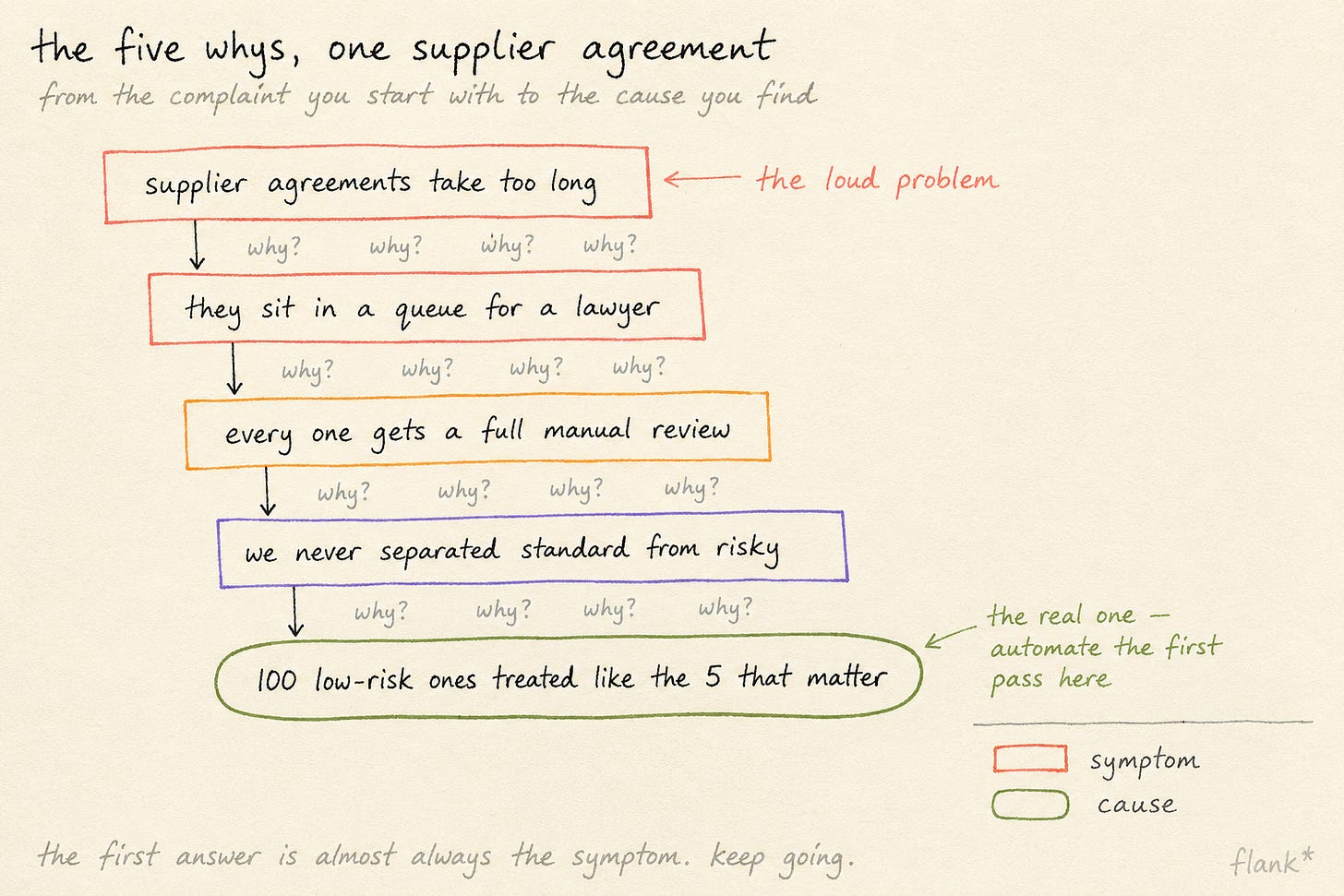
The problem was never that supplier agreement review is slow. It is that a hundred near-identical, low-risk supplier agreements get treated exactly like the five that genuinely need a lawyer to stop and think. That changes what you would hand over. You don’t give an agent “supplier agreement review” as one big undifferentiated block. You give it the first pass on the standard ones, so your lawyers only ever see the handful that actually need them. Same area of work, much sharper thing to automate. And you would have missed it if you had stopped at the first answer, because the first answer is almost always the symptom.
So that is roughly how I would think about it:
Break the pile into streams based on what you are doing, not what the document is called.
Look for the ones that are high volume, rules-based, and expensive when they spill over.
Then keep asking why about the most promising one until you hit a real cause instead of a symptom.
More often than not, the workflow worth starting with is sitting right there at the bottom.
You still don’t need the whole map. You just want to be reasonably sure the first step is the right one, and this is how you check.
✳️