Every GC I’ve spoken to this spring has the same folder - demos, decks, forwarded articles from the CFO - and less certainty than when they started.
This piece goes deep into the audit you need before any vendor conversation makes sense.
Too many tabs open, not enough conviction to close any of them
There is a specific kind of confusion I have been hearing in the legal AI conversation this spring, and it does not come from the GCs who have not yet engaged with what is happening. It comes from the ones who have engaged with it more than is comfortable. They have taken the demos, read the case studies, screenshotted the LinkedIn posts into a folder labelled “things I don’t have time to read but probably should,” and they feel less certain at the end of the process than they did at the start.
The shape of it goes something like this. A Harvey deck, a Legora deck, a third deck from a company that did not exist eighteen months ago. A Forbes piece on Eudia forwarded by the CFO with no comment. A board member emailing through a glossy case study at the weekend with 40% efficiency gains on the cover, asking, again, what the AI strategy is. None of it adds up to a decision. All of it adds up to a folder that is getting harder to ignore.
I think this is the modal GC experience in May 2026. Not the GCs who have already chosen a vendor and are deep in deployment, and not the ones who have decided to wait. The much larger group sits somewhere in between, with too many tabs open and not enough conviction to close any of them.
I think this is the modal GC experience in May 2026.
The market signals do not help. Harvey closed a $200M Series E at an $11B valuation in March, hit ~$200M ARR, and announced over 500 in-house teams on the platform including HSBC and NBCUniversal. Legora hit $100M ARR in April, raised a $550M Series D at a $5.55B valuation, named Barclays as its first corporate client, and opened US offices in Houston and Chicago. Eudia is at $20M ARR, has acquired two ALSPs, and is now selling into Bayer, Best Buy, and the US Air Force. Crosby has turned itself into a fixed-fee law firm and is processing a thousand contracts every three weeks at a median turnaround of fifty-eight minutes. By the time anyone finishes a vendor map, it is already wrong.
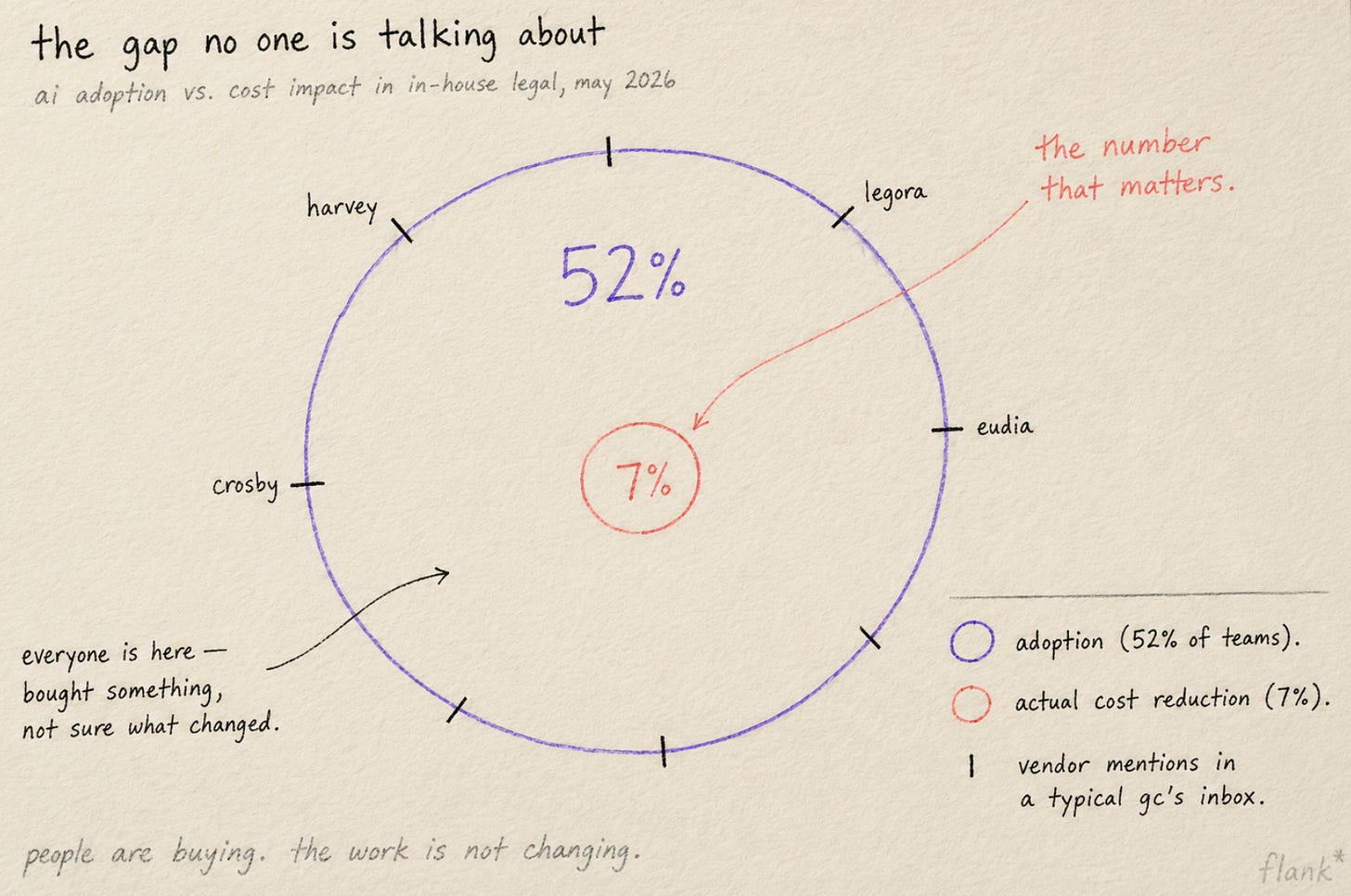
Read against these, the ACC/Everlaw numbers from earlier in the year are the ones I keep coming back to. Adoption of AI in in-house legal teams has doubled to 52%. The share of teams reporting an actual reduction in total cost is 7%. The gap between those two numbers is, I find, the most honest data point in the legal AI conversation right now. People are buying. The work is not changing.
I do not think this is a story about bad tools. The tools have improved dramatically in a year, and most of them do something useful for someone. The harder question is the order in which decisions are being made.
Why the order matters
The pressure on a GC is to pick something. The board has read the same articles you have, the CFO has follow-up questions about the new line item, and there is always somebody on the executive team who can quote a McKinsey statistic at you in a meeting. The simplest way to show motion is to buy. The harder version, the one that actually changes how the function operates, is to audit before you add anything.
“Audit your function” is the kind of phrase that has been worn smooth by repetition, so it is worth being concrete about what I actually mean by it.
The simplest way to show motion is to buy.
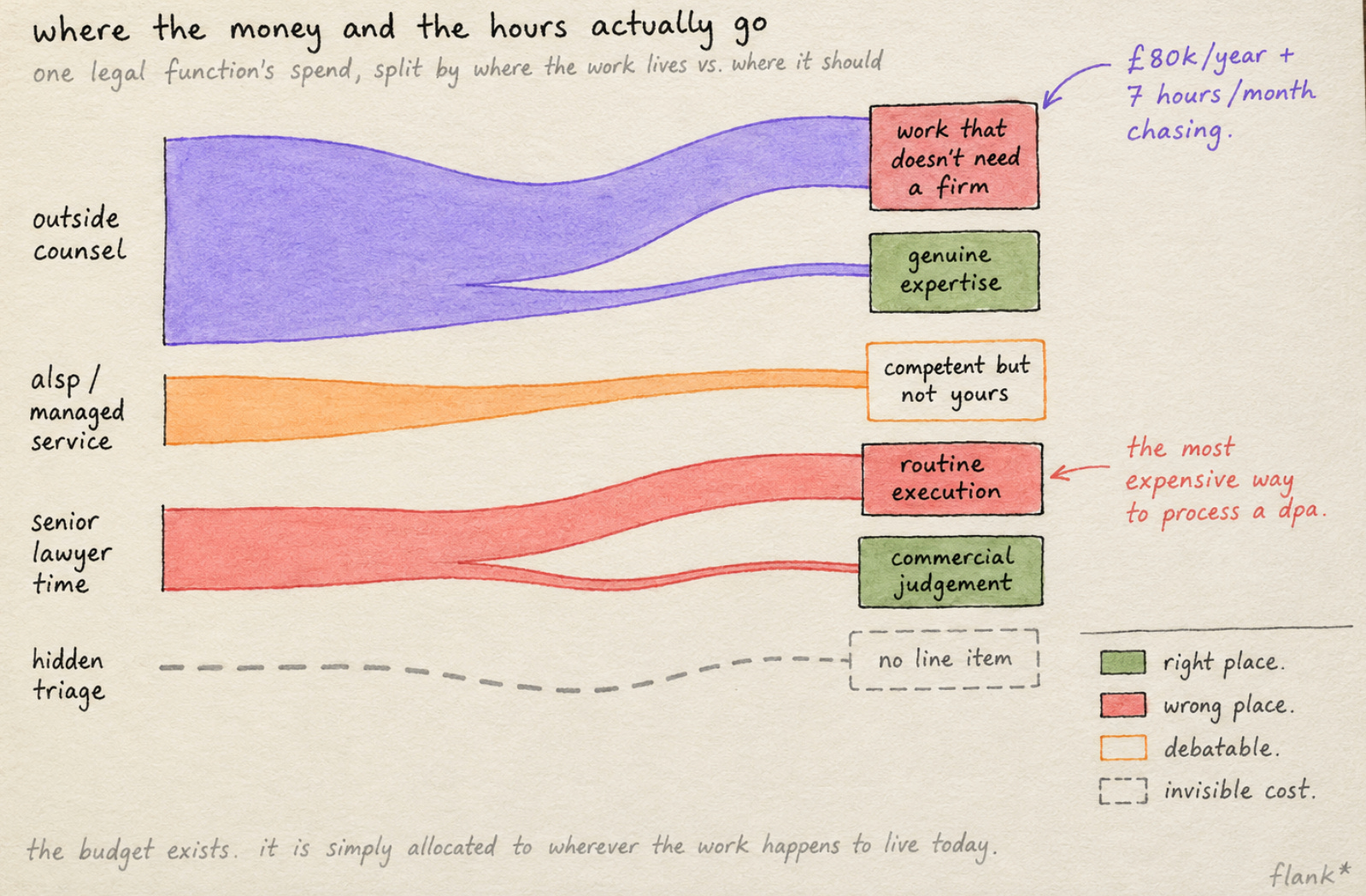
Step one. Look at where the money and the hours actually go.
The useful version of this is not the cost-centre breakdown your finance team gives you. It is a more granular map of who is doing what kind of work inside your function, and what each piece of that work is costing.
Split the spend three ways. What is your team doing in-house, and what is an hour of their time worth? What is going to outside counsel, at which rates, and for which workstreams? What is going to an ALSP, a managed service, or an offshore team, and at what effective rate per piece of work?
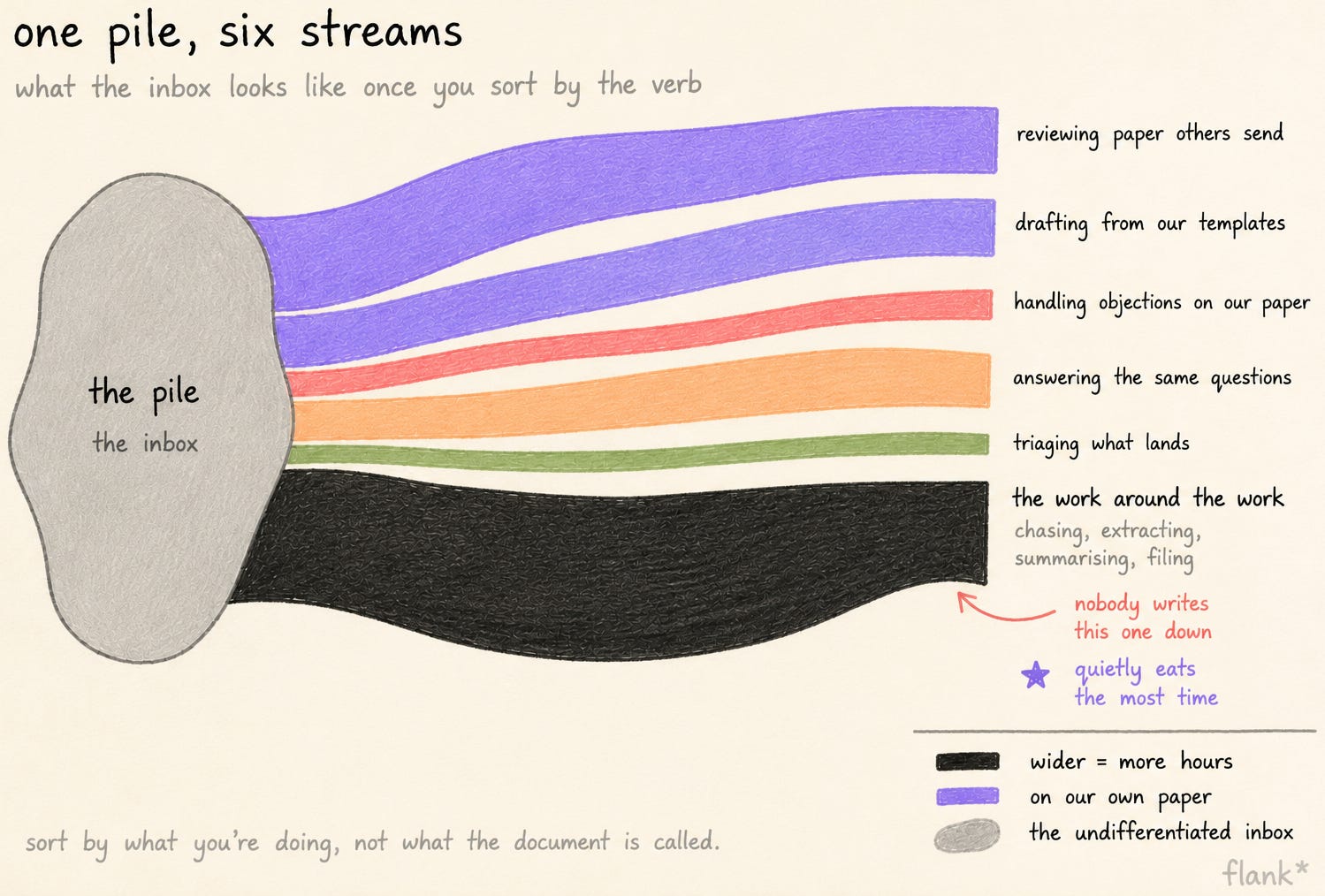
Then overlay the time, which is the part most teams skip. The DPAs that go to outside counsel might cost £80,000 a year on invoices, but they also consume seven hours a month of your deputy GC chasing the firm and reviewing the output. The vendor agreement workstream that lives with an ALSP at a flat rate per contract might also be quietly consuming an hour a week of your contracts manager triaging which ones to send them in the first place. The intake triage that has no line item at all is silently absorbing an hour of senior lawyer attention every working day, because nobody else in the function has been set up to handle it. None of this shows up on an invoice. All of it is part of the cost.
I find that almost no GC has this data on a single page. The numbers live in different systems, and none of them were designed to be added together. The exercise of putting them on one page is, in itself, more clarifying than any demo I have sat through.
I find that almost no GC has this data on a single page.
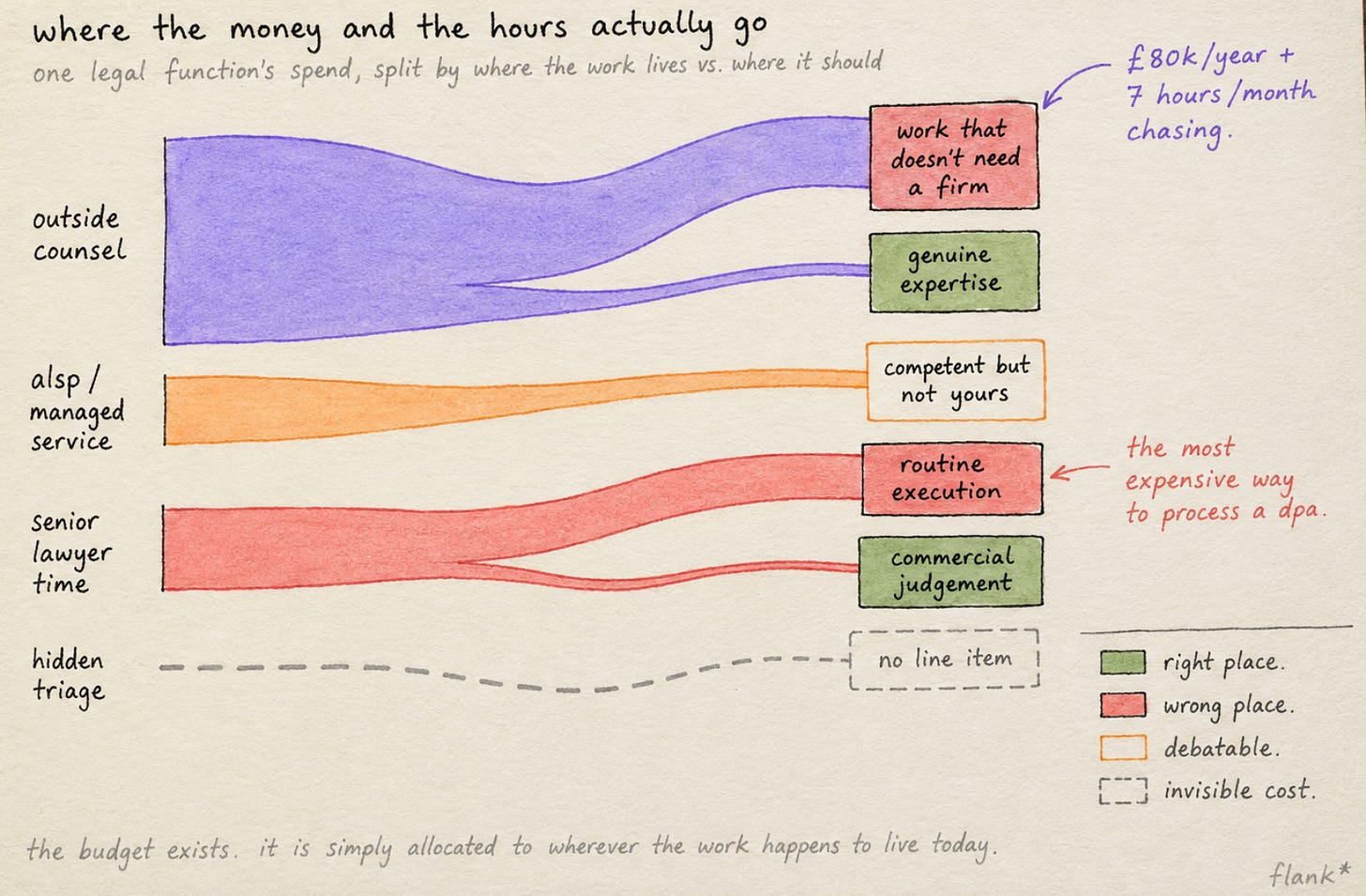
Once you have the spend mapped, you also have the budget for whatever comes next. The money is already going out the door for the work an agent would do, or for the work a different ALSP would do, or for the work a sharper internal process would absorb. The budget exists. It is simply allocated to wherever the work happens to live today rather than where you would put it if you were designing the function from scratch.
Step two. Be honest about whether each workstream is in the right place.
This is the harder step. Against each line of spend and each block of hours, write down the answer to one question: should this work be here?
It helps to do this without yet thinking about agents. The agent question comes later, and at this stage it gets in the way. The first question is purely structural. If you started the function from scratch tomorrow, with no inherited contracts and no inherited relationships, where would this work go?
A few examples of what that looks like in practice.
The NDA workstream that currently goes to a law firm at £450 an hour. The work has not required real judgement for three years. The firm uses a template. Your team has the same template, more or less. The work is at the firm because it always has been, and because nobody has had time to bring it back. The honest answer is that this work should not be at the firm at all. It should be inside the function somewhere, although you do not yet need to decide where.
The procurement contract triage that currently lands in the head of legal’s inbox. She opens forty emails a day, of which roughly half are requests to look at a counterparty’s paper that do not require her judgement. The work is on her desk because the business does not know where else to send it. The honest answer is that this should not be on her desk at all. It should be at the front door of the function, sorted before it ever reaches her.
The vendor agreements that go to an ALSP at a fixed price per contract. The ALSP is competent, fast, and predictable. The playbooks it uses, though, are not quite yours. The institutional memory is theirs, not yours. When the ALSP loses a key person, you discover that you do not actually know what your own positions are on cap and indemnity for vendor agreements under £100,000, because for three years that knowledge has been living inside someone else’s company. The honest answer here is more nuanced. The price is fair. The quality is fine. The question is whether the work needs to leave your building at all, given what is now possible.
When the ALSP loses a key person, you discover that you do not actually know what your own positions are.
The DPAs that currently sit with the deputy GC, who processes them between meetings because nobody else in the team has the bandwidth and nobody outside the team has the right playbooks. The work is competent. The deputy GC is overqualified. The DPAs are getting done because somebody with twelve years of experience is squeezing them in around the work she was actually hired to do. This is the most expensive way to process a DPA the function has, even though it is the line item with no obvious cost attached to it.
The discipline at this stage is to write the answer for each workstream without committing yet to how you will execute it. The instinct will be to jump from “this is in the wrong place” straight to “let me find a tool that does it.” Resist that for a beat. The point of the exercise is to surface the misallocations across the whole function, rather than to fix any one of them in isolation.
The discipline at this stage is to write the answer for each workstream without committing yet to how you will execute it.
Step three. Set a target distribution.
The third step is where most strategy documents stop and where most operational change starts. You set a target for what the function should look like once the misallocations are corrected.
The target is not a precise allocation. It is a direction, with a number attached. For example, the goal might be for senior lawyer time to be spent on commercial negotiation, complex regulatory work, and supervision, with no more than 20% spent on routine execution. Today you might be at 60%. Eighteen months from now you want to be at 25%. The number is something you can move against quarterly, in a way the board can read at a glance.
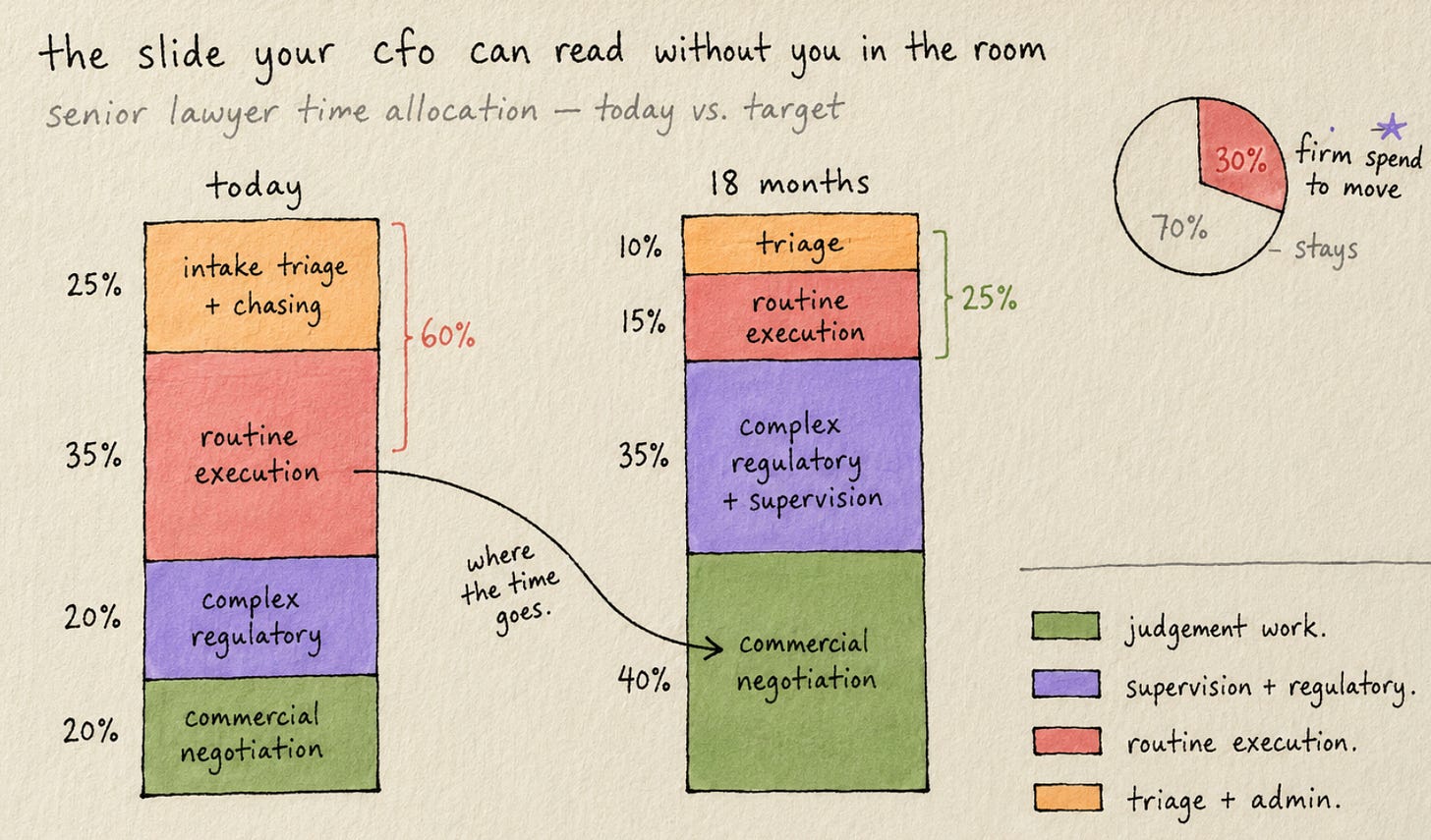
The same logic applies to spend. If 30% of your services budget is currently going to a law firm for work that does not require a firm, that is a percentage you have committed to moving. If 15% is going to an ALSP for work you would rather keep in-house, that is another number on the chart, with its own timeline and its own owner. The redistribution does not have to be perfect. It has to be intentional, and it has to be visible, ideally on a slide your CFO can look at without you having to be in the room.
This is where the vendor question finally enters the conversation. You now have a map and a target, and you are looking for the resource that fits each workstream rather than the workstream that fits each resource. Some of those slots will be best served by an agent. Others by a different ALSP, or by a smaller and sharper outside counsel relationship in place of a generalist firm, or by a process change inside your own team that does not require you to buy anything at all. The vendor list, which felt overwhelming an hour ago, has become a list of candidates for specific slots in a plan that you actually have.
What the end state looks like
The version of this that works produces what I think of as a zero-waste function. Every line of spend, and every hour of attention, is buying something the function needs. The senior lawyer hours are no longer being absorbed by work that did not need a senior lawyer, the external invoices are paying for genuine expertise rather than for capacity you could have generated yourself with a process change, and no agent is doing work that should have been a one-line update to the contracting policy in the first place. The function is not necessarily smaller after this exercise. It is sharper.
There is plenty about the next eighteen months that nobody should be calling with confidence. Whether Harvey’s enterprise pivot consolidates around them the way the headlines suggest, or whether the services-side competitors (Eudia, Crosby, Flank among them) end up defining where the spend goes, is not something I would bet on in either direction. The regulatory picture is similarly unsettled, with Colorado live in June, the EU AI Act in trilogue, and a patchwork of US state bills moving at different speeds. None of those things is inside any particular GC’s control.
The audit-before-vendor sequence sits in a different category. It is inside the GC’s control, and nothing in the rest of the market is making it any easier. The vendor list will keep growing, the pitches will keep getting better, and the board pressure is not going to ease with any of it. The FOMO does not resolve itself by reading another article, or by sitting through another demo, or by taking another call with someone who has just raised at $5B. The only thing that resolves it is having a plan that is yours, against which any specific vendor is a possible answer to a specific question you have already framed.
A GC I spoke to last month said something I have been quoting back to people since. She told me that the moment she sat down and wrote out, line by line, where her function’s money and hours were actually going, the AI conversation got fifty per cent quieter. The noise outside had not changed. She could finally tell the difference between the things that mattered to her function and the things that did not.
That is the work. The vendor question, when it comes, is much easier on the other side of it.