Every signed contract is a record of commitments. Most of them go into a folder that can’t answer a single question about what they hold.
This one is about metadata: the cheapest work in a legal function, and the work that almost never gets done. Here is why, and what finally changed it.
I’m Taariq. I lead Forward Deployment at Flank.
Your contract system holds a scan and nothing else
A few weeks ago I sat in a discovery session with the supply chain team of a large enterprise, walking through how a contract moves from request to signature. Somewhere in the middle of the workflow mapping, one of them said something almost as an aside. Metadata in their contract system is “treated as an afterthought”. It was the least controversial statement of the two-hour call with no internal divergences (which are often common with larger teams).
A colleague’s call the same fortnight made the extreme version concrete. A legal team handling five and a half to six thousand agreements a year, every signed contract scanned and filed into an internal system. No extracted terms, no renewal dates, no metadata at all. Six thousand times a year, a document full of commitments goes into a drawer that cannot answer a single question about what it contains.
Six thousand times a year, a document full of commitments goes into a drawer that cannot answer a single question about what it contains.
A more important aspect of this ‘negligence’ also comes up often. Because past legal approvals are never memorialised anywhere, their sourcing managers cannot cite them. A clause legal approved two years ago comes back around, and rather than pointing to the precedent, the manager escalates it again. Legal reviews it again. The same position gets re-investigated as if it were new, by people who all vaguely remember settling it the first time.
Metadata is where the economics of a legal function show up in their purest form, and the teams above aren’t failing to follow their process. They’re following the economics exactly.
📄 Why the capture never happens
Recording what a contract says is the textbook case of inexpensive work. The parties, the term, the renewal mechanics, the positions conceded. No judgment required. A checklist could do it.
And yet it doesn’t get done, and it isn’t about laziness. At the moment of capture, that work is pure cost. The deal is closed, the business has moved on, and the only people who actually know what the document says are lawyers and deal managers whose next negotiation is already waiting. Asking someone who costs hundreds of pounds an hour to key renewal dates into a repository is a losing trade, and everyone in the workflow can feel it. So the field stays blank, or gets filled from memory at some point
Asking someone who costs hundreds of pounds an hour to key renewal dates into a repository is a losing trade, and everyone in the workflow can feel it.
The shape of the mismatch I usually write about is expensive people doing inexpensive work slowly. Metadata shows me the other shape, which I find more revealing: when the only qualified operator for a task costs more than the task is worth, the task stops being done at all. Nobody decides this: it’s simply what the economics produce, year after year, in team after team.
You buy the work back at a markup
Skipped capture only looks like saved cost. The work comes back, and it comes back more expensive every time.
A renewal date nobody recorded gets discovered by the counterparty, on the counterparty’s terms. A due diligence exercise asks a batch of questions the archive was theoretically built to answer, change of control, expiry, assignment, and answering them means paying people to re-read documents the team already paid people to write. The supply chain team I sat with described sourcing managers reconstructing deal context from old email threads, because the system that was supposed to hold it holds a scan and nothing else. The same team has no rulebook for template selection either, which is the same disease in a different organ: managers pick paper by experience, sometimes pick wrong, and the work gets done twice.
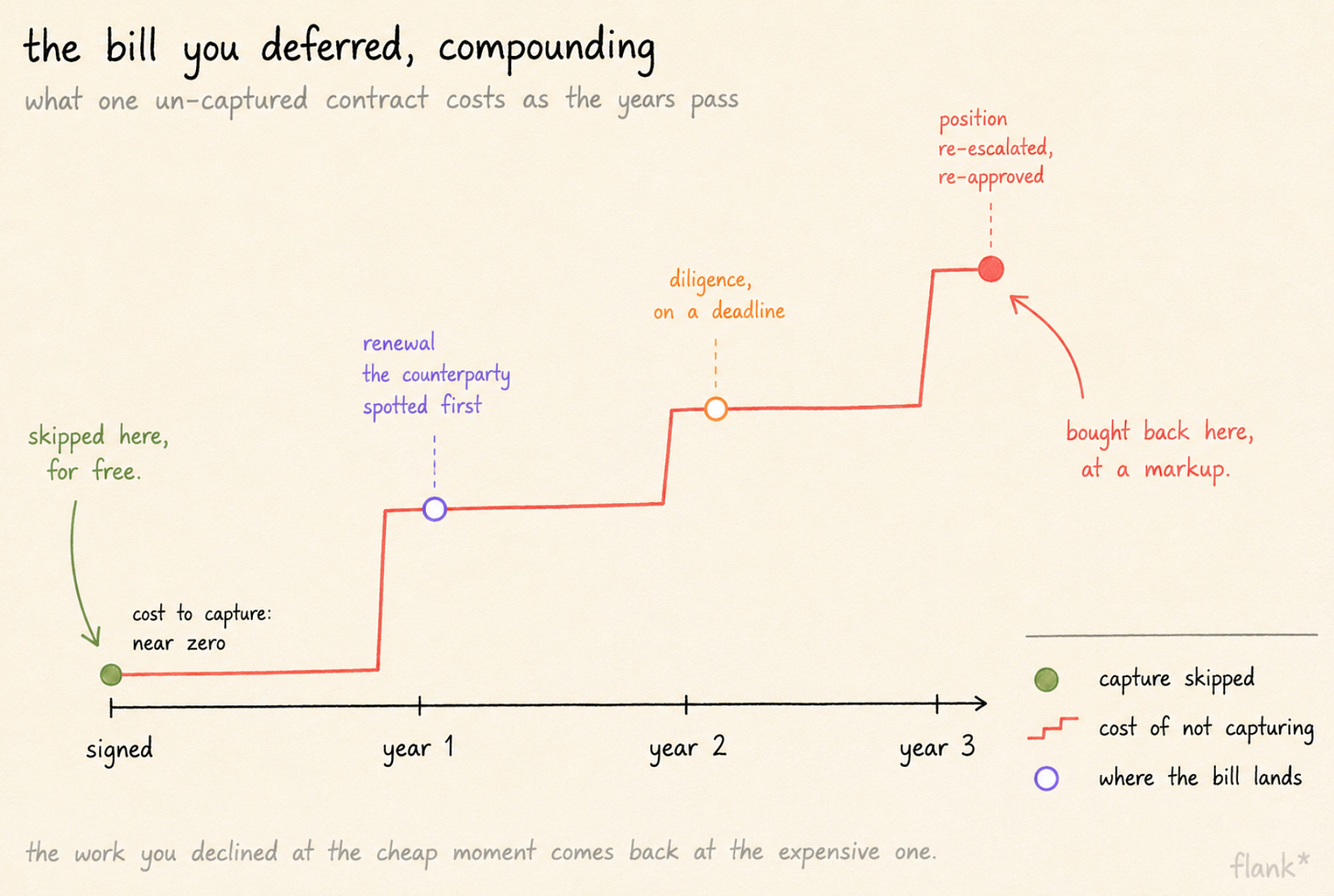
The precedent problem may be the most expensive version. When approvals are never memorialised, every settled position is unsettled the next time it appears. The team escalates things legal has already blessed, which clogs the queue, which in turn slows the deals that actually need judgment. The work you declined to do at the cheap moment gets bought back later at the expensive one.
A tagging initiative asks the same expensive people to do the same underpriced task, just with more discipline this time. The economics that killed the habit are still standing there, untouched.
I think this is also why “we should tag our contracts” initiatives fail so reliably. Ask a builder why the snagging list never gets done and they won’t tell you the team forgot. They’ll tell you the crew that could do it is already on the next site. A tagging initiative asks the same expensive people to do the same underpriced task, just with more discipline this time. The economics that killed the habit are still standing there, untouched.
⚡ What changed
The reason I no longer treat any of this as an unfortunate fact of life is that the capture no longer needs the expensive operator.
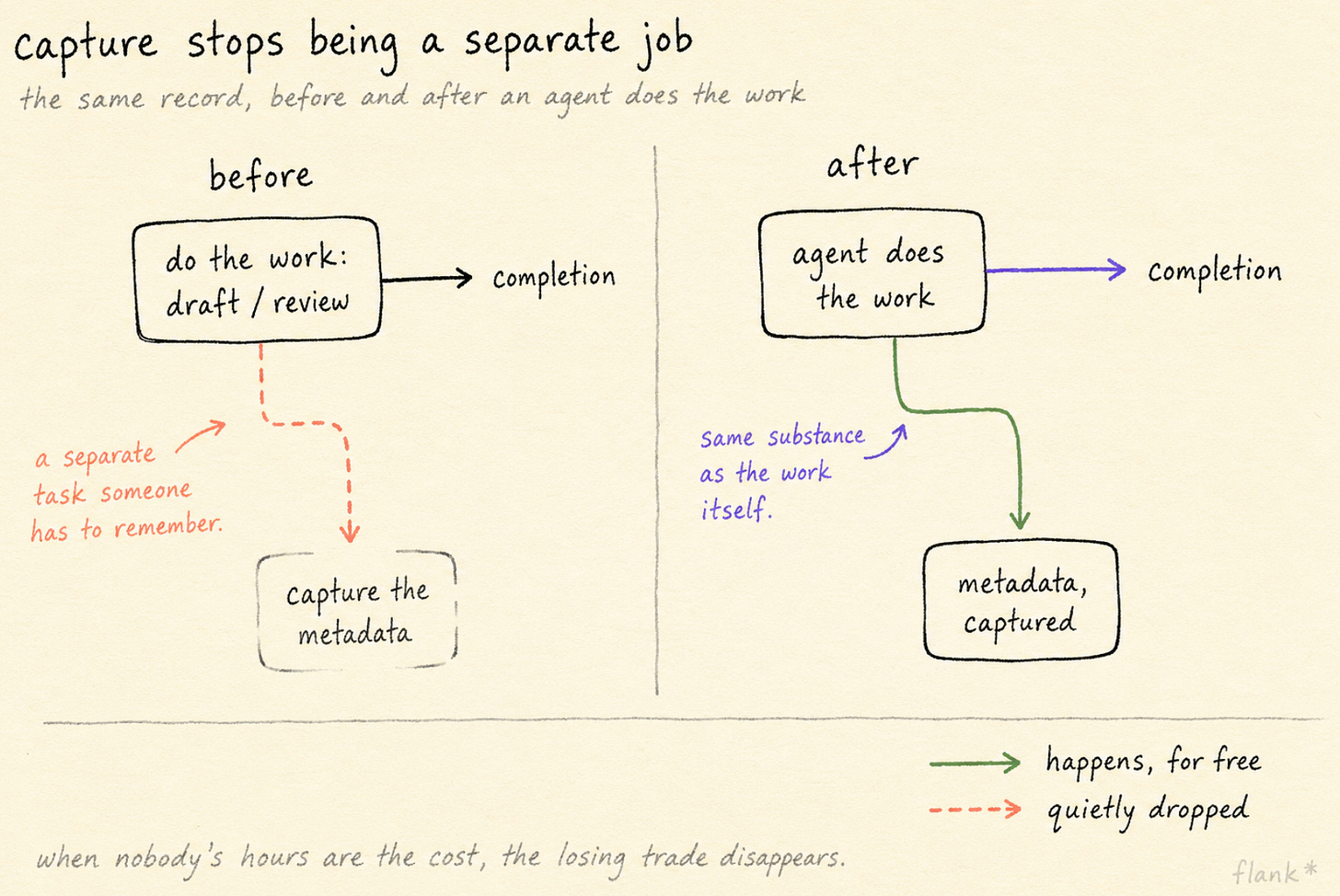
When an agent drafts or reviews a contract, it already knows the things a repository wants recorded. The parties, the term, the positions held and the positions conceded aren’t extra work to extract. They are the substance of the work itself. Capture stops being a separate task someone has to remember, and becomes a by-product of the work getting done. The losing trade disappears, because nobody’s hours are being spent on it. In the discovery session I mentioned, the team’s own first-choice use case wasn’t drafting or review. It was capture during the deal, not after it. They had diagnosed themselves before we said a word.
The back-book is harder: the teams I’ve seen think about this sensibly treat it as two different problems: capture-forward, which is now close to free, and backfill, which is a project you scope deliberately, starting with the contracts that are still alive.
Capture stops being a separate task someone has to remember, and becomes a by-product of the work getting done.
None of this makes the design questions disappear. The first schema a team writes will be wrong, because a team that has never had metadata doesn’t yet know which fields it will want, and I’d rather see someone start wrong and narrow than stall for months designing the perfect taxonomy for a memory they don’t have. And renewal dates are facts, but “why we accepted this indemnity cap” sits somewhere between a fact and a piece of reasoning; a thin note can masquerade as the full rationale, so the line between recording and flattening deserves real thought. Neither question is a reason to wait. Both are questions you can only answer once something is being captured at all.
The eighteen-month test
Pick a contract your team signed eighteen months ago. Ask what it would cost, today, in someone’s hours, to answer two questions: when does it renew, and what did we concede to close it.
If the answer involves anyone re-reading the document, your department is paying expensive people to remember things it could have written down for nothing. And that price isn’t fixed. It gets steeper with every year of contracts filed into a drawer that can’t answer questions, and it comes due at the worst possible moments: the renewal the counterparty spotted first, the diligence exercise on a deadline, the position your own team settled and then paid to settle again.
The team I sat with a few weeks ago had already worked all of this out. Nobody had to persuade them that the memory mattered. What had changed was that keeping it no longer required their most expensive people’s time, and once that was true, the argument for the drawer full of silent paper collapsed on its own. The contract remembers nothing.
✳️