✳️ Welcome to The Intake.
I'm Taariq. I deploy AI agents into enterprise legal teams at Flank.
I spend a lot of time in rooms where someone is about to make a legal technology procurement decision, and I keep noticing the same thing: the software they are evaluating is genuinely impressive, and the question they are not asking is whether the category of software they are buying is about to matter less.
Naval Ravikant posted a line on X recently that compressed this into seventeen words.
Better software, same wrapper
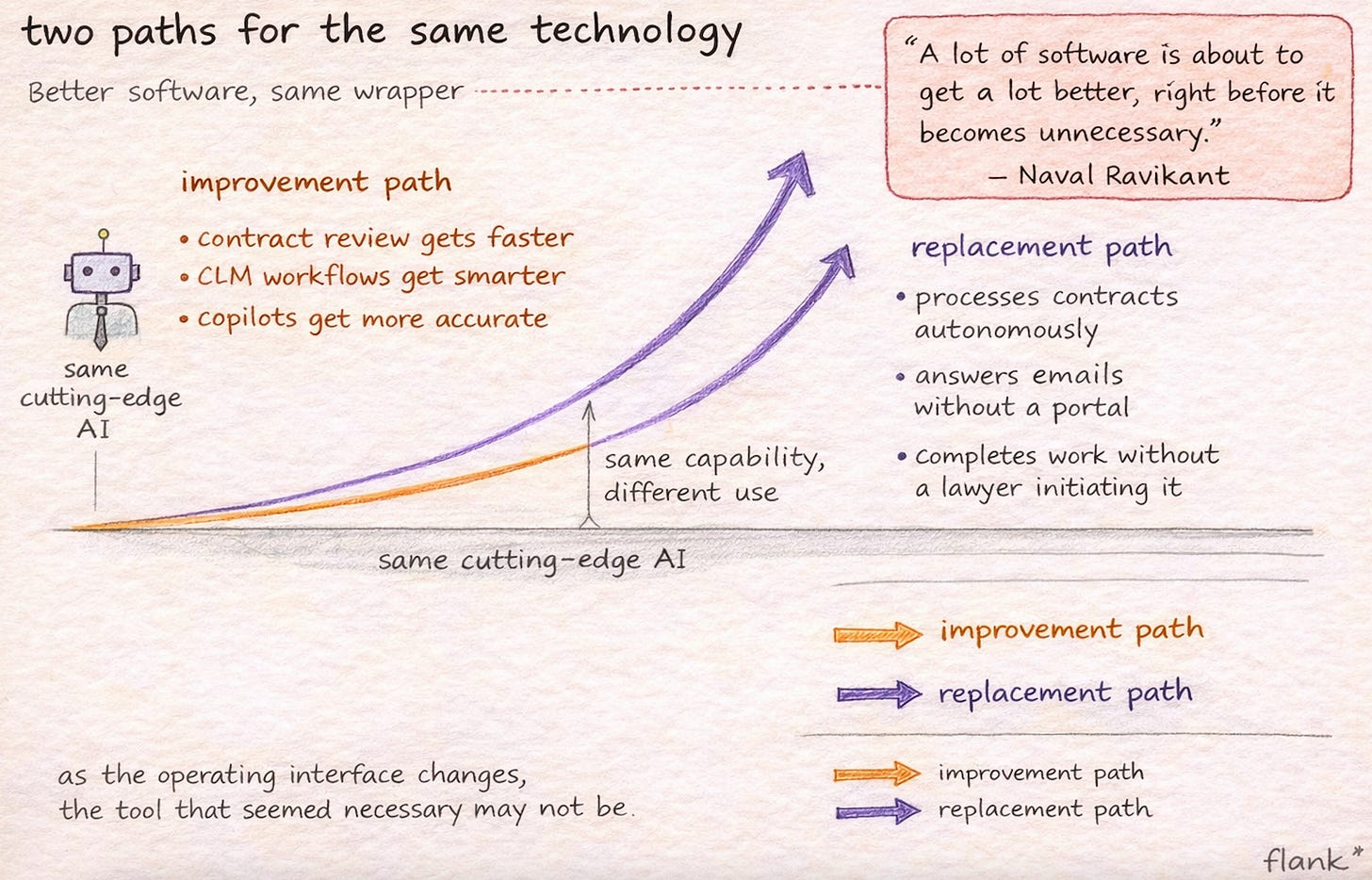
Naval Ravikant posted something profound on X just a few days ago: “A lot of software is about to get a lot better, right before it becomes unnecessary.”

It made me think about the legal AI market. Because the legal AI market, by almost any measure, is getting dramatically better. And I think it’s getting better in exactly the way Naval described: as the last clear expression of an underlying model, not as the beginning of the next one.
We’ve seen so many new (or improved tools on the market) - smarter drafting, better review, technically impressive - but that really isn’t moving the needle. I spoke to a consulting firm that advises enterprise legal teams and their verdict on this is: the technology was impressive, but enterprise clients weren’t adopting it. Not because the AI failed. Because the AI was sitting inside an interface model that nobody wanted to operate.
The business user still had to log into a portal, submit a form, track a request through a workflow board. The agent did smarter things inside that wrapper. The wrapper was still the wrapper. And after years of being trained by consumer software that answers arrive in your inbox, enterprise users had stopped wanting to go somewhere to get work done.
⚡ What “getting better” looks like right now
The numbers are genuinely striking. LexisNexis has replaced its entire AI product with a workflow platform grounded in 200 billion documents. Thomson Reuters is investing $200M annually in AI and building a proprietary legal model. CLM vendors are adding AI-powered review. Intake tools are faster and smarter. Every category of legal software is significantly more capable than it was twelve months ago.
If you were building a legal technology portfolio in 2023, almost everything in it is now more capable than when you bought it. That’s real, and I don’t want to dismiss it.
But the consulting firm’s observation kept bothering me. If the software is genuinely better, why aren’t enterprise legal teams adopting it more aggressively? Forrester’s estimate that 25% of planned AI spend is being deferred to 2027 due to ROI concerns is one part of the answer. The ACC/Everlaw finding that corporate legal AI adoption doubled from 23% to 52%, while only 7% of teams saw an actual reduction in total legal spend, is another. I think the gap points at something structural, not just friction in implementation.
The technology was impressive, but enterprise clients weren't adopting it. Not because the AI failed. Because the AI was sitting inside an interface model that nobody wanted to operate.
The mechanism underneath the observation
Here’s what I think Naval is describing. The same capability that makes software better is often the same capability that eventually makes the software unnecessary. It’s sequential, and not contradictory.
Fax machines are a cleaner version of this story than I’d like. They got dramatically better through the 1990s: digital, automatic redial, eventually network-connected. The technology making them better was modem and networking infrastructure. The technology making them unnecessary was email, running on the same modem and networking infrastructure. Improvement and replacement ran on the same rails.
AI makes contract review faster. The same AI can complete the contract review autonomously. You can use the first capability to improve a review interface, and you can use the second to make the review interface unnecessary. Both are available from the same foundation. The improvement is real. And it’s heading toward the point where the question changes from “how do I make this tool work better for my lawyers?” to “why is my lawyer initiating this work at all?”
The same capability that makes software better is often the same capability that eventually makes the software unnecessary. It’s sequential, and not contradictory.
In legal, the interface assumption underneath most software is something like: a lawyer uses a tool to do work faster and more accurately. The tool provides a better interface for work that a lawyer still needs to initiate, execute, and complete. This assumption has been stable through every generation of legal technology. Document management, CLMs, research platforms, copilots, all of them are better and better interfaces for lawyer-operated work.
The quality of the tools is improving but the fundamental change is questioning whether the work needs a lawyer to initiate it at all.
🏗️ What becomes unnecessary
I want to be careful here, because “unnecessary” is a strong word and the full picture is more layered than it initially sounds.
What I think is becoming unnecessary is not legal software. It’s a specific interaction model: the lawyer as operator, opening a tool, initiating work, applying suggestions, completing a task, and sending the output. That model has driven legal software design for thirty years. It’s the assumption underneath every copilot, every CLM workflow, every review platform.
The CLM agent that sits inside a portal doesn’t fail because the AI is insufficient. I think it fails because the portal is the wrong context for an agent. An agent doesn’t need a portal. The agent answers the email. The portal was necessary because human workflow management requires a visual system to track state across concurrent requests. The agent tracks its own state. The portal’s necessity evaporates, not because anyone decided to kill it, but because the work no longer needs the infrastructure that was built to coordinate it.
The agent answers the email. The portal was necessary because human workflow management requires a visual system to track state across concurrent requests. The agent tracks its own state.
A copilot that makes a lawyer 25% faster on NDA review is a genuine improvement on the previous generation of NDA review tools. It’s also, I think, the best version of an era in which NDA review is something that requires a lawyer at all for standard templates. The same capability that makes the copilot good at accelerating review is what makes an agent capable of completing the review under supervision without the lawyer doing the reviewing. These aren’t separate developments. One is the refinement, and the other is what the refinement points toward.
This is what I mean by the best version of the last thing. Not that the software is bad. That it’s being optimised along an axis that’s not the axis the market is about to reward.
What does NOT become unnecessary
I think it’s worth being specific about what survives this transition, because I’m genuinely uncertain about the boundaries.
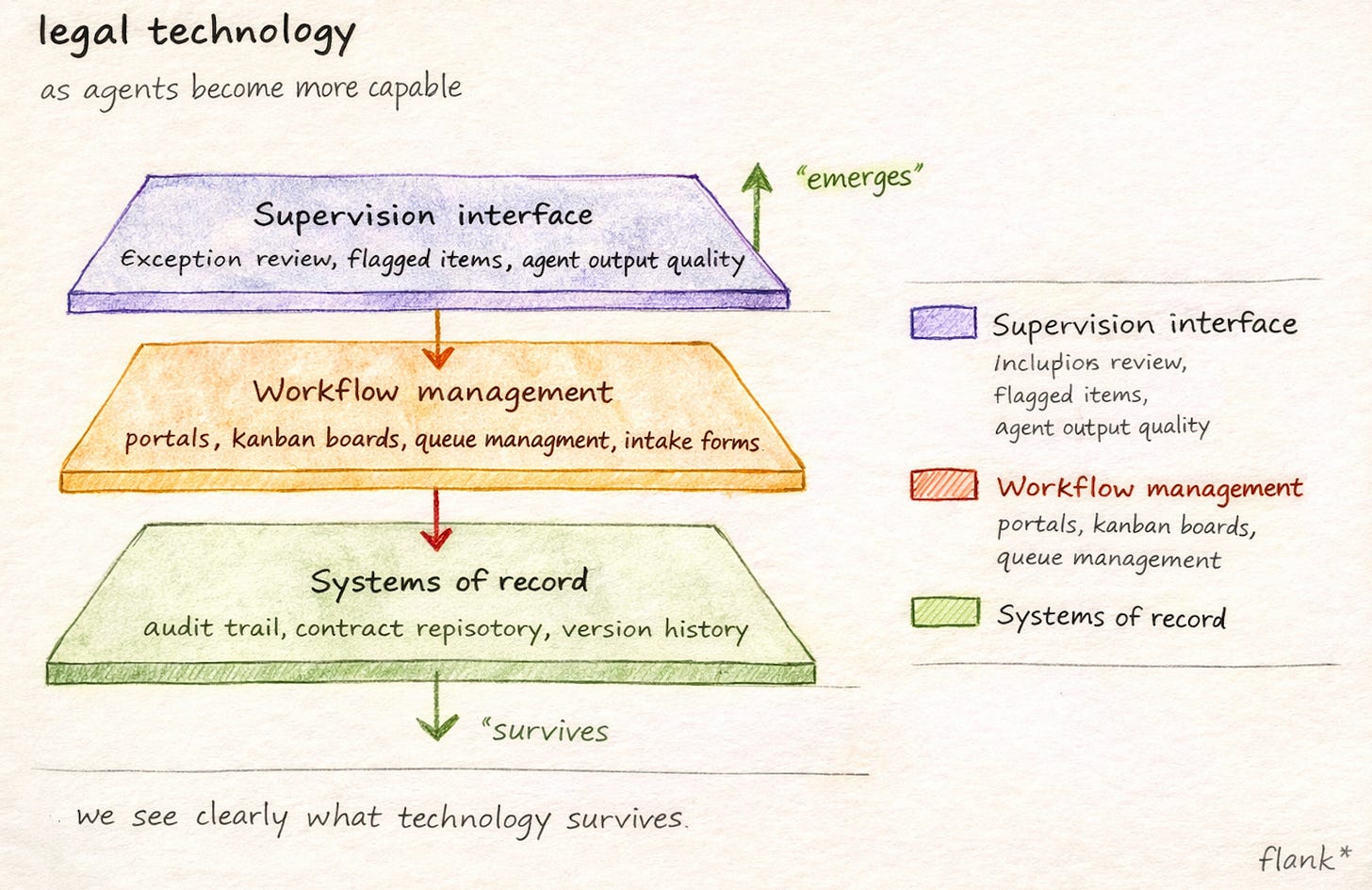
Systems of record survive. The audit trail, the contract repository, the version history. These are necessary whether a lawyer or an agent produces the document. You need to know what was agreed, when, and why. That layer doesn’t become unnecessary. It potentially becomes more valuable, because agents produce more transactions that need to be captured and evidenced.
The authoritative content layer survives. Case law, regulatory guidance, jurisdiction-specific precedent. This grounds the legal reasoning regardless of whether the reasoning is done by a person or a system. The Fortune framing of “authoritative AI vs operational AI” captures this well. The research and content layer is authoritative. The workflow execution layer is operational. The operational layer is what’s transforming. The authoritative layer is what it’s transforming on top of.
What I think doesn’t survive, or at least not in its current form, is the workflow management layer. The forms and queues and portal logins and kanban boards that were necessary because humans needed structure to manage concurrent work. Agents manage concurrent work without needing that structure. The coordination infrastructure that was necessary for humans becomes unnecessary for agents. And this is the layer inside which most of the “getting better” is happening right now. Which is, I think, exactly the dynamic Naval was pointing at.
The coordination infrastructure that was necessary for humans becomes unnecessary for agents. And this is the layer inside which most of the "getting better" is happening right now.
🔍 What this means for decisions being made right now
I’m not saying the transition happens fast, or that any specific tool is about to become irrelevant next quarter. The gap between a compelling demo and a production deployment is real, slow-moving, and filled with organisational change management that nobody wants to talk about but everyone encounters. The timeline on this could be two years or five.
What I am saying is that there’s a structural question worth asking before a software procurement decision, not after: is the layer of software you’re buying one where the improvement compounds toward autonomy, or one where the improvement is the ceiling?
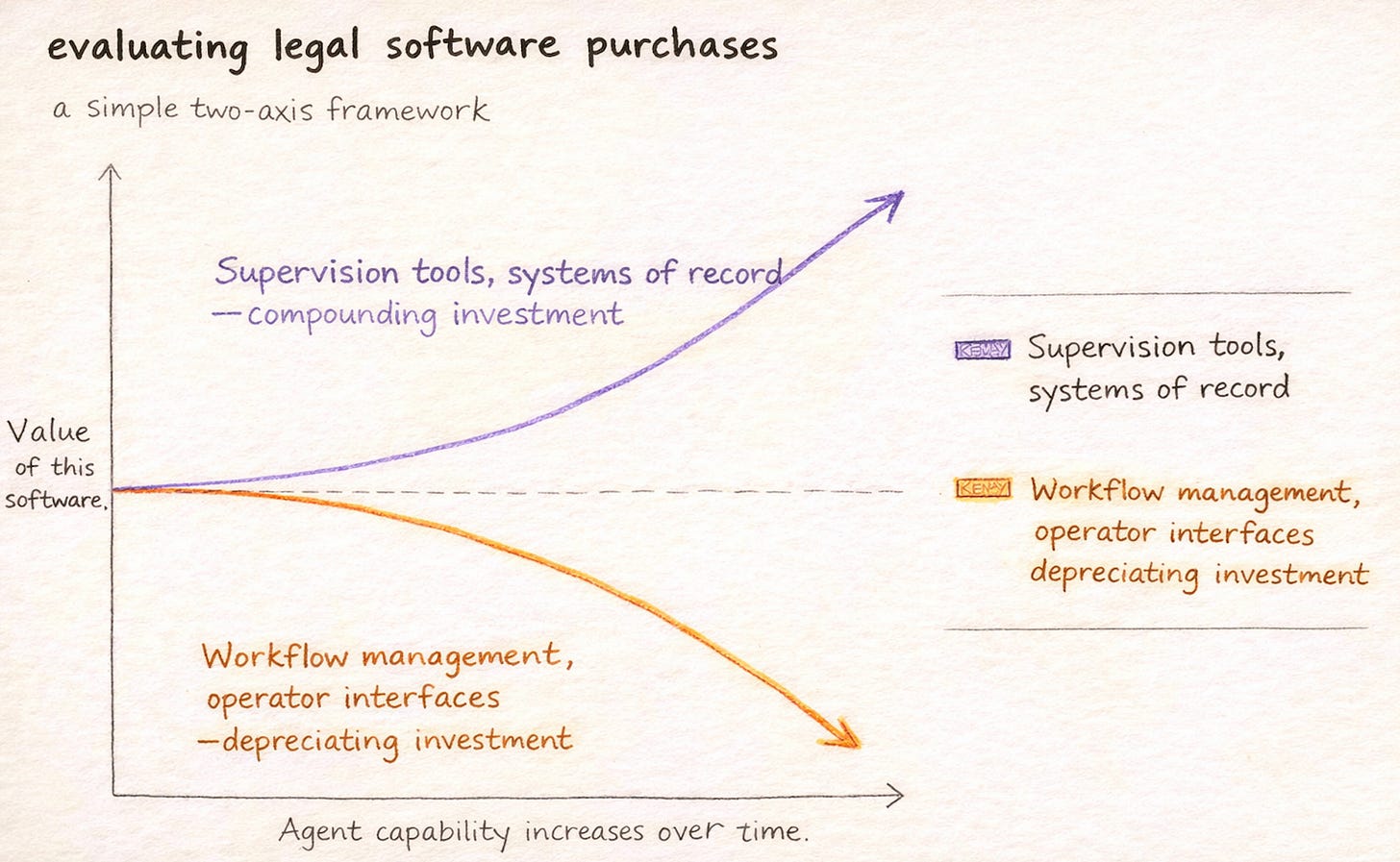
A supervision interface for agent output, something that lets a lawyer review flagged items, correct edge cases, and release completed work, gets more valuable as agents get more capable. The human’s leverage increases rather than decreases. That’s a compounding investment.
A workflow management platform that helps lawyers initiate, track, and complete individual pieces of work gets less valuable as agents get more capable, because the human’s role in initiating the work is the thing that changes. The investment doesn’t compound; it depreciates toward the point where the tool’s core assumption stops being true.
Not that the software is bad. That it's being optimised along an axis that's not the axis the market is about to reward.
The legal software market is, at the moment, improving across both categories simultaneously, and the distinction between them isn’t always obvious from the outside. Some vendors understand this transition and are building toward it. Others are optimising their current interface beautifully and may discover, two or three years from now, that they’ve built the best version of the last thing.
I don’t know with confidence which category any given vendor falls into. What I’m more confident about is the right question to ask: does the improvement in this software get more valuable as agents get more capable, or less valuable?
That question, more than any feature comparison, is probably the one that will matter most for legal technology decisions made in the next twelve months.
✳️