Most of what we bill for has a price floor that just dropped to near zero. The profession knows it. Almost nobody will say it out loud.
Output was never where value lived
I was listening to a recent Uncapped episode with Max Junestrand, the CEO of Legora, and one observation has stayed with me. He talked about building tools that work for either an agent or a human. The same affordances, the same outputs, the same surface, available to either operator. The tool does not care which is on the other side of it.
That is a small claim about design and a much larger claim about the work itself. Once the affordances are symmetric, the floor on capability is symmetric. An agent operating a contract review tool produces a contract review. A lawyer operating the same tool produces a contract review. On routine work, the output is fungible.
If output is fungible, output is not where value lives. And almost everything around the legal profession, pricing, training, promotion, hiring, even the language we use, is still organised as if it were.
There is a sentence almost every senior lawyer I know has thought in the last twelve months and not quite said out loud. Most of what I produce, an agent could now produce. The market priced the document. The document and I were never the same thing.
I trained at Pinsent Masons and spent five years there. I moved in-house to a fintech, then to Flank, where I now work on legal AI alignment. That trajectory is a polite way of saying I have sat on each side of this conversation in turn, and the murmur is the same from every seat. Publicly, the legal profession is busy organising a contest between lawyers and agents on output. That is the one contest lawyers have already lost. Almost nobody is willing to say it in those terms, so the discourse drifts politely toward “AI as a tool that makes lawyers faster,” which is the comforting version. I find it buys us about eighteen months before the structural problem catches up to the language we are using to describe it.
The market priced the document. The document and I were never the same thing.
Where the conflation came from
For most of the lawyer’s working life, output and value were the same thing. The thing you produced was the thing you were paid for. The contract that came back marked up, the advice note, the diligence summary. The hour was a unit of output, and the hour was the unit of price. The market did not need a finer instrument because the floor on output was set by the cost of the human producing it.
This is not a complaint about billable hours. It is an observation that the entire commercial machinery, internal and external, was downstream of one assumption: output is scarce because qualified humans are scarce. Career paths and promotion ladders were both built around the same thing, accumulating reps on output and outproducing your peers in volume and quality. Outside counsel relationships existed because the firm’s lawyers were the only route to the document at all. Even the legal industry’s default vocabulary, the language of “matters,” still treats each piece of work as a discrete unit of output that someone bills against.
The entire commercial machinery was downstream of one assumption: output is scarce because qualified humans are scarce.
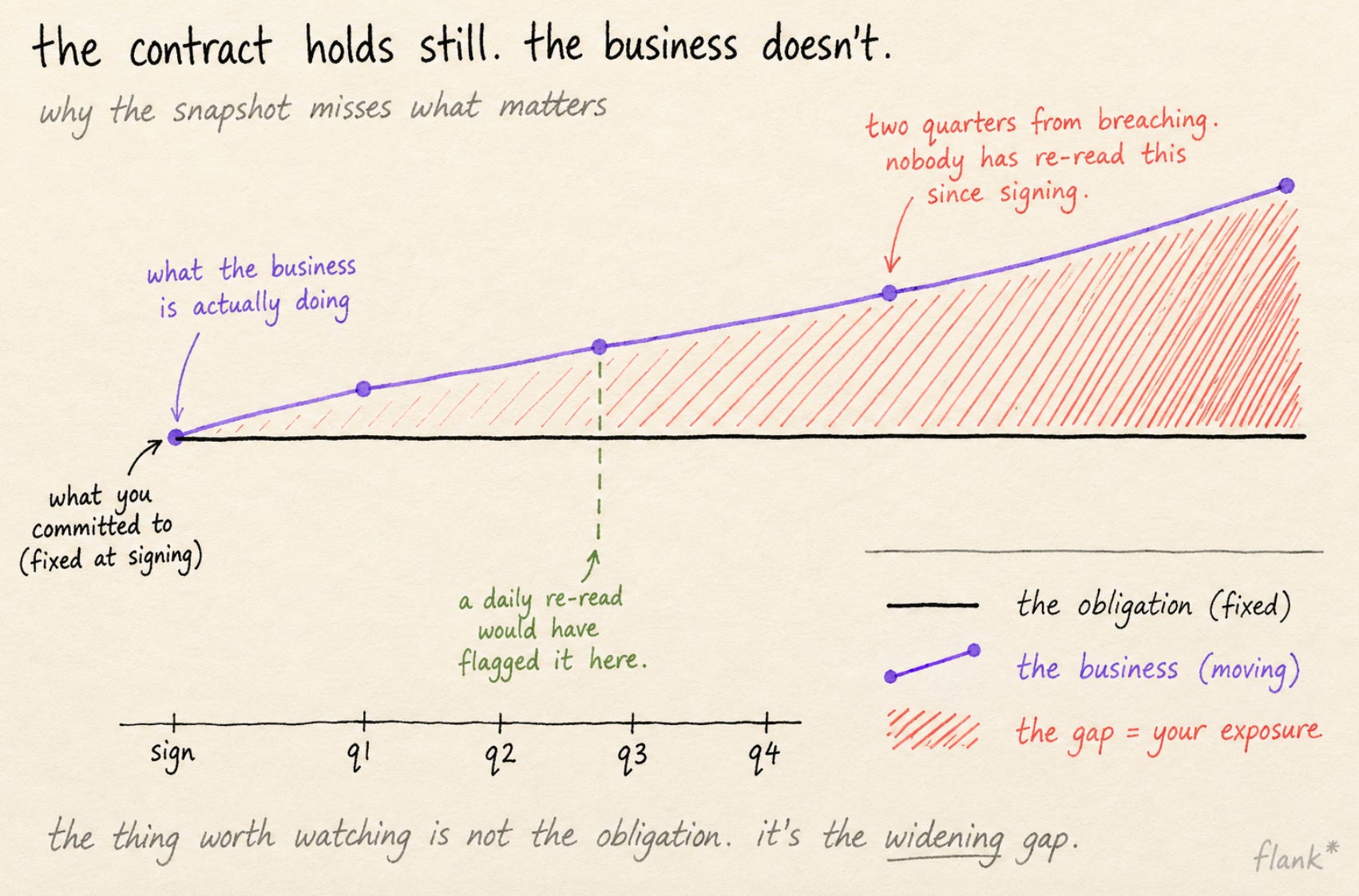
Read the 2026 numbers next to each other and the structural problem stops being subtle. Around 90% of firm revenue is still time-based, per Georgetown/Thomson Reuters. Clio’s 2026 trends report puts as much as 74% of hourly billable tasks in the automatable category. Mishcon’s CSO told the FT recently that broad agent availability inside Word will “meaningfully compress pricing and reduce demand for legal AI tools.” The revenue model is keyed to output. The output is being rebased to a lower price floor. A lot of work that used to require an hour now takes a minute, and the minute is doing what the hour used to do.
The dominant response so far, both inside firms and inside in-house teams, is to push lawyers to produce more, faster. Use the copilot. Hit the same outputs in less time. Reclaim margin. That is a defensive reflex. I do not think it survives the next twelve months, and I think the lawyers privately know it.
The contest the profession has already lost
The mistake I keep watching the legal market make is treating agents and lawyers as if they are competing on the same axis. As if the right question is “can the agent do the contract as well as the lawyer.” Sometimes yes, sometimes no, and the answer keeps tilting toward yes. So far, so unsettling.
But that question, on its own, treats output as the whole job. It is the question a lawyer asks when they are afraid. It is also the question that is most readily answered by a faster copilot, which is why so much of the market has settled on it. The deeper question is the one nobody quite wants to ask out loud, because the answer is destabilising. If output is fungible, then what was the lawyer’s hour ever buying.
I think we have all known the answer for a long time and have not had the language for it. The drafting was never what the firm or the business was paying us for. The drafting was the receipt. They were paying for the part that does not show up in any document.
The drafting was the receipt. They were paying for the part that does not show up in any document.
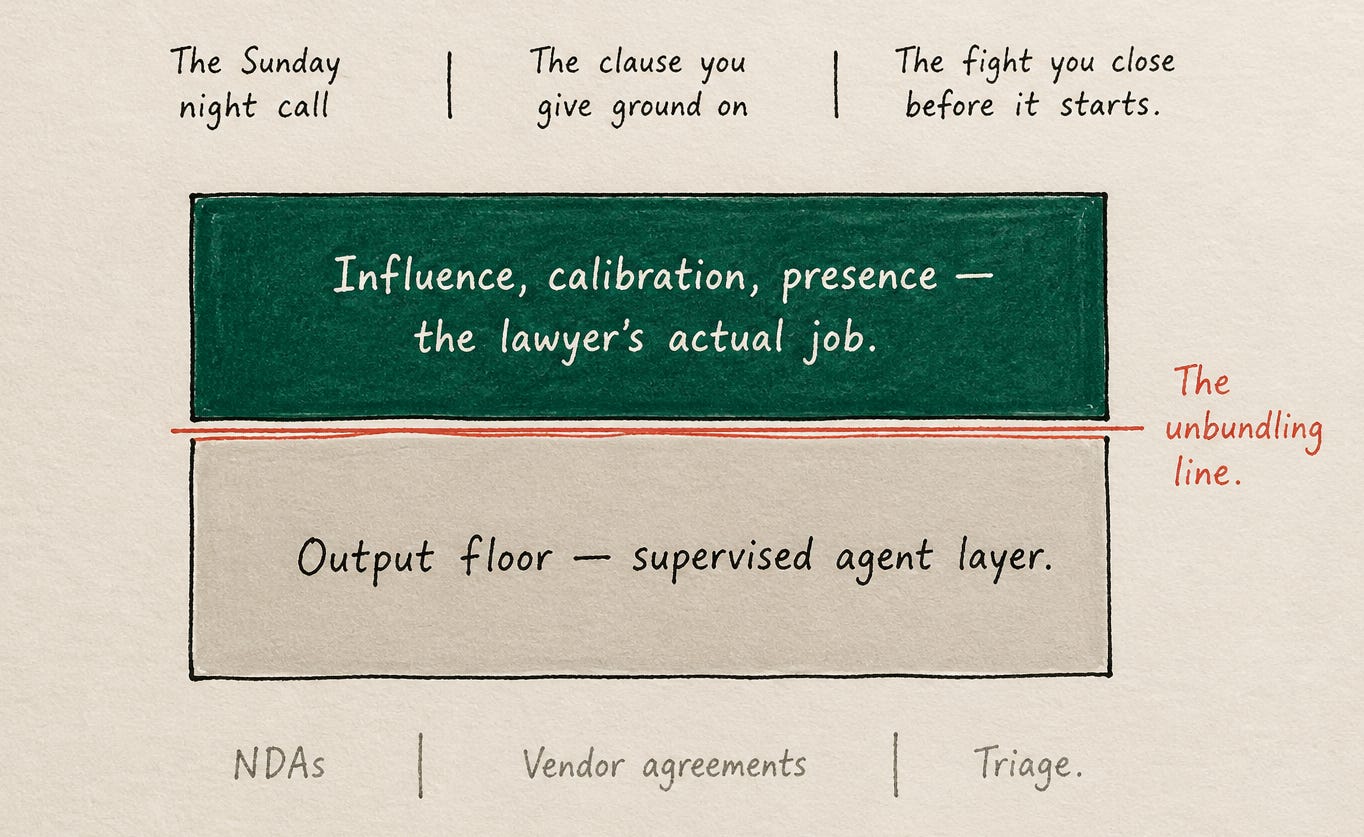
I will be specific about what I mean, because I do not want this to land as a slogan. I once spent three weeks negotiating a master agreement with a strategic supplier. The contract closed in version fourteen. The thing the deal actually turned on was a fifteen-minute call I made one Sunday night with the supplier’s GC, where neither of us referenced a contract, and we agreed how the two companies were going to work together for the next decade. The MSA codified a relationship that the call had already settled. If you had asked finance what they paid me for, they would have pointed at the redlines. If you had asked our CEO, he would have pointed at the call.
This is the gap. Reading the room in a procurement negotiation and knowing which clause to give ground on because the relationship matters more than the cap. Anticipating that the CFO is going to ask about indemnities even though indemnities are not on the agenda. Quietly closing a fight that two business teams did not realise they were about to have. Knowing when to send a one-line email and when to pick up the phone. Holding the line on something the rest of the deal team had stopped noticing because they had stopped caring. Comforting a founder at midnight before a sale.
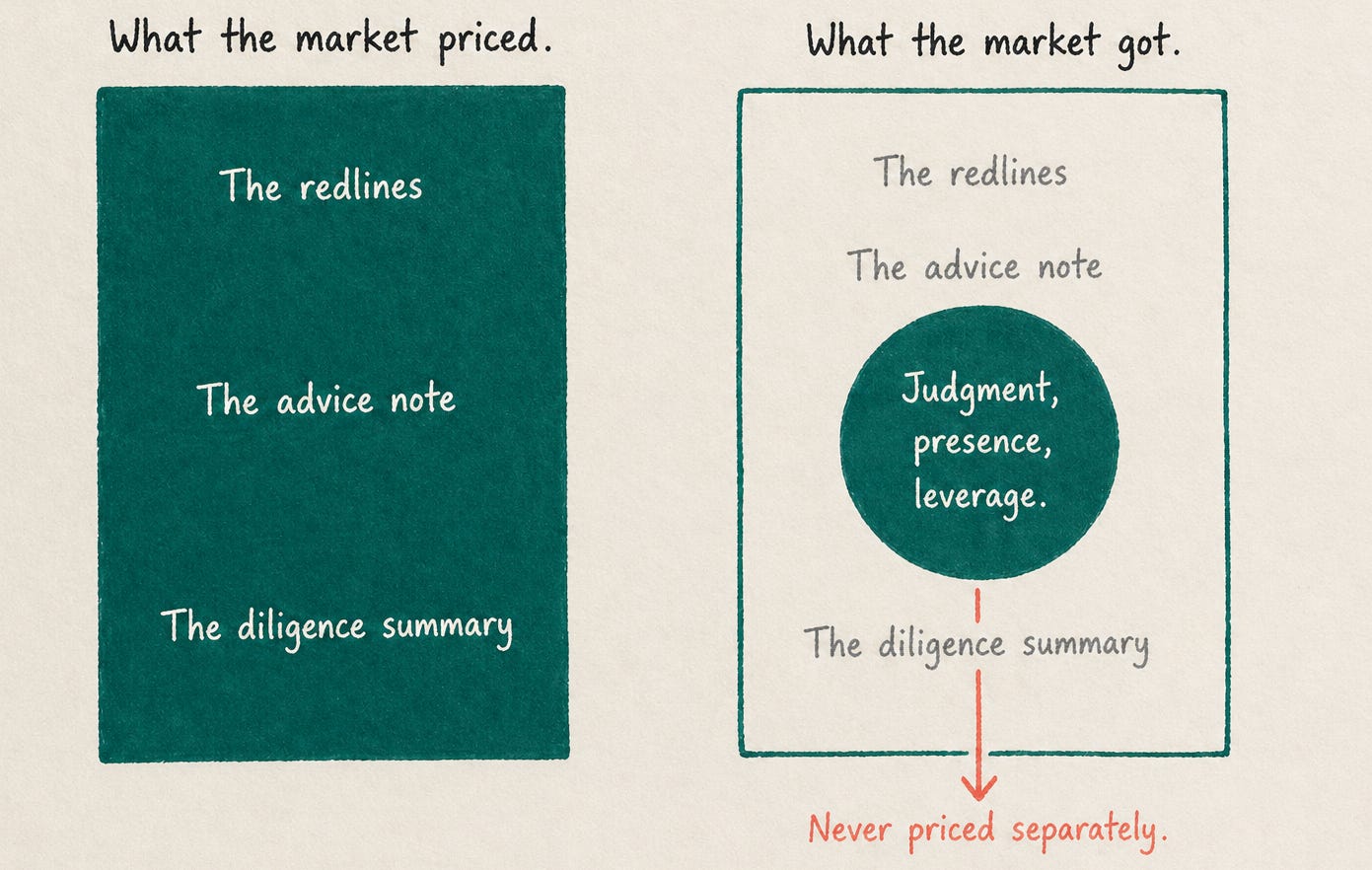
None of that registers as output in the way the billable hour was set up to count. Influence, leverage, calibration, presence, the shape a senior lawyer’s judgment takes when it lives inside a relationship and a context. It does not transfer to a tool that works equally well for an agent or a human, because the value of that judgment is not in the artefact it produces. It is in the situation it shapes. And it is precisely the part of the lawyer’s job that the market never priced separately, because the document was a more convenient unit to bill against.
The value of that judgment is not in the artefact it produces. It is in the situation it shapes.
When output and value were welded together, the soft layer travelled along with the document. Pay for the contract, you also got the relationship. Pay for the hours, you also got the judgment. The unbundling has now begun whether anyone wanted it or not. The relationship and the judgment are sitting on the same shelf as the document, and nobody has labelled them, or priced them, or built a career path that develops them on purpose.
The dilution that is already underway
There is a version of this where the human qualities I am describing get talked up at conferences, valorised in keynote slides, and quietly atrophied in practice. I want to be honest. That is the path we are on by default. The valorisation is happening on stage. The atrophy is happening at the desk.
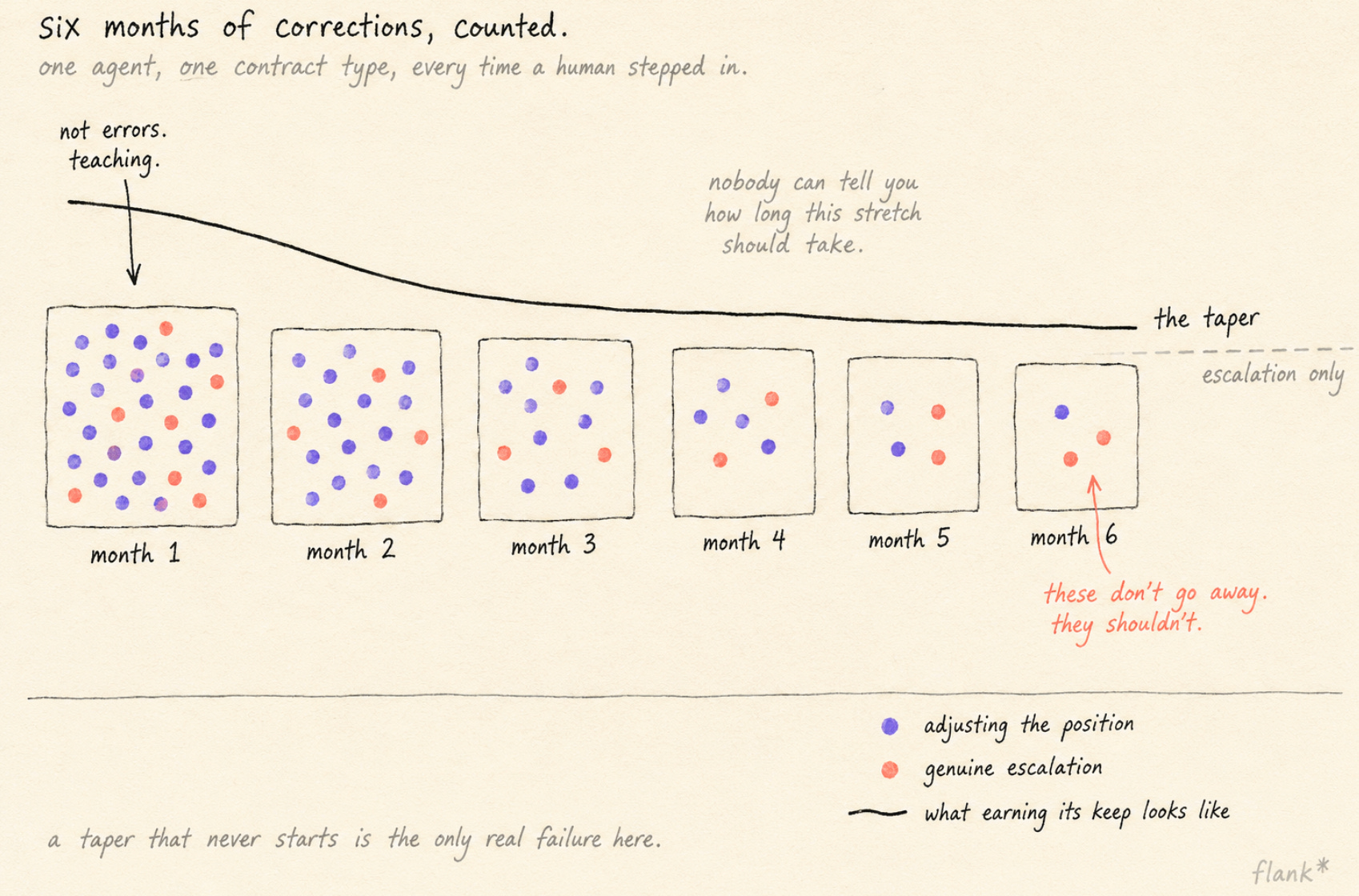
The reason is mechanical. If the lawyer’s day is still configured around producing output, and output is being rebased by agents, the lawyer’s day gets compressed in two directions at once. They lose the work that was developmental. The first-year contracts that taught judgment by failure. The triage that taught calibration. The drafting reps that turned theoretical risk knowledge into instinctive risk knowledge. Without those reps, the senior lawyer who was paid for the room is, in five years, not in the room because nobody trained her to be.
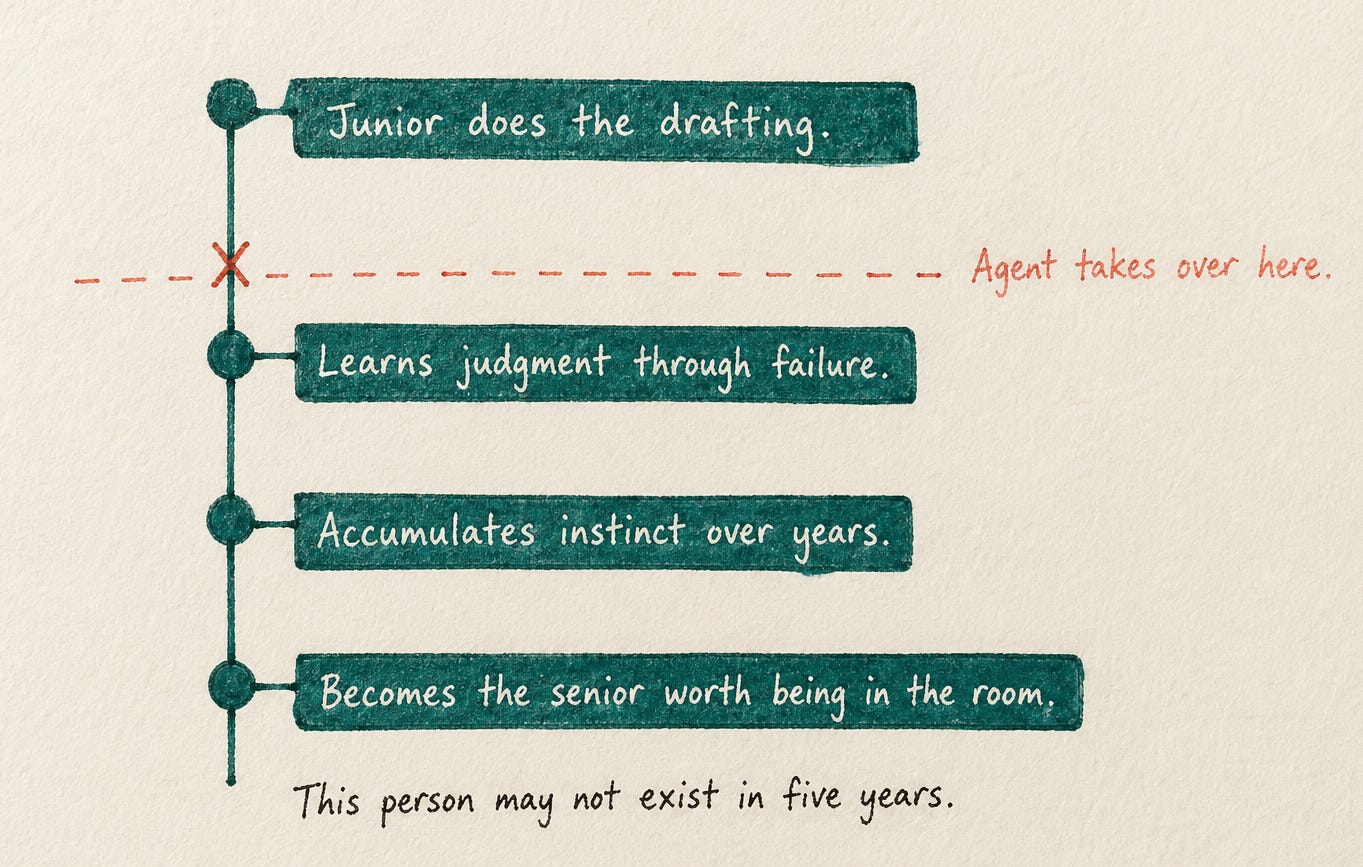
I have written before about the osmosis problem inside legal teams, the way junior lawyers learnt the work through proximity, observation, and correction. I think it has a sibling on the senior side that is under-diagnosed. The same dynamic that hollows out junior development can hollow out the soft layer that senior lawyers were always paid for, because that soft layer is itself accumulated by doing the work, badly, for years, in front of people who corrected you. Take the name off the document and the learning stops. The senior lawyer of the next decade is being made now, or is being prevented from being made.
The valorisation is happening on stage. The atrophy is happening at the desk.
I find this more uncomfortable than the pricing question, because the pricing question is at least solvable. You can change a billing model in a quarter. Rebuilding a development pipeline that produces the kind of senior lawyer worth being in the room with takes a decade.
What complementarity actually looks like
The opportunity is a complementary structure. Agents handle the output that has become the floor. Lawyers spend their hours on the part that always sat above the floor, the part that was being subsidised by output being scarce.
I want to be specific about what changes inside the operating model, because the abstract version of this argument is exactly how it gets watered down.
On the work itself, the easiest place to start is the routine, rules-based volume. Standard NDAs run against the team’s own positions. Vendor agreements that follow a template with three or four jurisdictional variants. Triage of inbound requests where the categorisation is mostly tractable. None of this is a lawyer’s competitive edge today. Most of it actively prevents the senior lawyer from spending time where the edge is. Move it to a supervised agent and the supervisor’s attention narrows to the exceptions. The exceptions are also where the developmental signal is densest, by the way, which is a useful side effect.
On pricing, the unit of price has to stop being the hour for routine output. I am not going to pretend the alternative is settled. Pay-on-delivery for routine workflows is one direction. Subscription pricing for capacity is another. Per-deal flat fees for known categories of work are showing up in early procurement conversations across our customer base. What I find common across those models is that they price the output close to its rebased floor, and they create separate room to price the human contribution, sometimes explicitly, more often through retainer or relationship pricing that funds presence rather than artefacts. Crosby is one of the more interesting examples to watch because they have priced the contract, not the hour, from day one. Whether their specific model is the right one is less interesting to me than the fact that the model has been allowed to exist.
They create separate room to price the human contribution — sometimes explicitly, more often through retainer or relationship pricing that funds presence rather than artefacts.
On career development, the change is harder and slower. Lawyers need to be developed for the work they will actually be paid for, not the work they currently perform on the way to being paid for it. That means earlier exposure to negotiation dynamics, to client relationships, to the room. It means treating the supervision of agents as a substantive skill, with its own apprenticeship, rather than as a downgrade from doing the work. It means promotion criteria that measure influence, judgment under uncertainty, and trust, alongside output. Most legal teams I have looked at are still promoting people for being the fastest at the work that an agent is about to do for free.
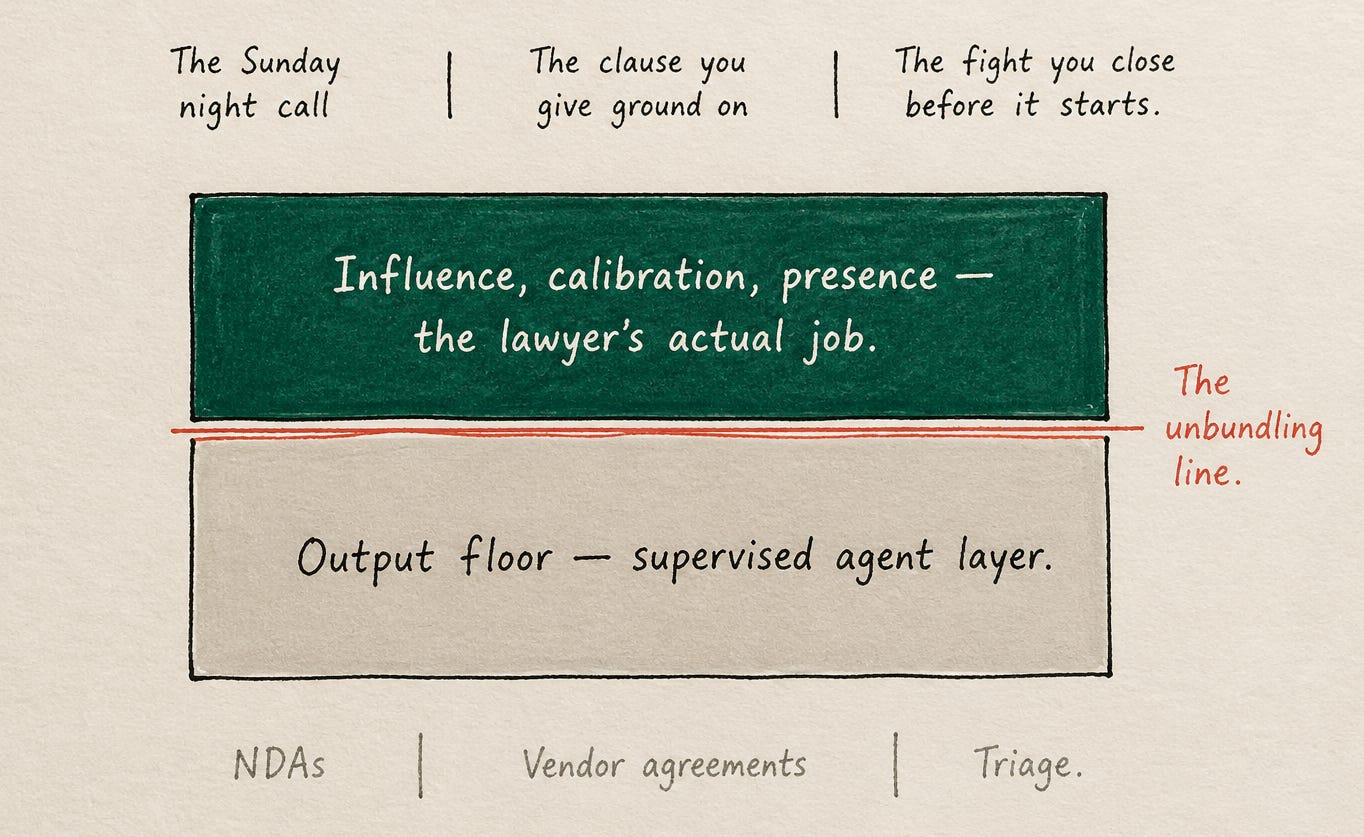
On the client-lawyer relationship, the simplest version is that the relationship has more room to breathe. When the routine work has stopped consuming the lawyer’s calendar, the lawyer has hours available for the call that was always producing more value than the redline. The internal clients I see most happy with their legal teams are the ones whose lawyers are now available for the things that matter, in a way that was impossible for a decade because the queue of things that did not really matter was always in the way.
Want to learn more?
Flank Co-founder Jake Jones and Horace Wu go deep on the real blockers to legal automation, the rise of AI-native law firms, and what the future of legal delivery actually looks like when autonomous agents handle the work.
What I do not know yet
I want to be careful not to overclaim. There are real things I do not have strong views on:
I do not know how fast the pricing model moves. The historical record on legal pricing change is not encouraging. The billable hour has survived a lot of confident predictions of its demise, and I would not bet against it surviving more. I think the in-house side moves first, because in-house teams already have a non-billable model, and the change for them is in how they buy services rather than in how they account for their own time. I think outside counsel moves slower, with a long tail of mixed models running in parallel for years.
I do not know how cleanly the soft layer can be developed at scale. It is possible that the things I am describing as the lawyer’s distinctively human edge are partly idiosyncratic, partly cultural, and partly accumulated by accident. If they are, no training programme produces them reliably. The honest version is that some of this is going to be discovered by trying, by individual lawyers who carve out time for the work the previous decade did not give them time for, and by leaders who are willing to fund presence as a line item rather than treating it as overhead.
I do not know exactly where the agent baseline lands. I find it plausible that the floor on output keeps rising for another two or three years and then plateaus while the soft layer continues to compound above it. I also find it plausible that the floor keeps rising in ways that surprise me, and that some of the work I have been describing as distinctively human turns out to have a thinner human core than it looks. I am holding both possibilities at once, because anyone claiming to have settled this is selling something.
What I think holds
What I do hold to, even with all of that uncertainty, is the structural point. Output and value were welded together because output was scarce. They are coming apart because output is no longer scarce, on the routine side. The lawyer who keeps competing on output will spend the next five years getting cheaper at something that was never really their job, and being applauded for it on the way down. The lawyer who lets the output sit where it now naturally sits, in a supervised agent layer, gets to spend their hours on the part that was always above the floor.
What I do hold to, even with all of that uncertainty, is the structural point. Output and value were welded together because output was scarce.
The practical version of that, for an in-house team or a firm thinking about the next five years, is to stop asking whether agents are good enough to take on a piece of work. They are, or they will be, on the routine side. Start asking what the lawyer’s hour is for, once it has been freed. The answer is the piece they have always been paid for and almost never priced explicitly. The influence, the comfort, the calibration, the way they read a room and shape it.
The tools may be symmetrical. The people are not. That is the part of the new paradigm I am most interested in working out.