I’ve been in dozens of legal tech evaluations this year. One question keeps coming up, and almost no vendor has a clean answer for it yet.
Every legal tech evaluation now turns on ONE thing
In software, headless means the capability is separated from the interface. The system exposes what it can do through an API or a protocol, and any other system can call on that capability without a human needing to interact with a screen. A headless CMS lets you manage content without logging into a dashboard. A headless commerce platform lets any front end trigger a transaction.
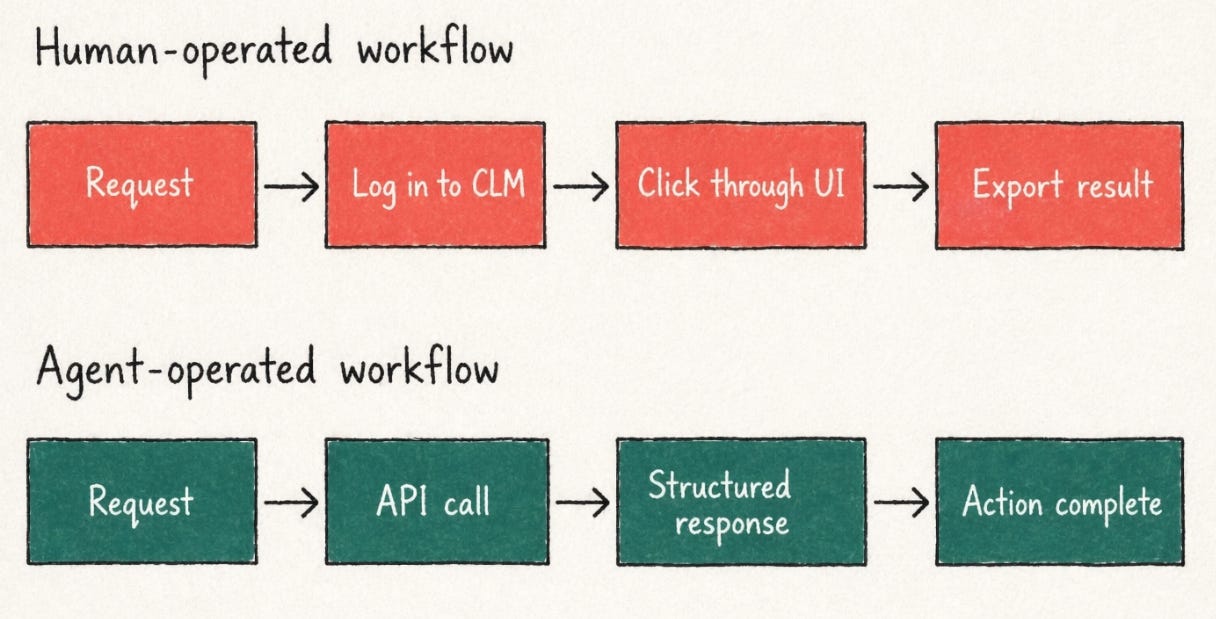
The enterprise AI leaders I spoke with are applying this logic to their entire software stack. In a world where agents are executing workflows, the software in those workflows needs to be operable by agents, not just by people clicking through a UI. If a procurement agent needs to check contract status in a CLM, it should be able to query the CLM directly. If a finance agent needs to verify that a vendor agreement has been signed, it shouldn’t require a human to log in, find the contract, and copy a status field into another system.
This sounds like a technical detail. I think it’s a strategic one.
First companies making the move
Last week, Salesforce made it concrete. Parker Harris, the company’s co-founder, asked a question that would have been absurd five years ago: “Why should you ever log into Salesforce again?” The answer, apparently, is that you shouldn’t have to. Salesforce Headless 360 exposes the entire platform as APIs, MCP tools, and CLI commands. Everything a human used to do by clicking through the Salesforce UI, an agent can now do programmatically. The framing from the announcement was blunt: if your platform requires humans to click through UIs to make progress, it is not ready for the agentic enterprise.
If your platform requires humans to click through UIs to make progress, it is not ready for the agentic enterprise.
When the largest enterprise software company on the planet rebuilds its product around the assumption that agents, not humans, are the primary operators, that’s a signal worth paying attention to. And the enterprises I spoke to are already acting on it. They’re evaluating their entire vendor portfolio through this lens, and they’re willing to drop vendors that can’t operate headlessly. The reasoning is straightforward. If you’re investing in agents to automate workflows, every tool in that workflow that requires a human to operate it becomes the new bottleneck. The agent can only move as fast as the slowest manual step.
Legal tech’s interface problem
Now consider the legal tech stack that most enterprise legal departments have built over the past decade. A CLM with a portal where business users submit requests through web forms. A matter management system with a kanban board that lawyers update manually. A contract repository that requires someone to log in, navigate a folder structure, and download a document before any work can happen.
Every one of these systems was designed around an assumption that made perfect sense at the time: a human will operate this software. The interface is the product. The quality of that interface, how intuitive, how seamlessly it guides the user through each step, was the primary axis of competition among legal tech vendors for years. And fair enough. When humans are the operators, the interface matters enormously.
But the enterprises I spoke with are moving to a model where agents operate alongside humans, and increasingly in front of them. This post is about what happens after the agent has the work and needs to interact with the rest of the legal technology stack to complete it. If the next step requires checking a clause library in the CLM, and the CLM can only be queried through a browser interface designed for a human, the workflow breaks. Not because the CLM is bad software. Because it was built for a world where the operator was always a person.
But the enterprises I spoke with are moving to a model where agents operate alongside humans, and increasingly in front of them.
In my previous post I wrote about change management being the most underestimated variable in legal AI deployment. One of the observations that stuck with me was that business users experience essentially zero change management when the delivery layer is invisible to them. They send an email, they get a response. The hard change management sits with the legal team, whose role shifts from doing work to supervising it.
I think there’s a third layer of change management that neither I nor most of the market has talked about enough: the change management required of the technology stack itself. A legal department that deploys agents into a software environment built entirely for human operators will spend an extraordinary amount of time on workarounds. Screen scraping. Manual data transfer between systems. Custom integrations that break when vendors update their UI. The agents can do the legal work. They can’t navigate a portal designed for a person with a mouse.
The interoperability question
Advanced companies are running multiple agents from multiple providers across multiple functions. A legal agent handling contract review. A procurement agent managing vendor onboarding. A finance agent processing invoices. These agents need to talk to each other and to the systems underneath them.
In that world, the question for any piece of software isn’t just “does it work well for a human user?” It’s “can an agent call on this system, retrieve what it needs, and act on it without human intervention?” If the answer is no, the software becomes a friction point that humans have to staff around. Which is, if you think about it, a particularly ironic outcome for technology that was purchased to reduce manual work.
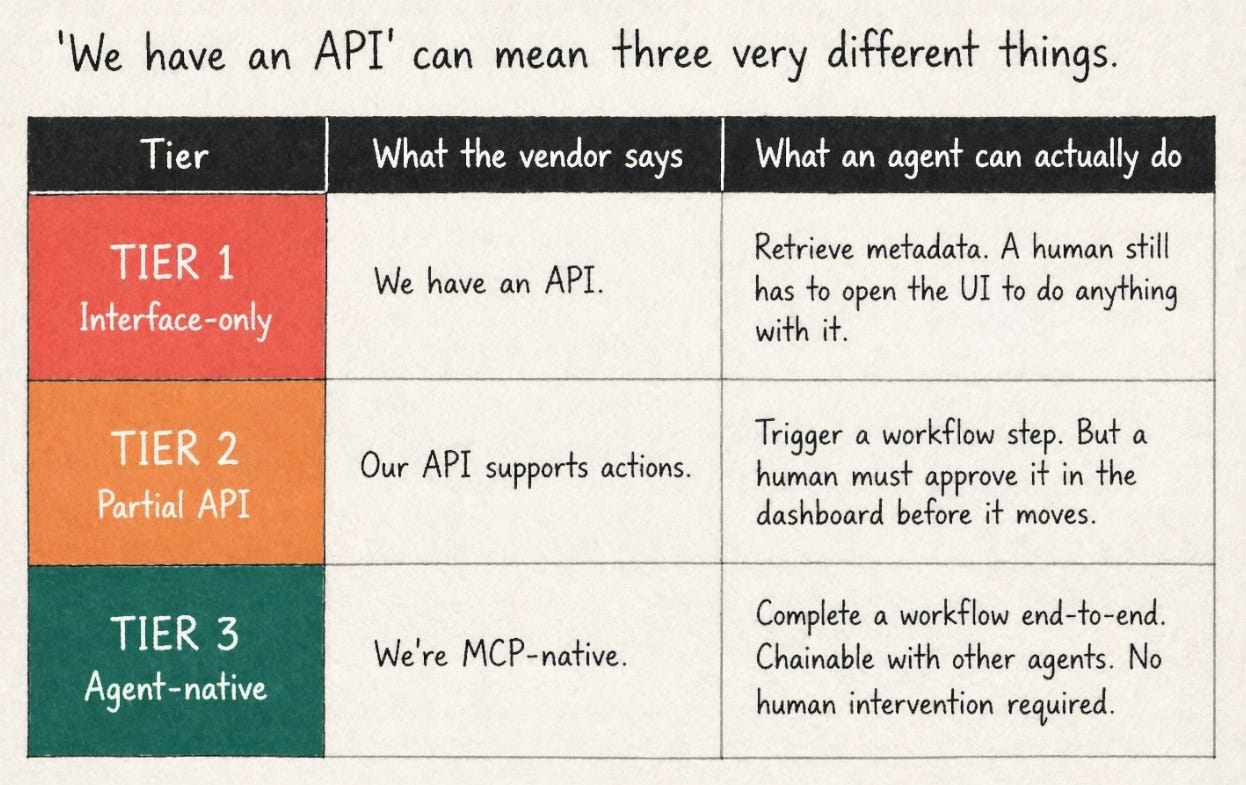
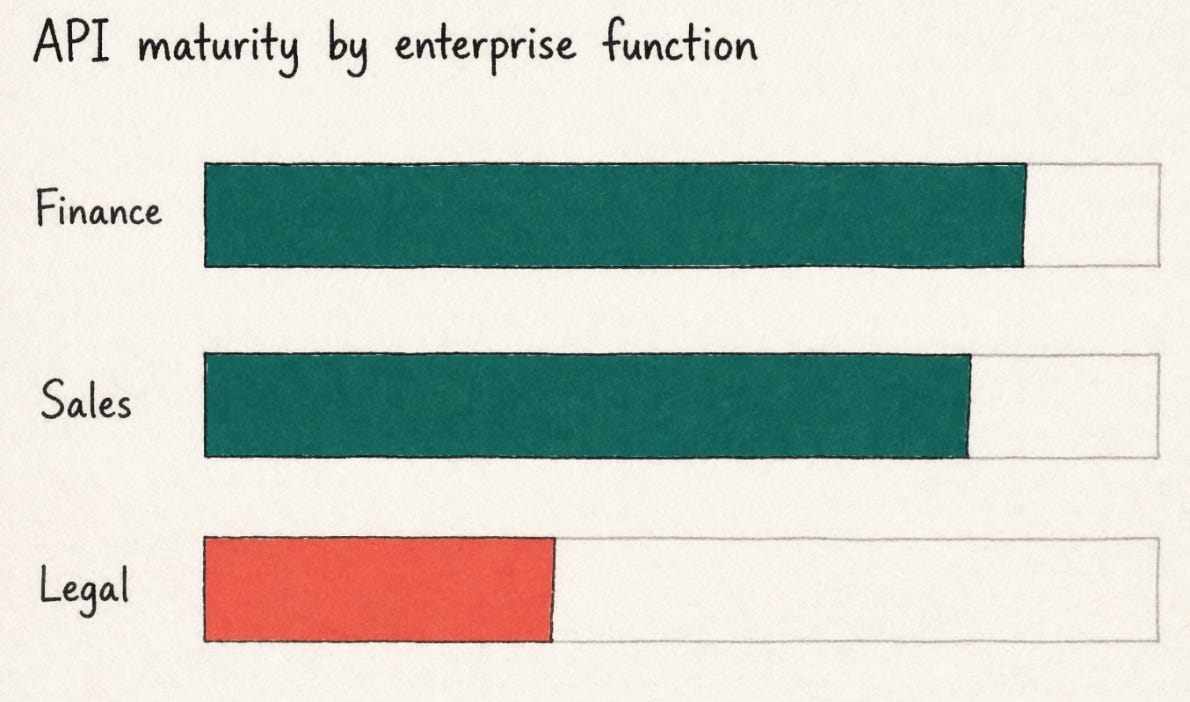
Legal is more exposed to this than most functions because the legal tech stack is, on average, less API-mature than the stacks in finance, HR, or sales. CLM vendors have been building integration layers, but many of them still assume the integration is between their system and another system’s UI, not between their system and an autonomous agent that needs structured data and programmable actions.
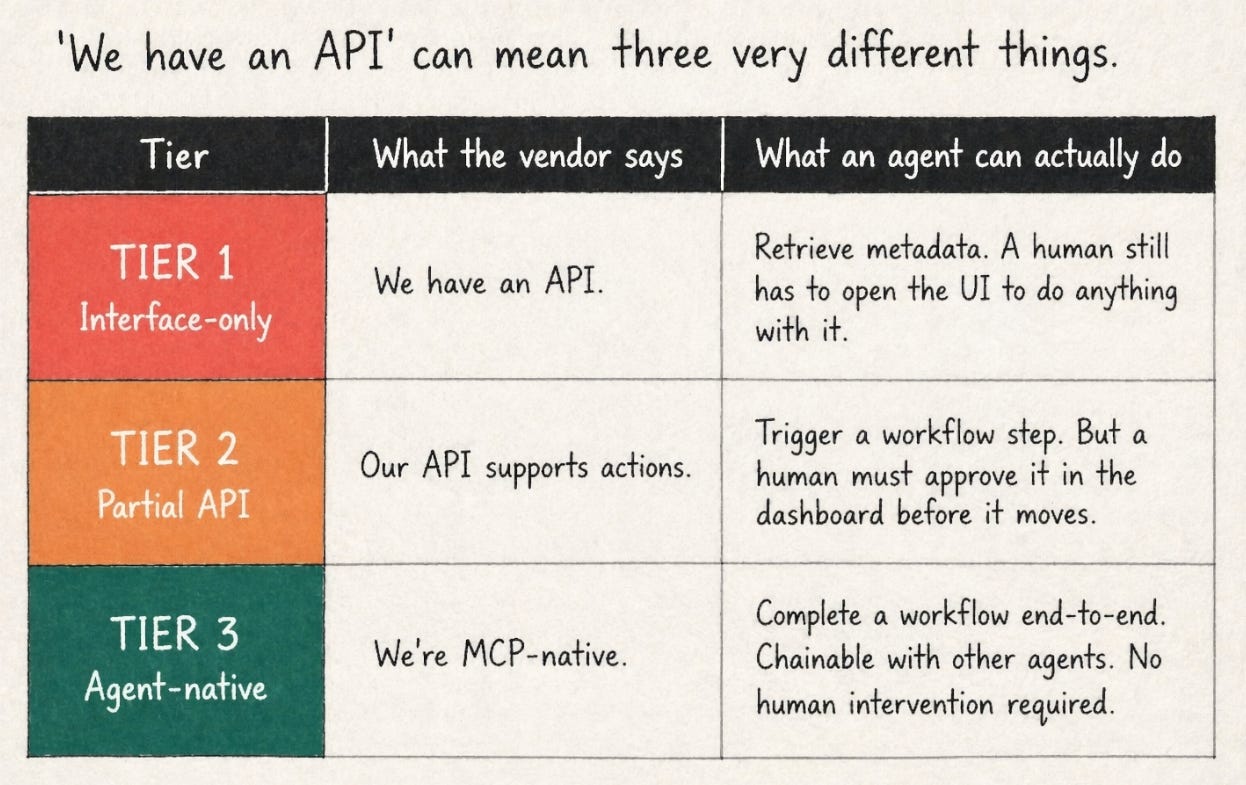
I’ve seen CLM APIs that can retrieve a contract’s metadata but can’t trigger a new draft from a template without a human approving a form in the UI. Or contract repositories where the search endpoint returns document IDs but not the content, so an agent still needs a human to download the file and pass it along. The gap between “we have an API” and “an agent can meaningfully use our API to complete a legal workflow step without human assistance” is, in my experience, quite wide.
What this means for buying decisions
Two questions arise that I think legal ops leaders should be asking during technology evaluations.
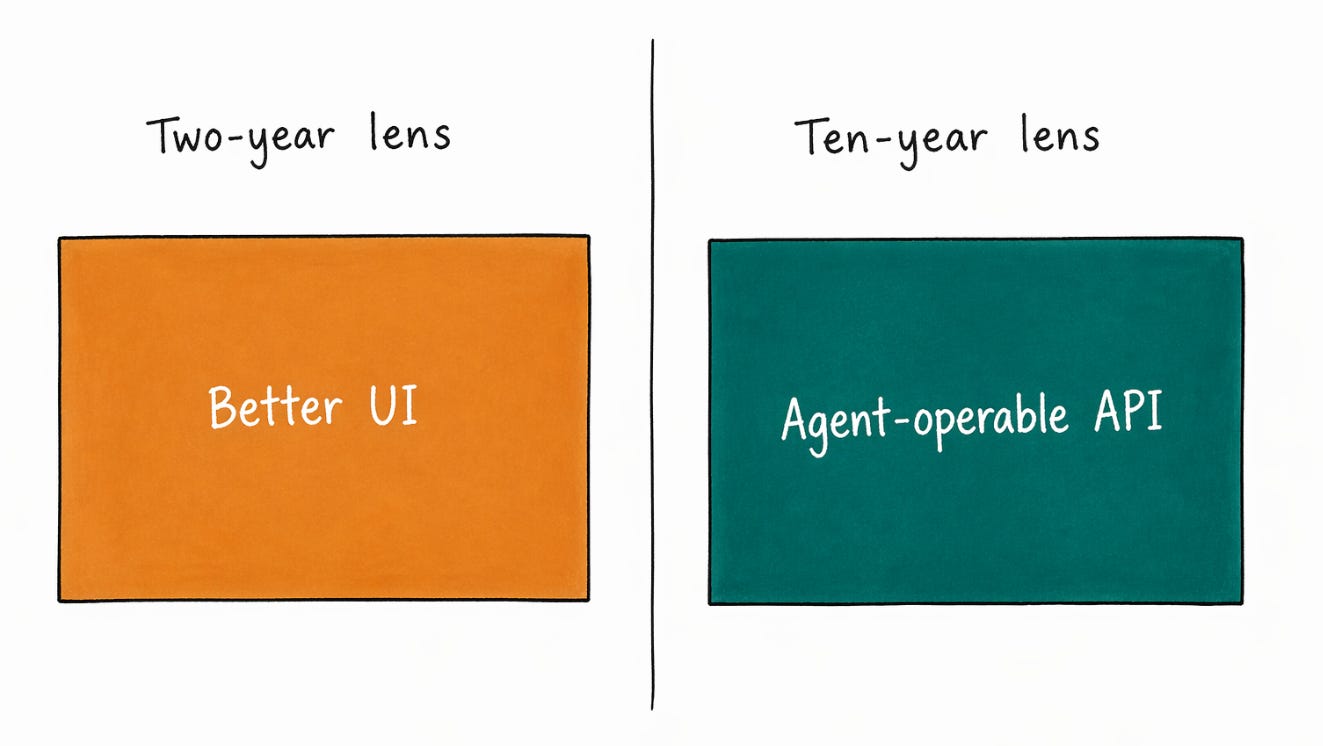
The first: can an agent use this software? Not “does this software contain AI features,” which is the question everyone asks now, but can an external agent interact with this system programmatically to retrieve data, trigger actions, and complete workflow steps? If the answer is “yes, through our API, with proper authentication and structured responses,” that system will age well. If the answer is “our AI features are built into the interface and require a human to use them,” that system is going to become a problem within two years.
Can an agent use this software?
The second: what happens to this software if the work it manages is done by an agent instead of a person? A CLM that manages the lifecycle of contracts still has value when agents draft and review those contracts, because the system of record is still necessary. An intake tool that routes requests to lawyers loses most of its value when an agent handles the requests end-to-end and the routing is built into the agent’s own logic. The question is whether the software provides a capability that agents need, or whether it provides a workflow layer that agents make redundant.
What happens to this software if the work it manages is done by an agent instead of a person?
These questions are uncomfortable because they challenge purchases that legal departments have already made, sometimes recently and at significant cost. I don’t think the answer is to rip out existing systems. It’s to evaluate new purchases with a ten-year lens rather than a two-year one, and to start asking vendors hard questions about headless operability before signing.
The change that doesn’t require change management
There’s a connection here to I’ve seen in Flank’s deployments. The legal AI implementations that succeed fastest are the ones that require the least change from the people around them.
I wrote about this in the context of how legal teams experience the shift from doing work to supervising it, and how that transition needs to be handled with honesty and patience. But I think the headless principle extends the same logic in a different direction. The less the technology stack needs to be manually operated, the less change management the deployment requires. If an agent can interact with the CLM or the contract repository directly, nobody needs to be trained on a new interface, nobody needs to change their workflow, and nobody needs to log into a portal they didn’t use before.
The irony is that the legal tech industry spent years optimising for user adoption. Better onboarding flows. Simpler interfaces. Gamified dashboards. All of that work was premised on the assumption that humans would be the operators. In a headless world, the best interface for a system that agents interact with is no interface at all. The value moves from the screen to the API, from the user experience to the data model, from how it looks to what it can do when asked by a machine. Salesforce understood this well enough to rebuild their entire platform around it. The question is whether legal tech vendors are thinking the same way, or whether they’re still optimising the dashboard.
All of that work was premised on the assumption that humans would be the operators. In a headless world, the best interface for a system that agents interact with is no interface at all.
I don’t think we’re fully in that world yet. Most legal teams are still operating primarily through human-driven workflows, with agents handling specific tasks at the edges. But some companies I speak with are planning for a world where that ratio inverts, and they’re making vendor decisions today based on that expectation. Legal departments that aren’t asking the same questions of their own technology stack may find, in two or three years, that the bottleneck in their operations isn’t the legal work itself but the software that was supposed to make it easier.