Four moves
A nine-year-old walks into a chess club at his new school. His eyes are too big for his face. It’s his first time there. He learned to play a week earlier. Within half an hour he’s beaten six boys. Each game lasts fewer than ten moves. The oldest of the defeated boys is thirteen, and after realising his king is mated, he pushes the board off the table, screeches his chair back, and walks out.
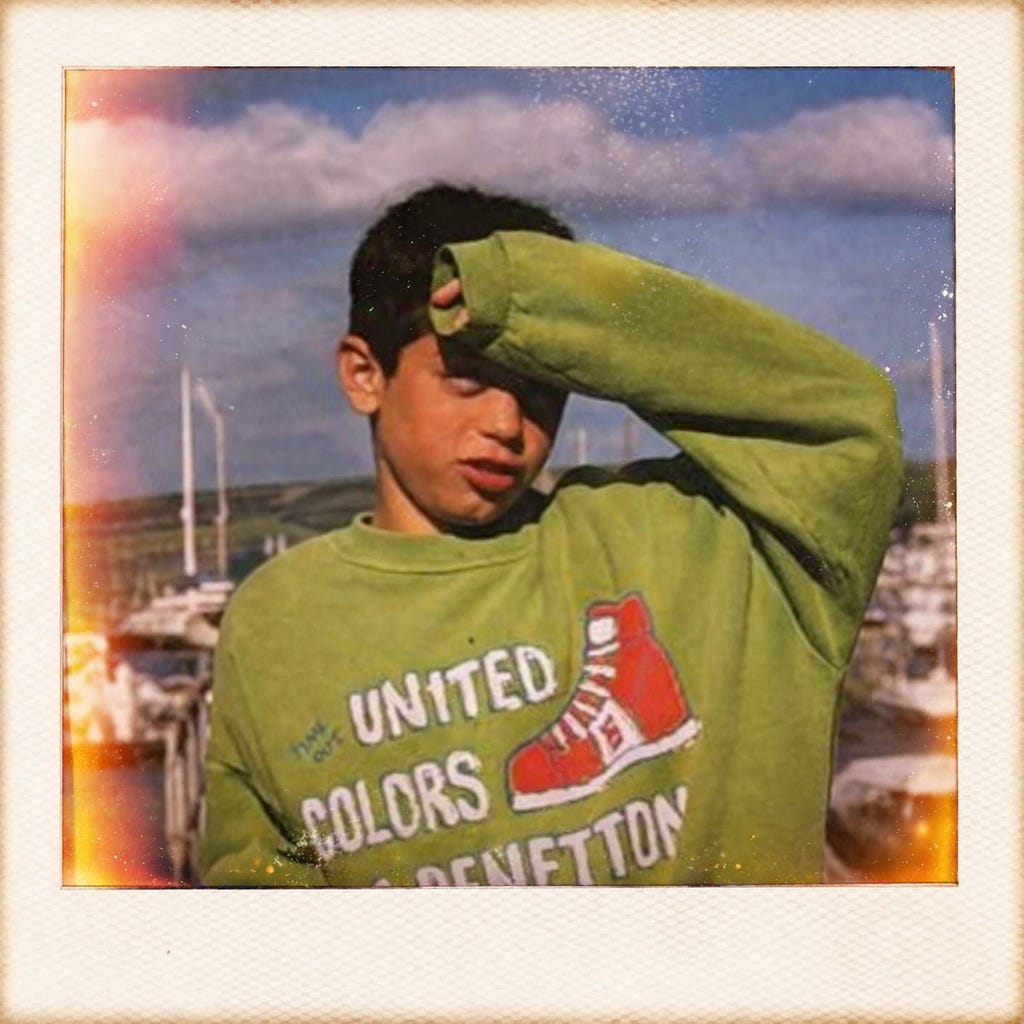
A week earlier for my birthday, my dad bought me a chess set. And the first thing he taught me after walking me through the basic moves was one of the first and most simple algorithms I would ever learn.
It was four moves. You point your bishop at one square, then your queen at the same square. If your opponent doesn't notice, you take the pawn and the king is trapped. Game over. Forty seconds. If they block with a knight, you take the knight. If they push a pawn to chase your bishop, you move it one square and the threat is still there. You don't need to understand chess. You just need to know: if they do this, I do that.
It is so simple, a nine-year-old could learn it.
Two hundred million
I first heard about Deep Blue from an Arcade Fire song, and I knew of IBM primarily because Coetzee had worked there as an engineer before becoming brilliant. Clearly, that rudimentary algorithm my dad taught me didn’t make an engineer of me.
The year is 1997. A 34-year-old man in a navy blazer and beige chinos sits down next to a tiny Russian flag on a stick. He looks professorial. Dark hair turning grey. Intelligence sketched into his brow. He unclasps his watch, a gold Audemars Piguet Royal Oak Chronograph, shakes it from his wrist, and places it on the table in front of him alongside a large, untouched wooden chess board.
May 11th. The man is Garry Kasparov, one of the most advanced minds of the 20th century and here the highest-rated chess player in history. This is game six of the second match between Kasparov and Deep Blue. Though the match is tied, the sense in the room is still one of relative certainty. A computer cannot beat an intuition like Kasparov’s. About a dozen rows of blue seats rake up to the back of the auditorium, and the bodies that fill them are relaxed. Whispering silences. Then the game begins with Deep Blue, e4.
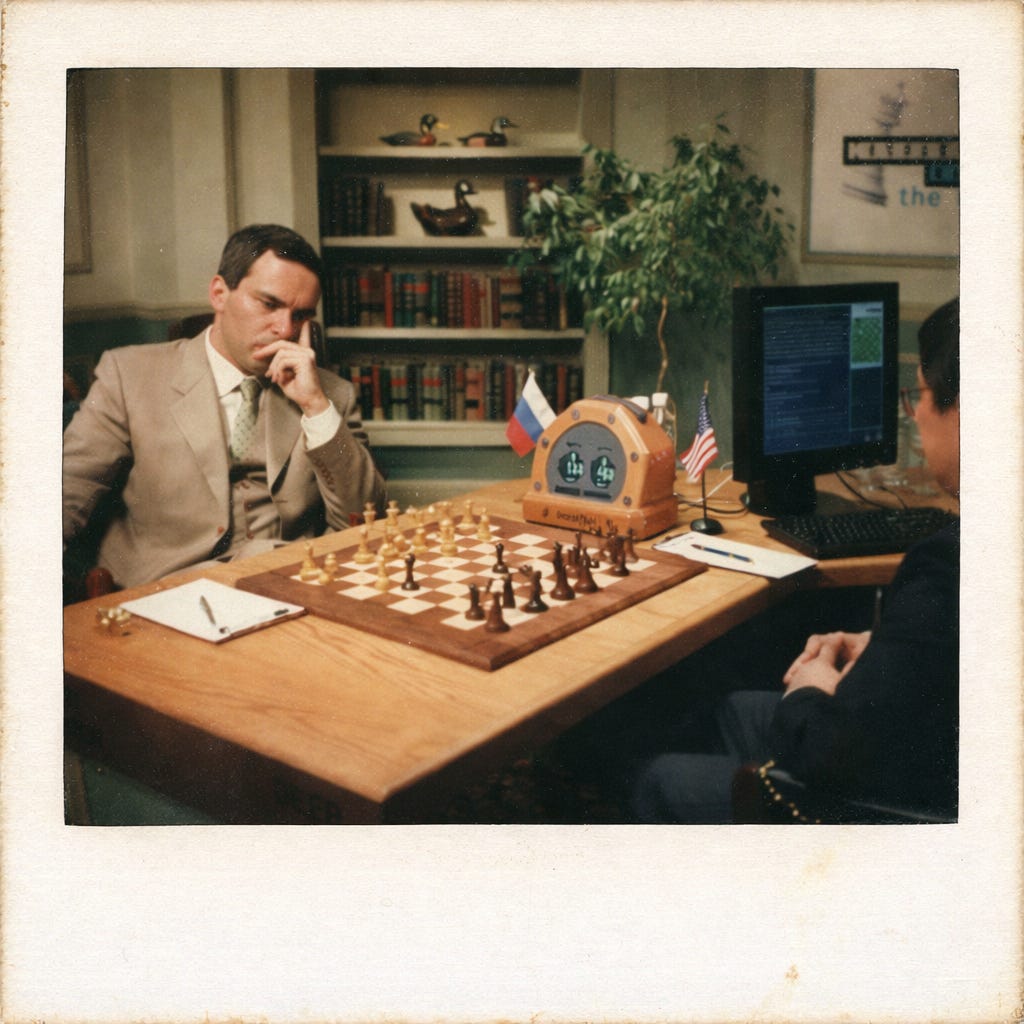
Barely an hour later, Kasparov’s eyes are shut tight. He leans back in his chair as if in pain, and pinches the bridge of his nose. Then he glances at the audience, catches someone’s eye there. He half smiles, raises his eyebrows. The room shakes with a short burst of laughter. Close up: He drags both hands through his hair. The hair looks greyer now than it had done 57 minutes earlier. He reaches for his pen. Thinks twice. Cups his face again. Then, as if throwing a final hopeless jab, he reaches his hand out to Deep Blue’s operator and resigns.
There is a whoop of shock from the audience. Some scattered applause. Kasparov is already gone. A single desperate shrug towards someone in the audience as he leaves. Deep Blue’s operator looks lost. He taps a few keys on the keyboard, then sits down at the computer as though ready to start a day of work. It’s an odd moment. But it is final.
Many experts are confused. When he resigned, Kasparov had not been in a losing position. In the press conference afterwards, a journalist asks him what went wrong. Kasparov says he felt, for the first time in his career, that his opponent understood something about the position that he didn’t.
And yet, his opponent had understood nothing. Deep Blue could not understand. It had no model of Kasparov, no sense of momentum, no feel for the psychology of a match that was slipping away. It had an evaluation function and it had speed (two hundred million positions a second) and that was all. It was doing what I had done as a nine-year-old with Scholar's Mate. If they do this, I do that. The tree was just deep enough now that the greatest chess player who had ever lived mistook its output for comprehension.
Move 37
After Kasparov’s defeat, the world did what the world does. It moved the goalposts. Chess, the new consensus went, had been a poor test all along. It had always been computable. The permutations were manifold, but they were finite. If you wanted proof that some problems were beyond the reach of brute computation, you needed a bigger game.
Go is played on a 19-by-19 grid. The number of possible board positions exceeds the number of atoms in the observable universe. Where chess rewards calculation, the rigorous, unapologetic learning of certain positions, Go rewards something harder to name. The greatest Go players describe their moves the way musicians talk about groove, as a matter of feel, of taste. In 1997, the year Kasparov resigned in under an hour, the best Go programs in the world could be beaten by a competent amateur. Experts estimated it would take at least a hundred years before a machine could play Go at a professional level.
It took just nineteen.
In March 2016, a 33-year-old South Korean named Lee Sedol sat down in a hotel conference room in Seoul. Lee was one of the greatest Go players who had ever lived, a prodigy who had turned professional at twelve and spent two decades dismantling opponents with unpredictable, almost wild artistry. His opponents described him as seeing a different board to everyone else… or perhaps seeing the same board from some different angle, through some additional dimension.
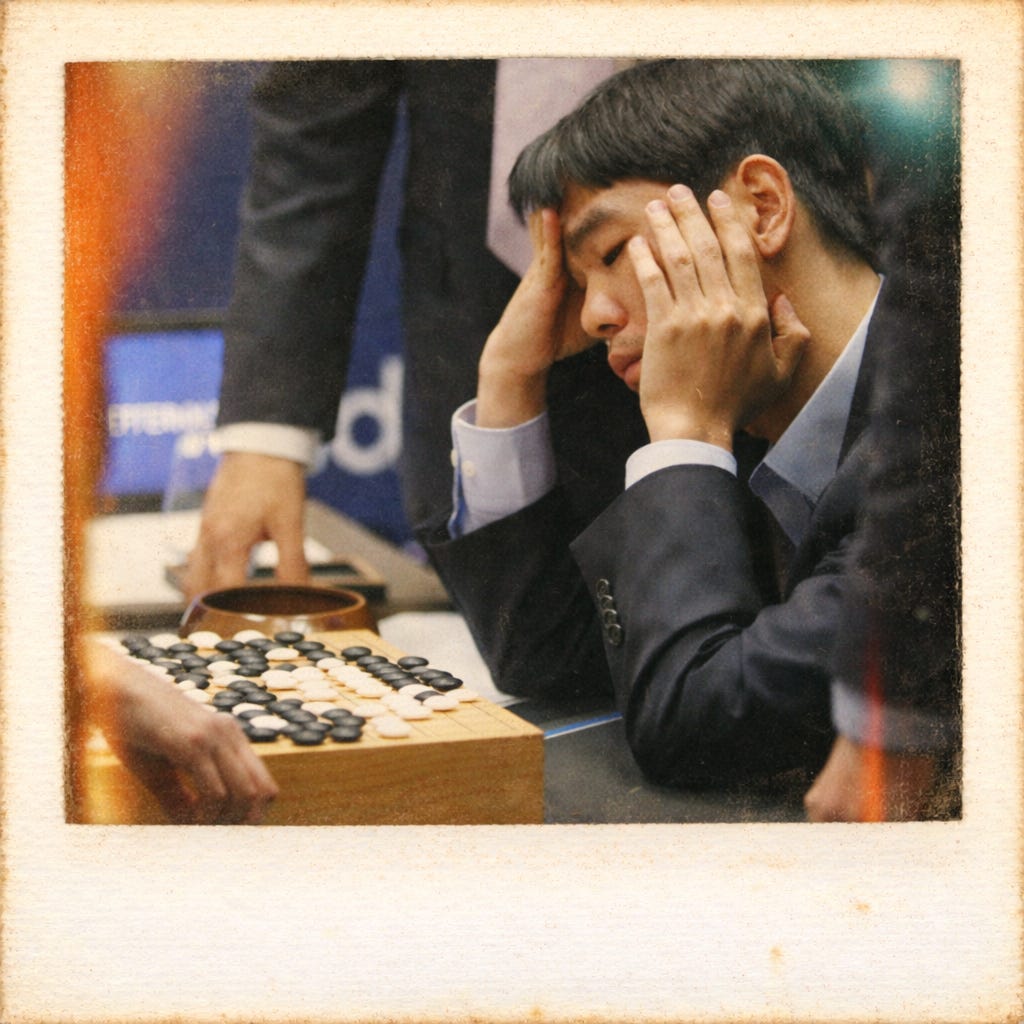
On this day, his opponent was AlphaGo, a program built by a small team at Google DeepMind in London. Before the match, Lee told reporters he expected to win comfortably. He gave himself a 5-0 or maybe 4-1 chance. He was being polite about the 4-1.
Game 1 was a shock. AlphaGo won. But shocks in single games had happened before (Deep Blue had won a single game against Kasparov in 1996). Lee would adjust.
Game 2 changed things. Thirty-seven moves in, AlphaGo placed a stone on a position that no professional Go player would have considered. It was either idiotic or brilliant. The engineers wondered if the system had bugged out. The commentators went quiet. Fan Hui, the European champion who had lost to AlphaGo in a private match five months earlier and had since been working with the DeepMind team, was watching from another room. He stared at the screen. The move violated principles that Go players absorb over decades of study. It was not the kind of move you arrive at by calculating every possibility. It was the kind of move you play because some indescribable instinct tells you it’s right.
AlphaGo had not been told to play it. Nobody had programmed Move 37 into its opening book. Instead AlphaGo had played millions of games against itself, more games than a human could play in a thousand lifetimes. From those games the system had developed its own sense of what a good position felt like. Its own taste. Not by evaluating two hundred million positions a second. Not by brute force. By building, through repetition, something that looked from the outside exactly like intuition.
Fan Hui, still staring at the screen, said, simply, that it was beautiful.
Lee Sedol lost Game 2. He lost Game 3. He won Game 4, in a moment that moved him to tears, and then he lost Game 5. After the match he said something that Kasparov could have said nineteen years earlier but didn’t quite have the language for. He said he had been forced to question everything he understood about the game.
Deep Blue had proved that computation, at sufficient depth, could beat the best human at the most complex game we had. AlphaGo proved something more unsettling. It proved that a machine could develop what looked, to every expert watching, like feel. Like taste. Like a sense of beauty.
And if that was computable, the question was no longer which games a machine could win. It could win them all. The question was this: what other facets of human intelligence and endeavour were at risk from the coming wave of silicon based intelligence?