Five stories that matter
⚡ 01 Linklaters launches Applied Intelligence - lawyers and data scientists selling AI to clients
Linklaters launched Applied Intelligence, a client-facing team of lawyers and data scientists that co-designs and delivers bespoke AI workflows for clients’ most complex challenges. The unit works across frontier models and large data sets to build custom tooling that an off-the-shelf product cannot deliver. It is a law firm using AI to sell what a law firm has never sold before: the software layer underneath the legal advice.
⚡ 02 Harvey publishes the Legal Agent Benchmark - 1,200 tasks, 24 practice areas, open-source
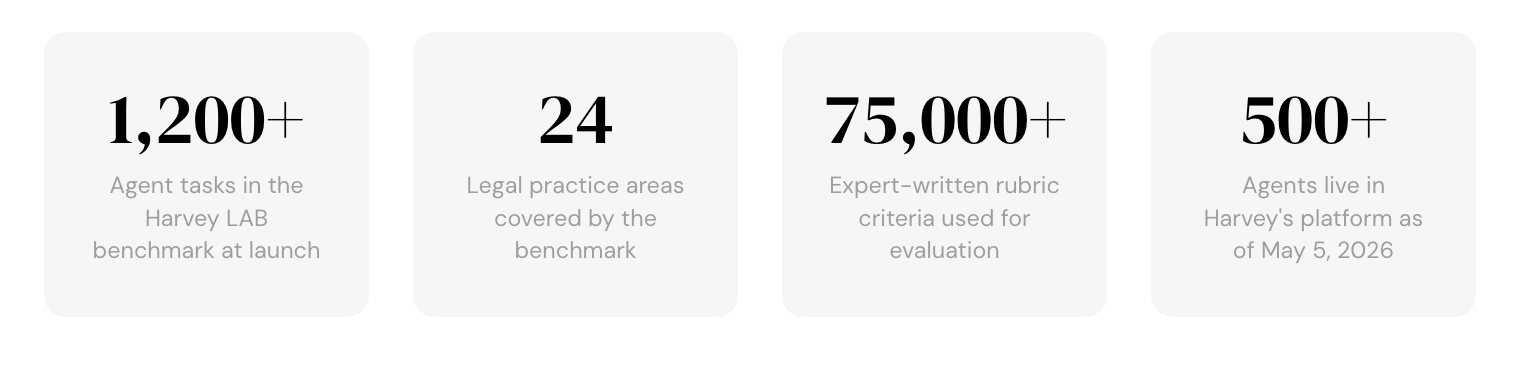
Harvey open-sourced the Legal Agent Benchmark (LAB) - the first industry-wide framework for evaluating whether an AI agent can do real legal work. Each task mirrors how work is assigned in a law firm: an instruction, a client matter with relevant materials, a required work product. The benchmark launches with support from Nvidia, OpenAI, Anthropic, Mistral and DeepMind. Harvey simultaneously announced 500+ agents live in the platform, with an Agent Builder in early access.
⚡ 03 Brazilian legal AI startup Enter raises $100M at $1.2B valuation - Latin America’s first AI unicorn
Enter, founded in São Paulo by Mateus Costa-Ribeiro, raised a Series B led by Founders Fund, alongside Sequoia Capital and Ribbit Capital, tripling a $350M valuation in under eight months. The company builds AI agents that handle mass litigation - reading each lawsuit, pulling case-specific data, and drafting a defence -for clients including Itaú, Santander, Nubank, Mercado Livre, and Airbnb. It processes more than one million cases a year inside a court system that generates more new lawsuits annually than any country on earth.
🏗 04 Federal government intervenes in lawsuit challenging Colorado’s AI Act
The Department of Justice intervened in xAI’s lawsuit against the Colorado AI Act, supporting the challenge. Separately, SB 189 - a rewrite of the original law - moved through committee and proposes pushing the effective date back to January 2027. The collision between federal preemption ambitions and state-level AI regulation is no longer theoretical: it is now in a courtroom.
⚡ 05 Slaughter and May goes firmwide with Harvey, completing the Magic Circle sweep
The last holdout among London’s Magic Circle firms announced a firmwide deal with Harvey covering all practice groups - M&A, due diligence, regulatory research and document analysis. Every Magic Circle firm has now committed to a named AI platform. The last time an industry-defining technology moved this quickly through the entire top tier of a professional services market, it took a decade rather than three years.
Receive two articles and our weekly briefing by subscribing below.
⚡ 01+05 The Magic Circle is complete - and one firm just started selling AI as a service
Slaughter and May’s firmwide Harvey rollout is a milestone, but the more interesting story of the week is what Linklaters did next. One firm completed the tool deployment. Another firm started selling the deployment as a product.
The Magic Circle is now fully committed
Every Magic Circle firm has now publicly committed to a named AI platform. The spread is instructive:
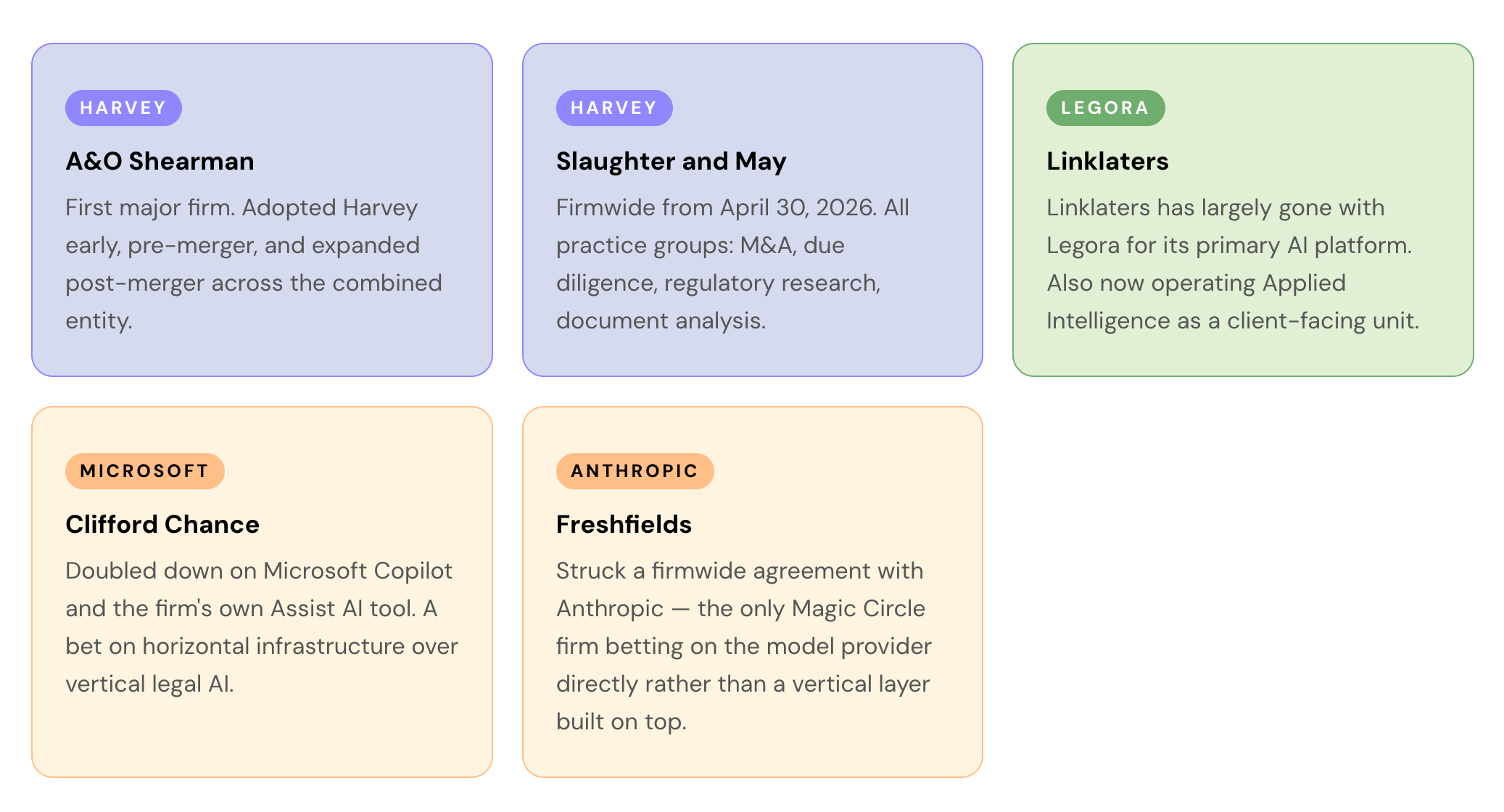
The variation in choice is itself a signal. The market has not converged on a single platform. Harvey has the most Magic Circle logos, but Legora, Microsoft and Anthropic are each present. The competition is real, and the firms with the most sophisticated procurement processes are still reaching different conclusions.
Linklaters and the new revenue line
The more structurally interesting event of the week is Linklaters’ Applied Intelligence launch. The unit is not an internal AI programme. It is a client-facing team of lawyers and data scientists that co-designs and delivers bespoke AI workflows for client use - analysing large data sets, building custom tooling, and selecting from frontier models on a project-by-project basis.
The framing in Linklaters’ own announcement is careful: it is described as an AI-enabled legal service, not a product, keeping it within the firm’s existing regulatory structure. But the economic model is different from any legal service that came before it. Clients are paying Linklaters to build AI infrastructure for them. The deliverable is software. The price is not a per-hour rate; it is a project fee. The work is not being done by a partner billing at £1,200 per hour. It is being done by a team designing something that, once built, runs at near-zero marginal cost.
The structural question. What does a law firm do when its most profitable work - the high-complexity, high-judgement advisory - is still protected by expertise and relationships, but its volume work can be delivered by agents at a fraction of the cost? Applied Intelligence is Linklaters’ answer: sell the agent layer as a premium service, not just the advice it produces. Whether that model survives long-term depends on whether clients conclude that a law firm is the right vendor for AI infrastructure. Many will not. But it is a rational first move.
⚡ 02 Harvey just defined what “good” looks like for legal AI agents
The release of the Legal Agent Benchmark is, on one reading, a product announcement. On another reading, it is a bid to set the standard before anyone else does. That distinction matters enormously for how this market develops.
Every mature software category eventually gets a shared benchmark that buyers and vendors both reference. Security has CVE and CVSS. Machine learning has MMLU, HELM, and a dozen others. Legal AI has had nothing that measures what actually matters: whether an AI agent can take a real legal matter and produce a work product a lawyer would sign off on.
Harvey’s LAB is an attempt to fill that gap. The benchmark is open-source on GitHub, built around 1,200 agent tasks across 24 practice areas and evaluated against 75,000 expert-written rubric criteria. The structure is explicit: an instruction, a client matter containing relevant materials, and a work product. Not a question-answer pair. Not a research retrieval test. A task that looks like the actual work.
The backing is significant. Nvidia, OpenAI, Anthropic, Mistral and DeepMind are all named launch partners - which means the model providers are aligning to a legal-specific capability measure at the same time as the legal-AI vendors. Harvey has declined to publish a leaderboard on day one, saying it expects the dataset to evolve. That is a deliberate signal: the benchmark is designed to be the long-term frame, not a one-week news story.
What it means for buyers. For the first time, an enterprise legal team evaluating a legal AI agent has a shared vocabulary to work from. The question is no longer “does this tool make lawyers faster?” — which is unmeasurable and unanswerable in a trial. The question is “where on the LAB task set does this agent pass, and where does it fail?” That is a procurement-grade question. It will change the conversation in every RFP that a legal AI vendor answers from this week forward.
Why the benchmark is also a moat move
The legal-AI market has so far competed on a mix of credentials (Magic Circle clients), fundraise headline ($11B valuation), and narrative (”fiduciary-grade”, “agent-native”). The LAB changes the competition surface in Harvey’s favour. By publishing the benchmark - and by being the company whose products will inevitably score well against it because Harvey built it - Harvey has done something sophisticated: it has created a public measure of capability that its own training data is optimised for, while inviting every competitor and model provider to be evaluated on it.
The right comparison is not to a software benchmark. It is to what AWS did by publishing the Well-Architected Framework, or what Salesforce did by publishing the enterprise SaaS evaluation criteria it knew its own products would pass. The entity that sets the standard usually wins the market that forms around it.
⚡ 03 Latin America just produced a legal AI unicorn - and the thesis is the same one
Enter’s $1.2B valuation is not an outlier. It is the clearest evidence yet that the structural problem legal AI is solving is not an Anglo-American problem. It is a feature of every legal system built on high-volume, rule-based work done by expensive human labour.
Brazil’s court system receives more new lawsuits per year than any other country in the world. The practical consequence is that large Brazilian companies - banks, fintechs, platforms - each face hundreds of thousands of active cases at any given moment. The traditional response was to maintain enormous internal legal teams or outsource to law firms at per-case rates that added up to material operating costs. Enter builds AI agents that read each incoming lawsuit, pull the case-specific facts, and draft a defence brief. The company processes more than one million cases a year.
The founder’s background is worth noting. Mateus Costa-Ribeiro became Brazil’s youngest practising lawyer at 18, finished Harvard Law, passed the New York Bar at 20, and left a fully funded Stanford MBA seat to start the company. The $100M Series B was led by Founders Fund and joined by Sequoia Capital and Ribbit Capital - three of the most structurally rigorous investors in technology. All three diligenced the mass-litigation use case and concluded it was venture-scale.
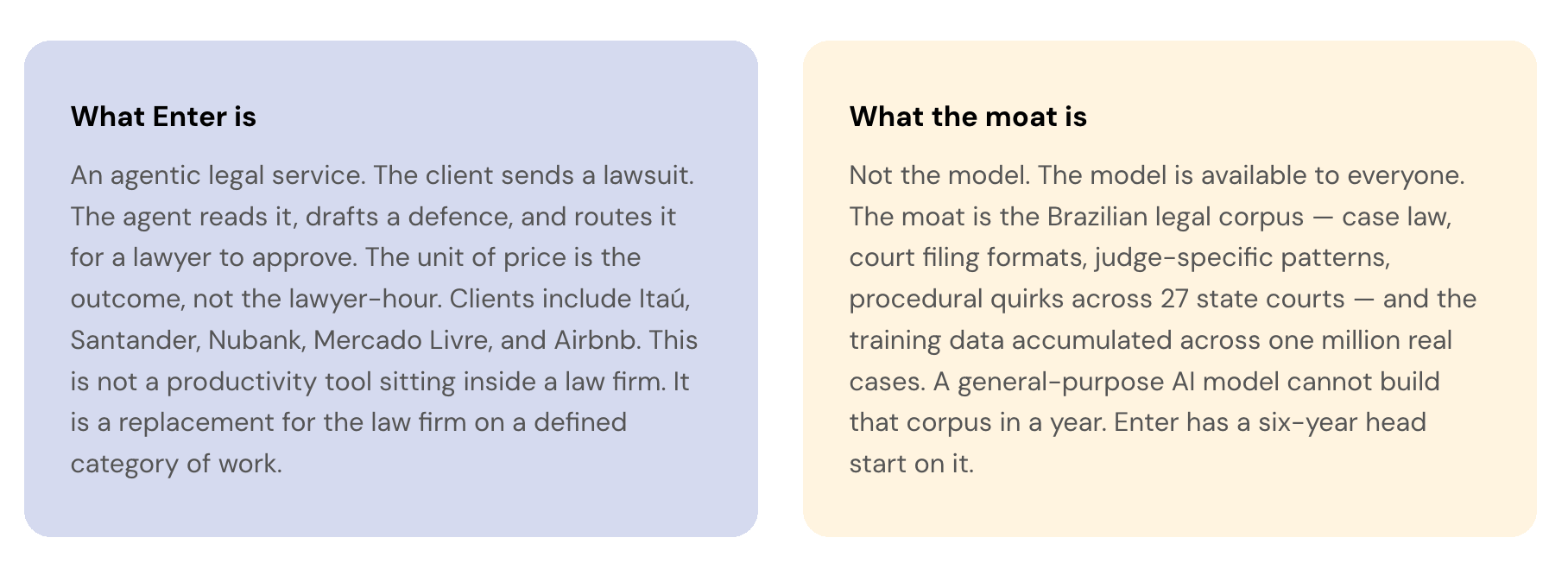
The Flank read. Enter is doing in São Paulo what Flank does in London and New York: taking the category of legal work defined by high volume, rule-based repetition, and a fixed relationship between input and outcome, and moving it from expensive human time to supervised agents. The Brazilian court system is an extreme version of the problem - more volume, less predictability, harder to automate - but it makes the proof stronger, not weaker. If the thesis works at one million Brazilian lawsuits per year, it works at ten thousand UK NDAs per year. The cost structure is the same. The inexpensive work is being done by expensive people. That is the structural inefficiency agents remove.
🏗 04 The federal government picks a side in the AI regulation fight
The DOJ’s intervention in the Colorado AI Act lawsuit is the most significant US AI regulatory event in months - not because of Colorado specifically, but because of what it signals about how the federal preemption fight will actually be conducted.
The Colorado AI Act (SB 24-205) was the first comprehensive US state AI law - passed in 2024, originally effective June 30, 2026. It imposes duties on developers and deployers of high-risk AI systems to avoid algorithmic discrimination in consequential decisions affecting Coloradans: education, employment, financial services, healthcare, housing, insurance, and - directly relevant here - legal services.
xAI filed a lawsuit seeking to invalidate the Act in April 2026. The Department of Justice intervened on April 28, supporting the challenge. The White House’s December 2025 executive order had already established an “AI Litigation Task Force” specifically to challenge state AI laws inconsistent with federal AI policy. This is that task force acting.
At the same time, inside Colorado’s own legislature, SB 189 moved through committee proposing to drop the requirement that companies explain how their AI works and push the effective date to January 2027. As of this week, the Colorado AI Act is simultaneously under attack in a federal courthouse and being rewritten by the legislators who passed it.
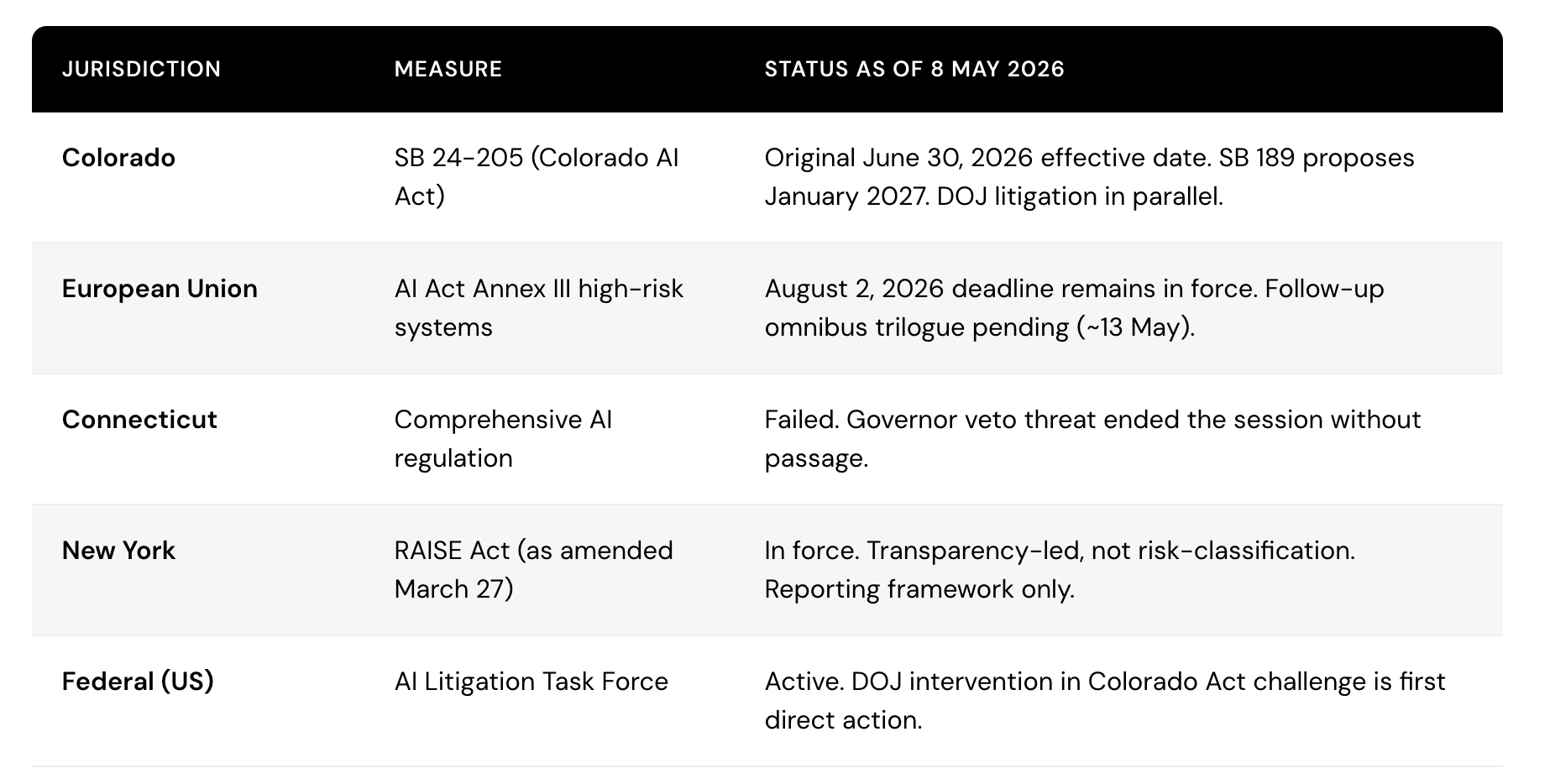
What this means for enterprise legal teams
The Troutman state AI law tracker for May 4 catalogued another cluster of new proposals across multiple states. The net result of this week is that the US AI regulatory landscape is simultaneously more active and less clear than it was a month ago. The federal preemption play - if successful in Colorado - would simplify the landscape significantly, but it will take years to resolve in the courts. Enterprise legal teams deploying AI are planning against a target that is moving in three directions at once: federal preemption, state legislation, and international obligations.
The compliance burden is, in itself, a kind of market signal. Every hour a legal team spends mapping AI obligations across 50 state regimes and the EU AI Act is an hour not spent on work that creates value. That cost - borne by expensive in-house lawyers doing work that is, structurally, research and mapping rather than legal judgement - is exactly the kind of work agents should be doing.
🧠 What this week tells us
The benchmark sets the competition surface. Harvey’s LAB is not just a product announcement. It is a bid to define what legal AI capability means before anyone else does. Buyers now have a shared vocabulary. Vendors will be evaluated against it. The entity that sets the standard usually wins the market that forms around it. Procurement conversations will change from next week.
The thesis is now provably global. Enter at $1.2B is the cleanest proof that the core structural problem - inexpensive work done by expensive resources - exists in every legal system with high-volume, rule-based litigation. Founders Fund, Sequoia and Ribbit diligenced a Brazilian mass-litigation agent and wrote the cheque. The addressable market for supervised agentic legal services is not London and New York. It is every jurisdiction where companies face repetitive legal work at scale.
The Magic Circle is in; the question is what comes next. The firmwide deployment story is largely written. Every Magic Circle firm is committed. The interesting action is now in how those firms use AI to change what they sell - not just how they work. Linklaters Applied Intelligence is the first example of a BigLaw firm turning its AI capability into a client-facing revenue line. Others will follow, or lose the premium clients who prefer to buy the infrastructure directly.
The regulatory fight just escalated. The DOJ’s intervention in the Colorado AI Act challenge is the opening move in the federal preemption play the White House’s December 2025 executive order signalled. If the federal government wins, the state-by-state compliance patchwork simplifies - eventually. If it loses, the compliance burden on enterprise AI deployers (including legal teams) intensifies. Neither outcome arrives quickly. The planning assumption for 2026 remains: design for the most complex regulatory environment you expect to operate in, because it will be with you for several years.
The hallucination problem is being measured, not solved. Damien Charlotin’s database crossed 1,350+ globally documented AI hallucination cases this week. Courts fined lawyers $145K in Q1 alone. The benchmark Harvey published measures task completion, not hallucination prevention - those are different questions. The open problem for every legal AI vendor, and every buyer evaluating one, is the relationship between capability on structured tasks and reliability on unstructured ones. That question is not answered by a leaderboard.
✳️ The Flank view
Two of this week’s stories - Harvey’s LAB and Enter’s unicorn round - define the same moment from different angles. The LAB defines what “good” looks like for a legal AI agent on a discrete, structured task. Enter shows what the commercial model looks like when you build a business around agents that can do those tasks at scale, on a defined category of work, for clients who need a million of them done per year.
The common thread is the work itself. Mass litigation in Brazil. Contract review in London. Procurement processing in New York. These are all the same structural problem: a large volume of inexpensive work being done by expensive resources inside a billing model that prices the resource, not the outcome. The agent fixes that by decoupling the output from the input cost. Enter proved it on lawsuits. Flank does it on contracts. The market is now validating both at the same time, with the same investors, for the same structural reason.
The benchmark matters for Flank’s customers specifically because it makes the conversation easier. The question is no longer whether agents can do legal work - Enter’s million cases a year, Harvey’s 500+ live agents, and the LAB’s 1,200-task evaluation set all answer that in the affirmative. The question is whether your legal team is outsourcing to agents yet, or still paying a law firm to do the same work at ten times the cost. That is the question we are having with every GC we talk to. This week made it easier to ask.
✳️