"We just want it to draft faster."
I hear that at the start of nearly every deployment. It's almost never where the first month actually goes.
I'm Taariq, I lead forward deployment at Flank. I've been writing about what agents change once they're live. This one is about what they reveal in the first week.
Subscribe below to receive two expert articles and a weekly legal AI roundup per week
It wasn’t the agent that stalled
A few weeks ago I led an agent rollout that stalled in the pre-deployment phase. Pre-deployment became about everything except the agent itself.
The customer’s team had asked it to do something that sounded simple. Draft from the right template. Within a day they’d discovered they couldn’t agree on which template was right. One lawyer picked by experience. Another had been using a version she preferred for the better part of two years. Nobody had noticed, because until that morning the question had never actually been asked out loud.
I’ve watched some version of this happen enough times now that I’ve stopped thinking of it as a snag in the rollout and started thinking of it as the main event. In the very early stages of deployment, the agent’s main job is to hold up a mirror. And I think the teams that get the most out of these tools are the ones who understand that the reflection is the point, not a delay before the point.
🔍 What it shows you first
The first thing the mirror shows you is that a lot of what you thought was a process was actually a habit.
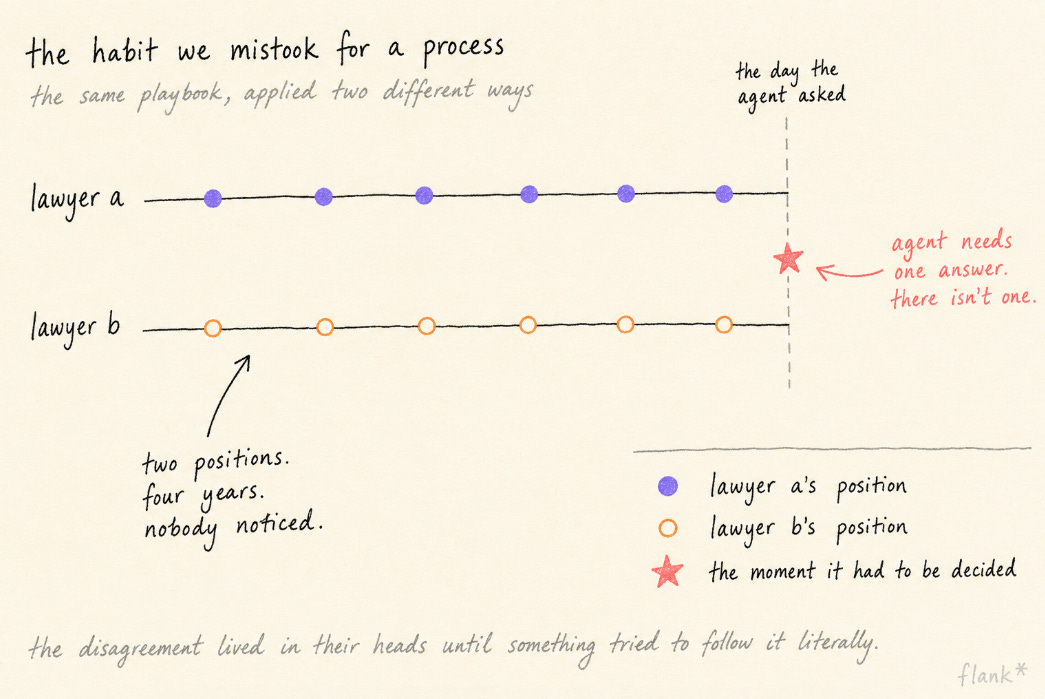
Whilst building a playbook for a recent deployment at a large enterprise, we examined some historical examples, and found that two lawyers had been applying very different positions. Not once. As a standing practice. For years it didn’t matter, because the disagreement lived in their heads and got smoothed over case by case, the way most things in a legal team get smoothed over. The moment you ask an agent to apply that playbook, the smoothing stops. The agent needs to know which position is the position. It turns out nobody had ever decided.
This is the uncomfortable part, and I want to be honest about how it actually feels in the room. An agent can’t resolve an ambiguity it inherits from you. Hand it a process that depends on who you happen to ask, and it will do one of two things. It will pick an answer and look wrong to half the team, or it will flag everything and look slow. Both get read as the tool failing. Most of the time the tool is reflecting. The inconsistency was always there. It was just invisible until something tried to follow it literally, and an agent follows things very literally.
Most of the time the tool is reflecting. The inconsistency was always there.
I’ve come to think the real first deliverable of a deployment isn’t time saved. It’s a slightly awkward conversation about what your positions actually are, often for the first time. That conversation has value whether or not you ever switch the agent on.
Then it catches you
The second thing the mirror does lands differently, and it’s the one I didn’t expect the first time I saw it.
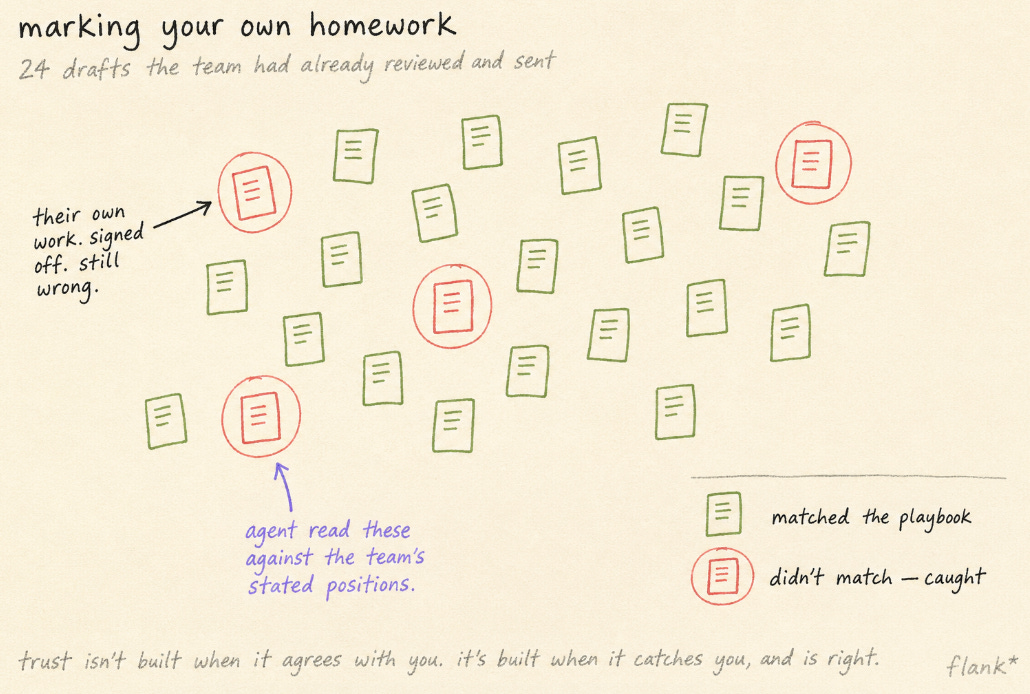
At one team the turning point wasn’t a speed number or a clever demo. It was the moment the agent flagged errors in their own existing drafts. Work their own lawyers had written, reviewed, and sent. In our testing phase, the agent read those documents against the team’s stated positions and found places where the two didn’t match.
Trust in a tool doesn’t get built when it agrees with you. Anyone can agree with you. It gets built when it catches you, on your own paper, and is right.
That was the moment the room changed. Not because the agent was fast, but because it had noticed something careful people had missed. I find this is roughly the opposite of how the value tends to get sold. The standard pitch is that the agent does what your lawyers already do, only quicker. The thing that actually wins people over is subtler: the agent sees what your lawyers, being human and busy and on their fourth review before lunch, sometimes don’t.
Trust in a tool doesn’t get built when it agrees with you. Anyone can agree with you. It gets built when it catches you, on your own paper, and is right.
⚡ Why I think the mirror matters more than the minutes
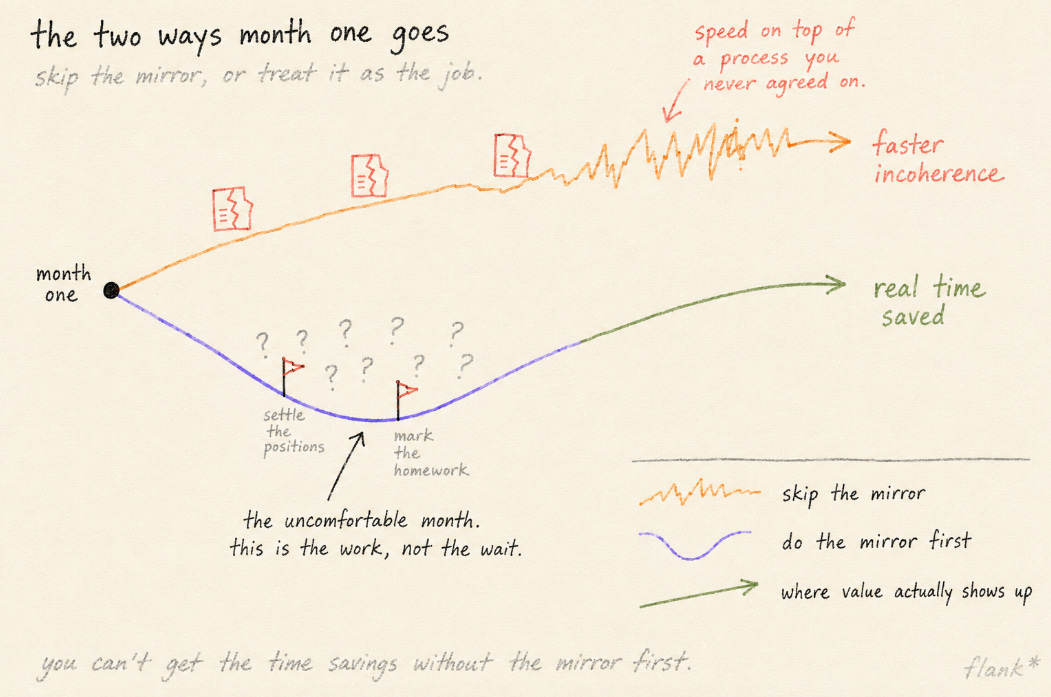
Put those two together and you get a different way of thinking about what an agent is for in its first month. Before it can change how much work your team gets through, it tells you two things you probably couldn’t see from the inside. Where your process only looked like a process. And where your output only looked finished. Both sting a little, which I suspect is exactly why teams hurry past them toward the time-savings conversation they came for. But I don’t think you can get the time savings without the mirror first. An agent pointed at a process you never genuinely agreed on will produce inconsistent work, because it’s faithfully reproducing an inconsistency you gave it. Speed on top of incoherence is just faster incoherence. The teams I’ve seen get real value are the ones that treat the uncomfortable month as the work rather than the wait. They use the agent’s questions to finally settle positions that had been drifting for years, and they let it mark their own homework instead of getting defensive about what it finds.
The tension
I want to be careful not to oversell this, because there are two things I haven’t fully resolved.
The first is that not every team actually wants a mirror. Some would genuinely rather have a faster version of the status quo, inconsistencies and all, and for low-stakes, low-volume work I’m not sure they’re wrong. The mirror is most valuable to teams whose whole problem is that they’ve outgrown the case-by-case smoothing, and that isn’t everyone.
The second is harder. Sometimes the “inconsistency” the agent surfaces isn’t sloppiness at all. It’s real commercial judgment that experienced lawyers apply on purpose and have simply never written down. Telling those two apart, a position you never settled versus a judgment you never codified, is its own piece of work, and I haven’t found a shortcut for it. Get it wrong and you can flatten exactly the expertise you were trying to protect.
But if I were choosing one of these tools, I’d spend less time on how fast the demo runs and more on what it’s willing to tell me about myself. The agent that only ever agrees with you is the less useful one. The one worth having is the one that holds up a mirror, and is right about what it shows.
✳️