There's a moment in almost every demo where the conversation shifts.
The questions stop being about the technology and start being about the team.
This is about the human variable that decides whether those investments deliver.
The common story about legal AI adoption goes something like this: find the right use case, run a pilot, prove ROI, scale. It’s a clean sequence. It fits in a board presentation - but it skips the part that determines whether any of it works.
I spend most of my time talking to legal teams about AI agents, and I’ve come to believe that change management is the single most underestimated variable in whether a deployment succeeds.
The question nobody prepares for
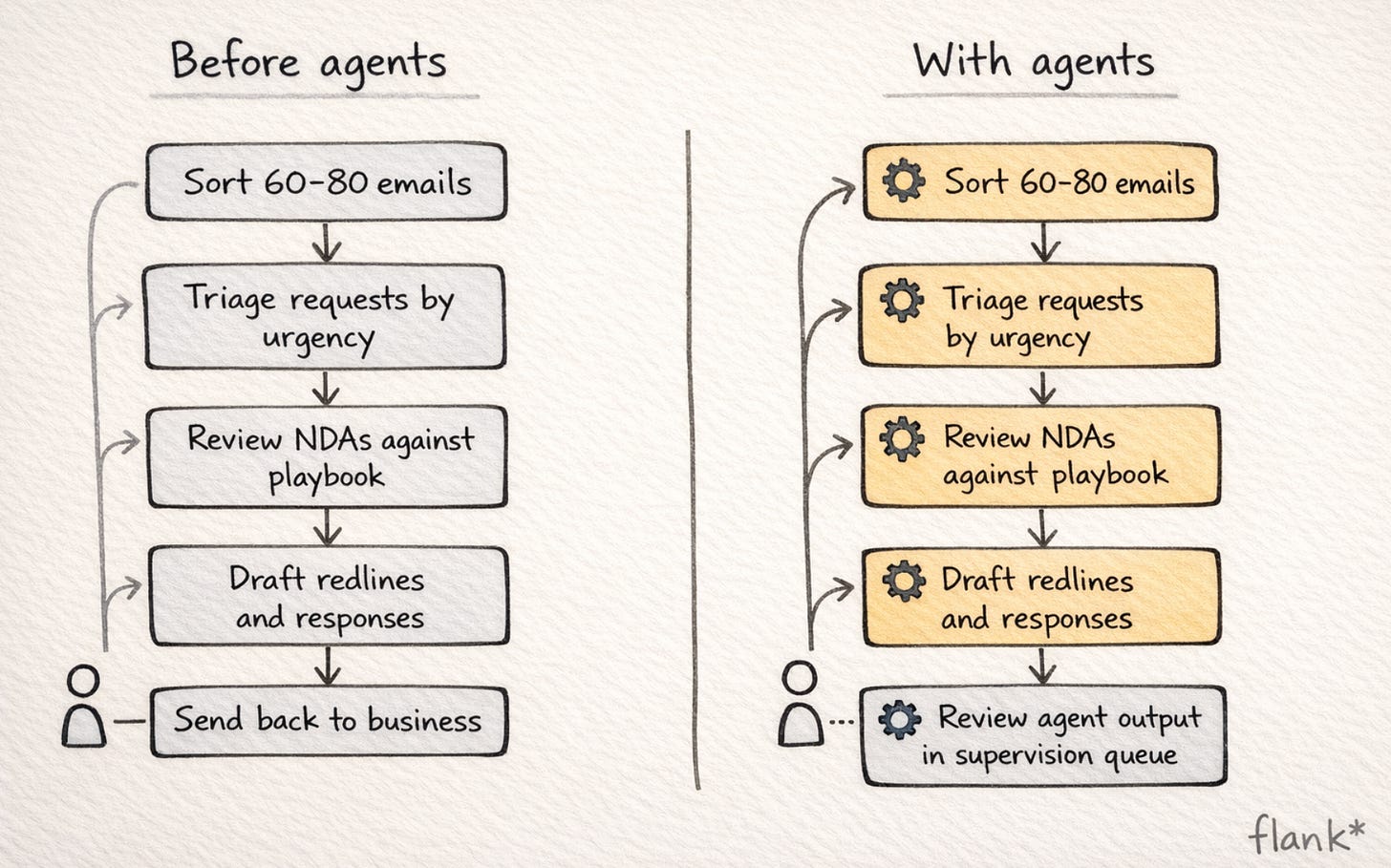
There’s a moment I encounter a lot in conversations. A GC or legal ops leader is describing their problem in the terms you’d expect: the NDA backlog, triage eating their mornings, the business treating legal as a bottleneck. Then I show them a live workflow. An email arrives at a shared inbox. The agent picks it up, categorises it, drafts a response using the team’s own playbook, sends it back. The lawyer never touches it.
The reaction is almost never about the technology. It’s a version of: “so what does my team do now?”
That question sounds like it’s about headcount. It’s actually about identity. A lawyer who has spent fifteen years reviewing certain contracts has built something real around being the person who does that. You can’t just tell them a machine handles it now and expect enthusiasm, even when the benefits are obvious. I think we massively underestimate the emotional weight of this in how we talk about adoption.
“So what does my team do now?” That question sounds like it’s about headcount. It’s actually about identity.
The half-truth worth examining
There’s a version of the AI deployment pitch that says “zero change management required.” For business users, it’s actually true. They send an email to a mailbox, they get a response. No portal, no form, no new interface. A consulting firm that advises enterprise legal teams confirmed this to us recently: business users have stopped wanting to go somewhere to get work done. They expect answers where they already are.
But the legal team’s world changes completely. They move from doing work to supervising how work gets done. From reviewing individual contracts to monitoring patterns across hundreds of agent decisions. That’s not a configuration change. It’s a role transformation.
I think of it like a factory floor supervisor who used to operate the machines being told they now design the programmes the machines run. Same factory, same output, completely different job. And if you treat that transition as a training session and a login, you’ll lose people.
They move from doing work to supervising how work gets done. That’s not a configuration change. It’s a role transformation.
Some patterns I’ve noticed
I don’t have a tidy framework for the human side of this. The reality resists one. But I’ve started noticing what separates deployments that stick from ones that stall.
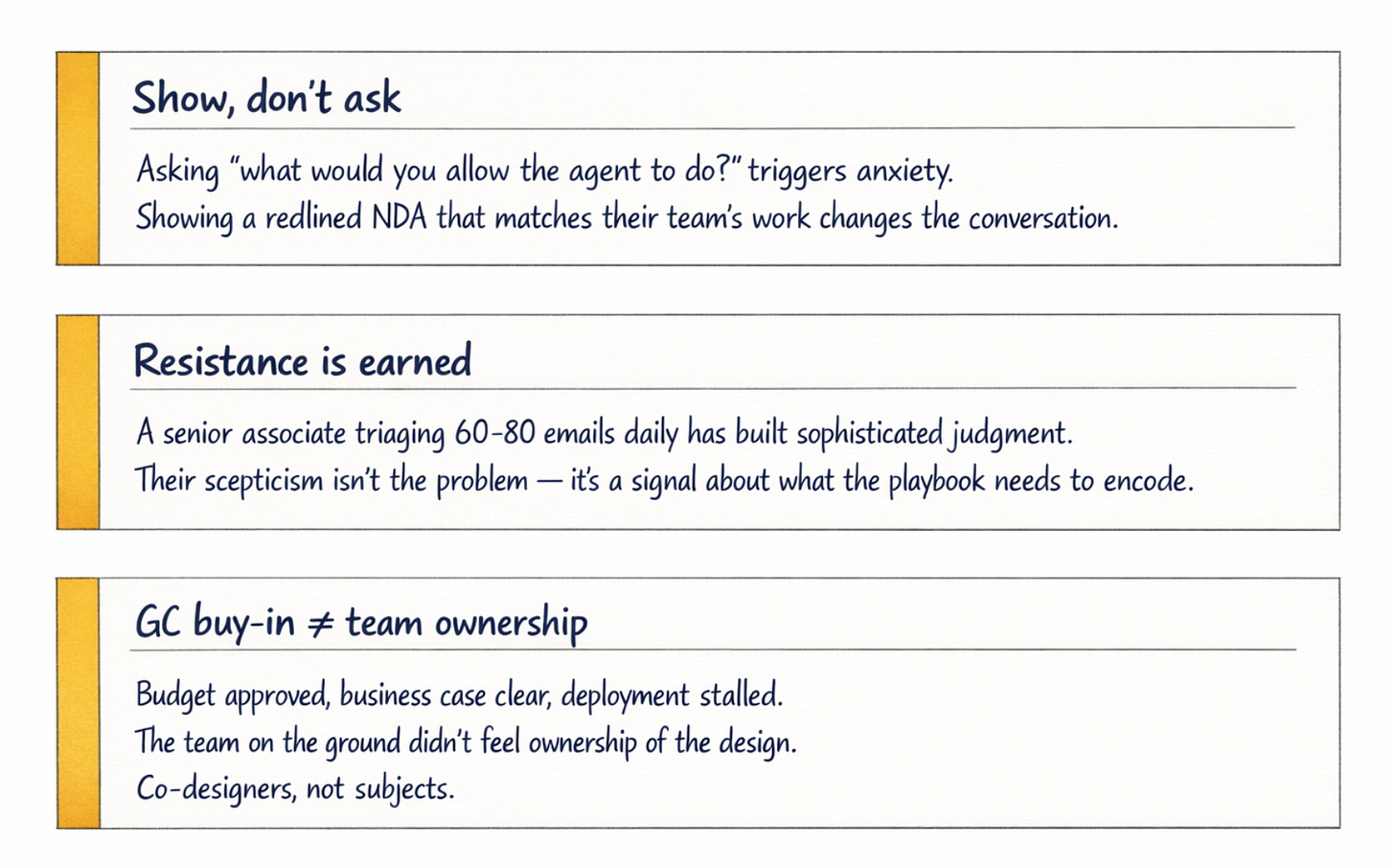
Showing beats asking, every time. We learned internally that the framing “what would you allow the agent to do?” is significantly less effective than just showing someone their existing workload being handled. The first version asks people to imagine delegation, which triggers every anxiety about control and professional relevance at once. The second shows them evidence and lets them react to a concrete result. A lawyer who sees a redlined NDA that looks like their team’s work has a very different response from a lawyer asked to theoretically trust an AI.
A lawyer who sees a redlined NDA that looks like their team's work has a very different response from a lawyer asked to theoretically trust an AI.
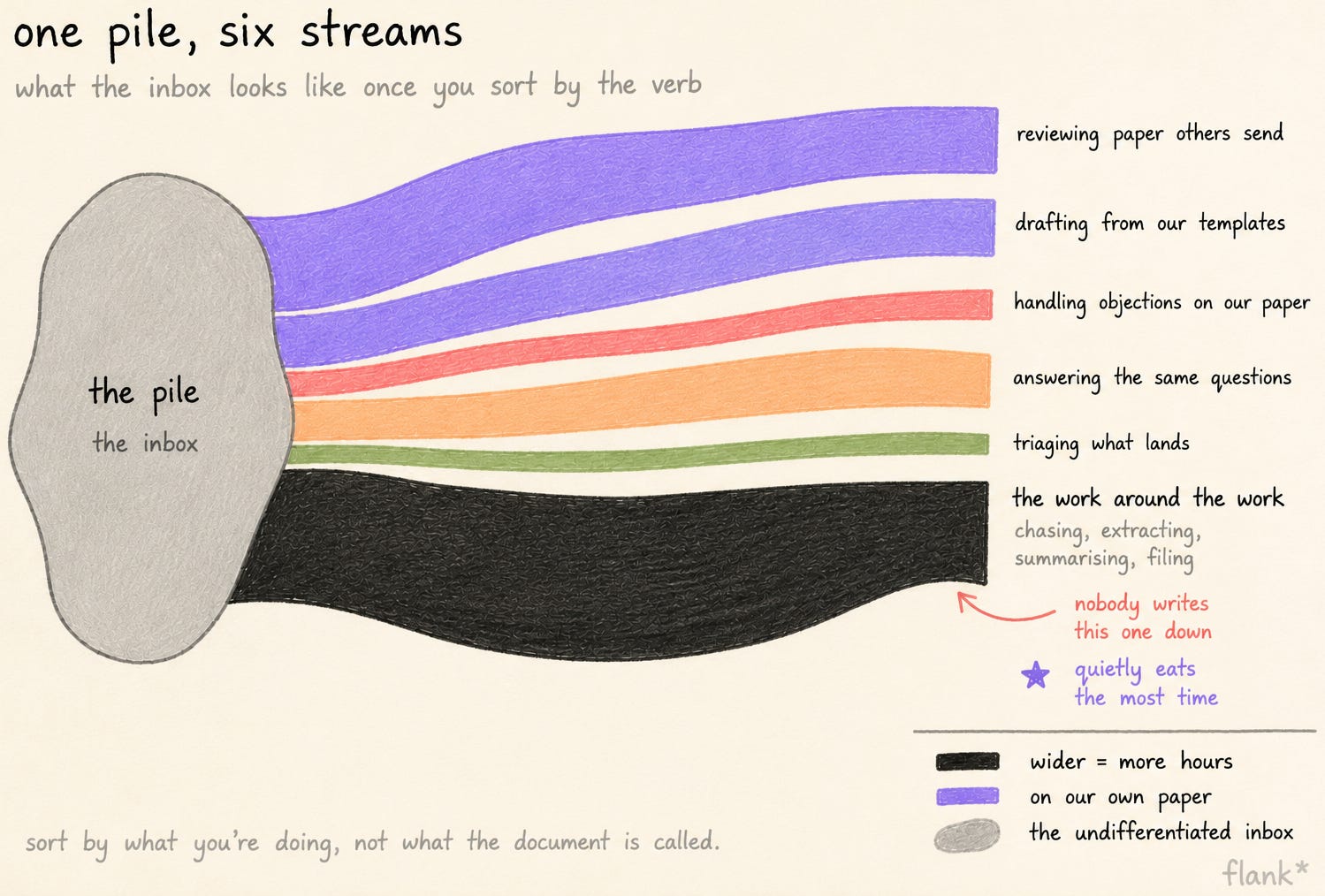
The people closest to the work resist hardest, and they’re right to. A senior associate triaging sixty to eighty emails a day, spending thirty to forty-five minutes each morning just sorting what needs attention, has built a set of judgment calls that are genuinely sophisticated. They know which business units cry wolf. They know which counterparty templates hide unusual clauses. When you tell them an agent can do this, their scepticism is earned. The work is showing them how their tacit knowledge becomes the playbook the agent follows, so the agent’s judgment is actually their judgment, encoded and running at scale.
GC buy-in is necessary but nowhere near sufficient. I’ve watched deployments stall where the GC was fully committed, the budget approved, the business case clear, because the team on the ground didn’t feel ownership. A GC who announces “we’re deploying AI agents” without bringing the team into the design is making the same mistake as any leader who mandates change from the top without building understanding where the work happens. The deployments that stick are the ones where the legal team builds the playbook, reviews the first wave of agent outputs, shapes the supervision workflow. They become co-designers, not subjects.
The conversation that keeps getting deferred
Harvard Law’s Forum on Corporate Governance argued recently that the era of AI pilots is over, that firms embracing agentic transformation will compete on outcomes.
I agree with the direction. But I think both framings skip a step.
Before you can prove value, you need to decide what your operating model looks like on the other side. Most legal teams are not having that conversation, or not having it early enough.
The operating model question sounds abstract until you make it concrete. Who reviews agent output, and how often? What happens when the agent flags something it can’t handle? What does a lawyer’s Tuesday look like in month three versus month one? What does the team stop doing? These questions are uncomfortable because they’re really about roles and responsibilities, which is the part of change management nobody enjoys.
Before you can prove value, you need to decide what your operating model looks like on the other side.
Each of those transitions needs someone to guide it. In most organisations, nobody has been assigned that role.

What I think I’m actually doing
I’ve started describing my job, at least to myself, less as “deploying legal AI” and more as “helping legal teams see a version of their future they’re willing to walk toward.” In practice, that means spending the first thirty minutes of a conversation not talking about the product at all.
I ask about their team. What does a typical week look like? Where do they feel the weight? What have they tried before, and what happened? When the CFO asks what legal has delivered this year, what do they say? The answers tell me more about whether a deployment will succeed than any technical requirements document. The technical requirements are solvable. Organisational readiness is the constraint.
I don’t always get the balance right. There’s a tension between helping someone see the larger transformation and making the first step feel manageable. A GC who hears “you need to redesign your operating model” might decide the change is too big. A GC who hears “start with NDA triage, measure the result, expand from there” might move forward but never reach the operating model conversation at all. I find myself moving between these two constantly, and I’m still not sure I’ve found the right cadence.
The market has shifted noticeably. The disbelief phase is over. But what comes next is harder. The technology question has been largely answered. The human question, how to guide a team through a transition they didn’t ask for in a way that preserves their expertise while changing what they do with it, is where I spend most of my time now.
I don’t think we talk about this enough. Conferences are full of panels on capability and compliance. Vendors demo what the technology can do. Very few people are talking about what it feels like to be the lawyer whose daily work is about to be restructured around a system they didn’t build, and what the people guiding that transition owe them in terms of honesty, patience, and genuine involvement in the design.
That’s the work I think matters most. It doesn’t fit on a slide.