Legal is the function every deal, every hire, every supplier waits on. I’ve spent eight years working alongside these teams. Almost everyone inside them knows it.
The strange part: because no one has ever removed the constraint, no one has ever priced what removing it would be worth. This is the argument for treating that queue as a design flaw, not a fact of nature.
Everyone waits on legal, and no one has priced what that costs
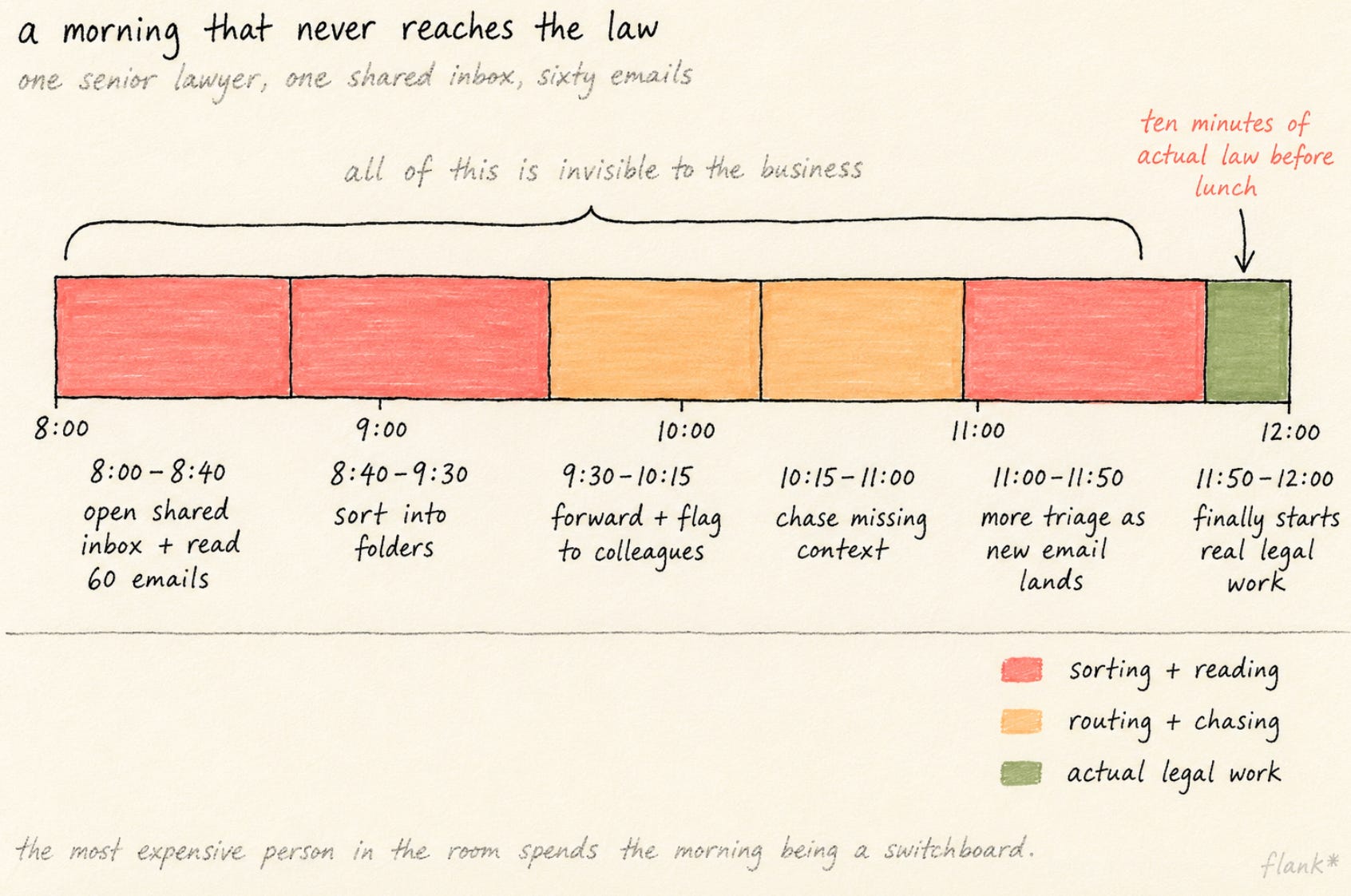
Legal is an operational bottleneck. Every deal, every hire, every supplier waits on it. That is a brutal thing to write about a function I have spent eight years working alongside, but it is true, and almost everyone inside these teams knows it is true. What is stranger is this: because no one has ever removed the constraint, no one has ever priced the upside of removing it. The gain does not appear in any business case, because there has never been a version of the company without the queue.
In April I published eight principles for how an enterprise legal function should be designed when execution is no longer constrained by headcount, and promised the full methodology would follow. It is now live at insights.flank.ai/method. This piece is the argument underneath it, and an honest account of the parts we argued about most on the way to publishing.
The tell
Start with how the queue shows up in the numbers. Gartner finds only one in five legal matters stays within budget. That gets read as a budgeting problem, and it is a structural one: the overflow model sends routine work to outside counsel at premium rates because there has been nowhere else to send it, so the overrun is priced in before the matter opens.
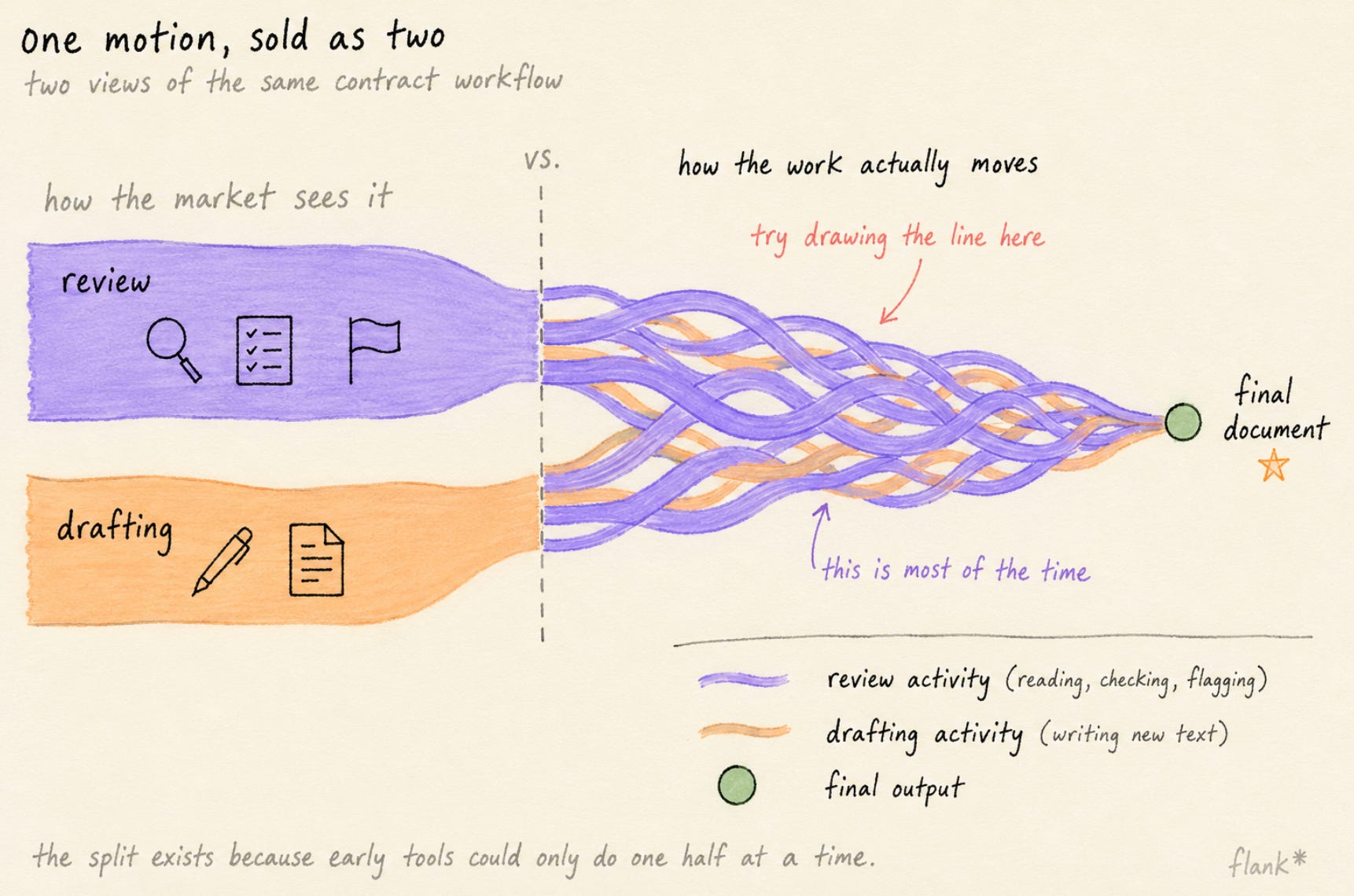
The tools have not touched this, because they solve a different problem. They are good, and lawyers genuinely like using them. But a copilot makes an expensive person slightly faster at inexpensive work.
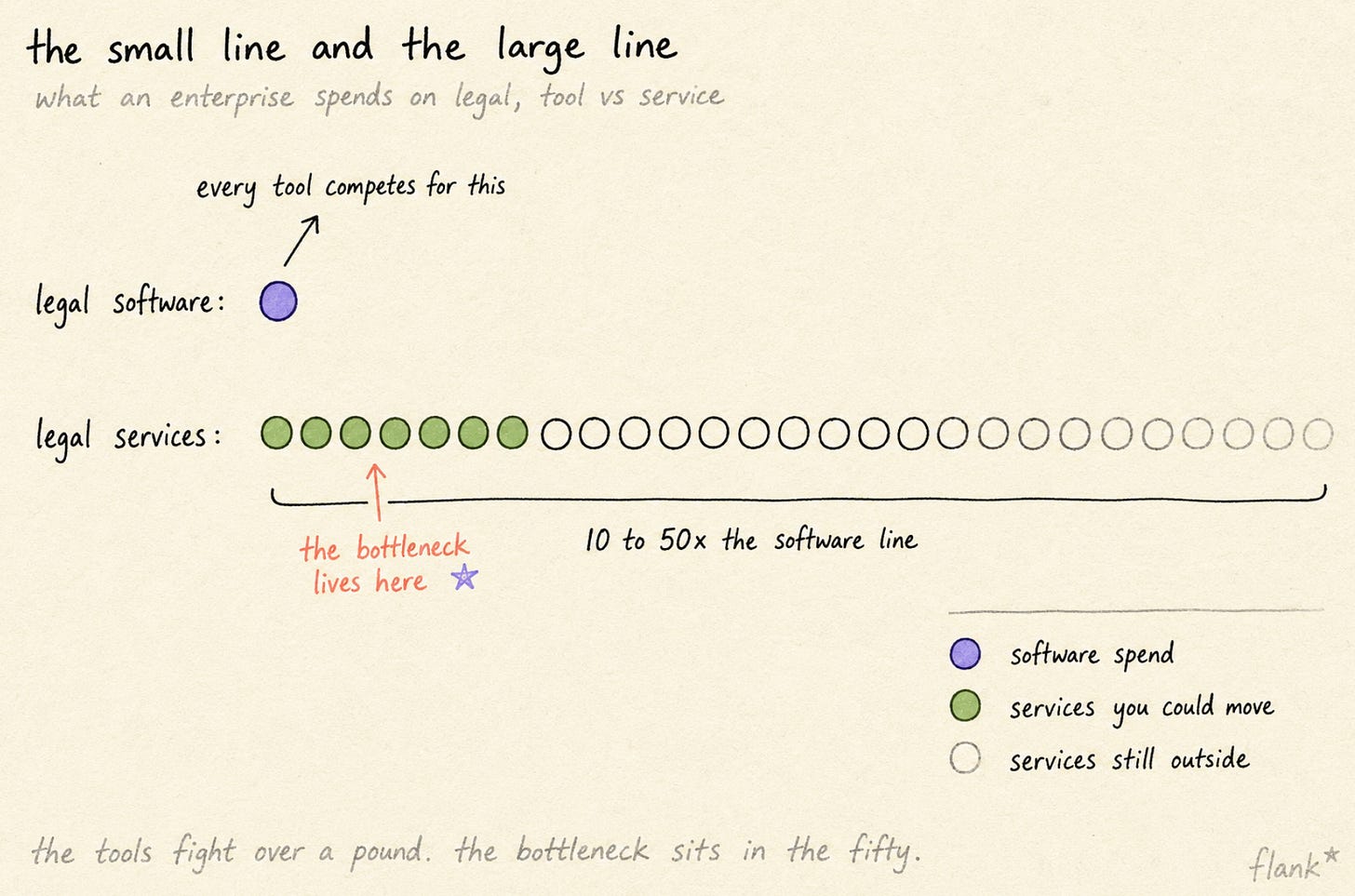
A faster lawyer does not remove a bottleneck. The contract still passes through the same desk, joins the same queue, waits for the same person to come back from the same board meeting. The bottleneck simply gets a better interface. Moving the work is what removes it, and moving the work is a services question, which is why the budget picture matters. For every pound an enterprise spends on legal software, ten to fifty go on legal services: outside counsel, ALSPs, offshore delivery centres, contract reviewer pools, and the team’s own salary cost on routine work. The tools compete for the small line. The bottleneck lives in the large one.
A general counsel put it to us better than any positioning document could, explaining why they stopped shopping for a tool: “I don’t want my team looking at DPAs and NDAs anymore. I want it done. And I still want control.”
The analysts have started saying the same thing. Gartner now expects that by 2029 roughly half of contract reviews will be delegated to self-service systems that escalate only one in ten to a human, with legal tech budgets doubling to fund the shift. The forecast is not about faster lawyers. It describes the work moving.
A faster lawyer does not remove a bottleneck. The bottleneck simply gets a better interface.
The method in four lines
The Flank Method is long, deliberately, because it is a how-to guide as much as a point of view. But it reduces to four commitments, and if you read nothing else, read these.
First, legal is a bottleneck because the wrong people are doing the work. Expensive, judgment-trained professionals spend most of their capacity on routine, rules-based tasks. Remove that mismatch and the gain is structural rather than marginal, which is exactly why it has never been priced.
Second, the fix is less work reaching the lawyer, rather than a faster lawyer. Routine work routes to a supervised agentic system, so most of it never arrives on a legal desk at all. The staffing model changes. The backlog changes. The headcount does not have to.
Third, stay involved exactly enough to own the output. Human involvement exists to put responsibility somewhere a board, a regulator or a counterparty can find it. Sometimes that means checking every result. More often it means writing the playbook and auditing a sample.
Legal is a bottleneck because the wrong people are doing the work.
Fourth, what remains is the work that always needed a lawyer. Contested terms, house positions, litigation, the deals that decide the company’s future. The lawyer moves above the process instead of sitting inside it.
The line that took longest to draw
The third commitment took us the longest to get right, and I think it is the most useful idea in the document.
Every conversation about agentic systems in legal eventually arrives at the same anxiety: who stands behind the output? The anxiety is earned. Icertis surveyed over a thousand US in-house practitioners this spring and found 47% would not detect an unauthorised or incorrect AI action until after it had occurred, sometimes weeks later. The lazy answers sit at the extremes. Review everything, which recreates the bottleneck one layer up. Or trust the system, which no serious legal team will do and no serious vendor should ask them to. The useful answer is that the right amount of human involvement is whatever lets a named person stand behind the result, and no more. For high-stakes work that might be every output. For a standard NDA run against a well-worn playbook, it is the playbook itself plus a sampled audit. Supervision falls where the risk is, and it has to scale faster than the volume does.
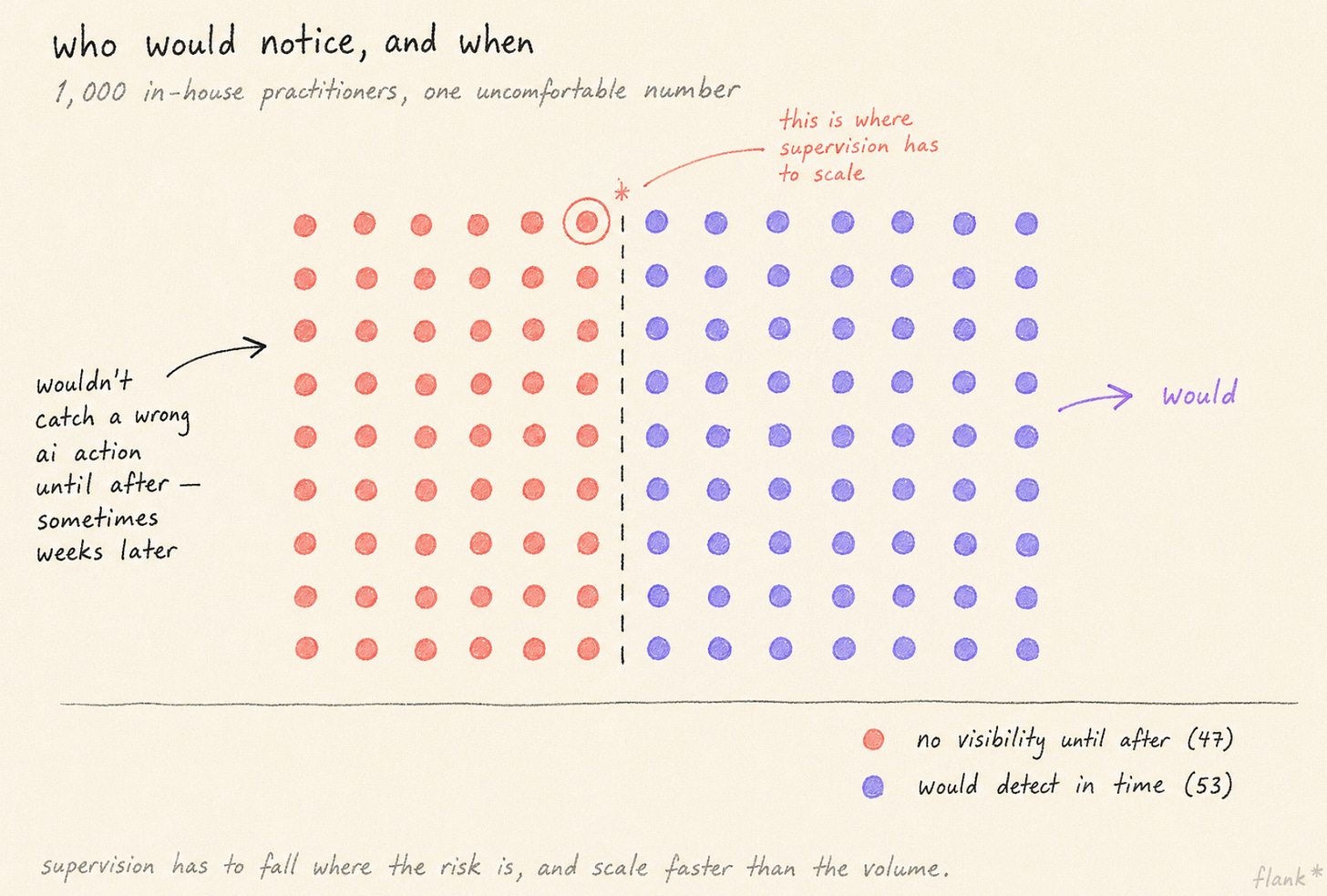
Once you frame it that way, something clicks that I had not seen written down anywhere. Where that responsibility sits is what the words insource and outsource actually mean now. If your own team supervises the system and owns its output, the work is insourced. If a provider or a partner firm holds the standard on your behalf, it is outsourced. Same system, same agents, same playbooks. The only thing that moves is the locus of supervision. That reframe matters because it dissolves a false choice. Teams assume that getting routine work off their desks means sending it outside the building, with everything that has always cost them: the context lost in the handoff, the playbooks accruing to the provider, the institutional knowledge walking out the door. It no longer has to. The economics can match outsourcing while the judgment, encoded and owned, stays yours.
And around that supervision a new discipline is forming. Someone has to watch the overrides, notice the drift, keep the playbook honest. I find the most interesting open question is who does it, because I am not convinced it has to be lawyers.
The right amount of human involvement is whatever lets a named person stand behind the result, and no more.
What we have not solved
A method worth following should say what it has not worked out, so the published version ends with a section we nearly cut and I am glad we kept.
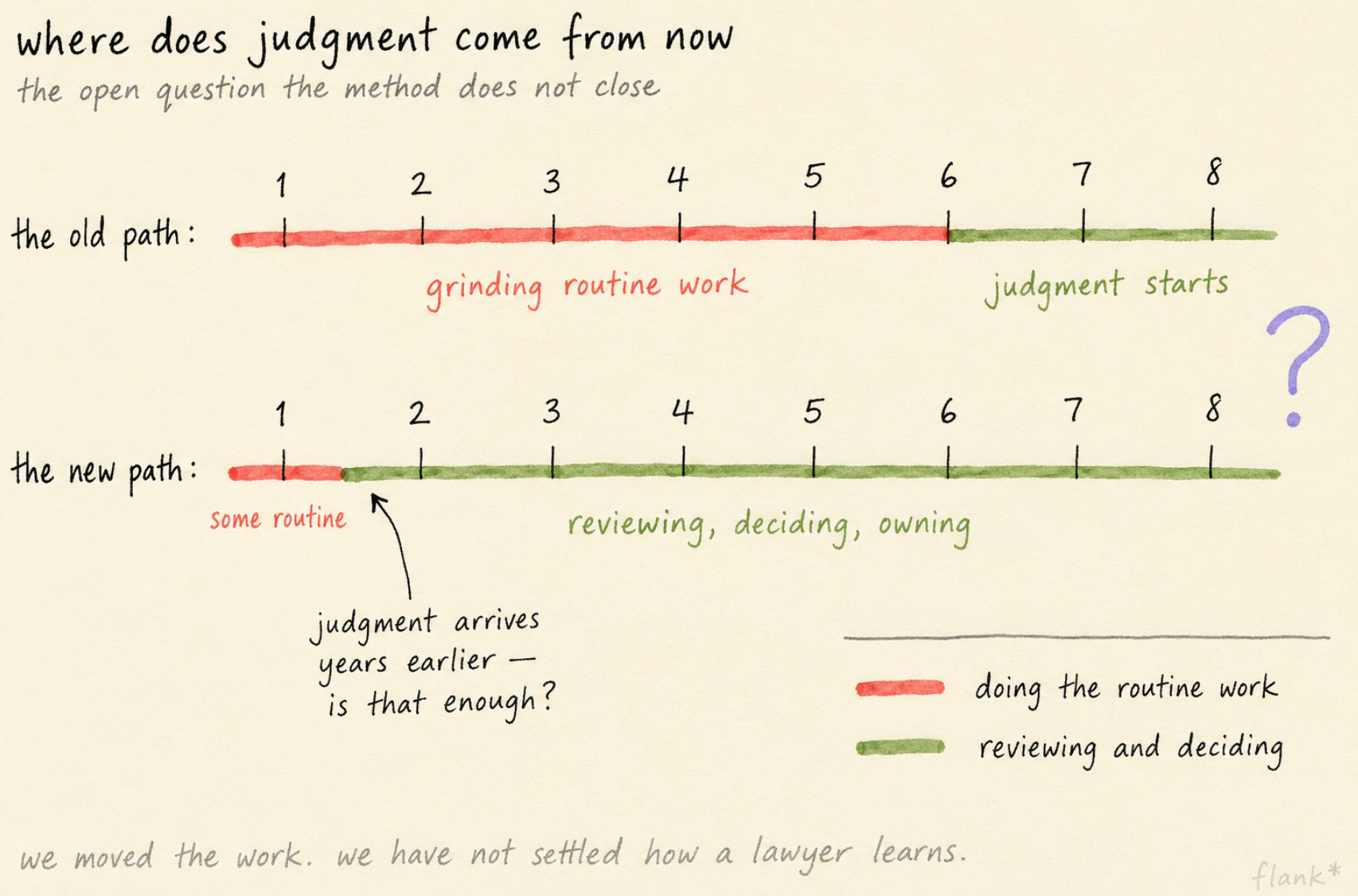
Junior development is the open problem I take most seriously. If associates do not grind through the routine work, where does judgment come from? Our current guess is that development shifts from doing the work to reviewing it, much earlier in a career than the profession is used to. I do not consider that settled, and I am suspicious of anyone who claims it is. The same goes for the optimal shape of a legal team once throughput is no longer tied to headcount, and for where the supervision standard lands as regulators catch up with all of this.
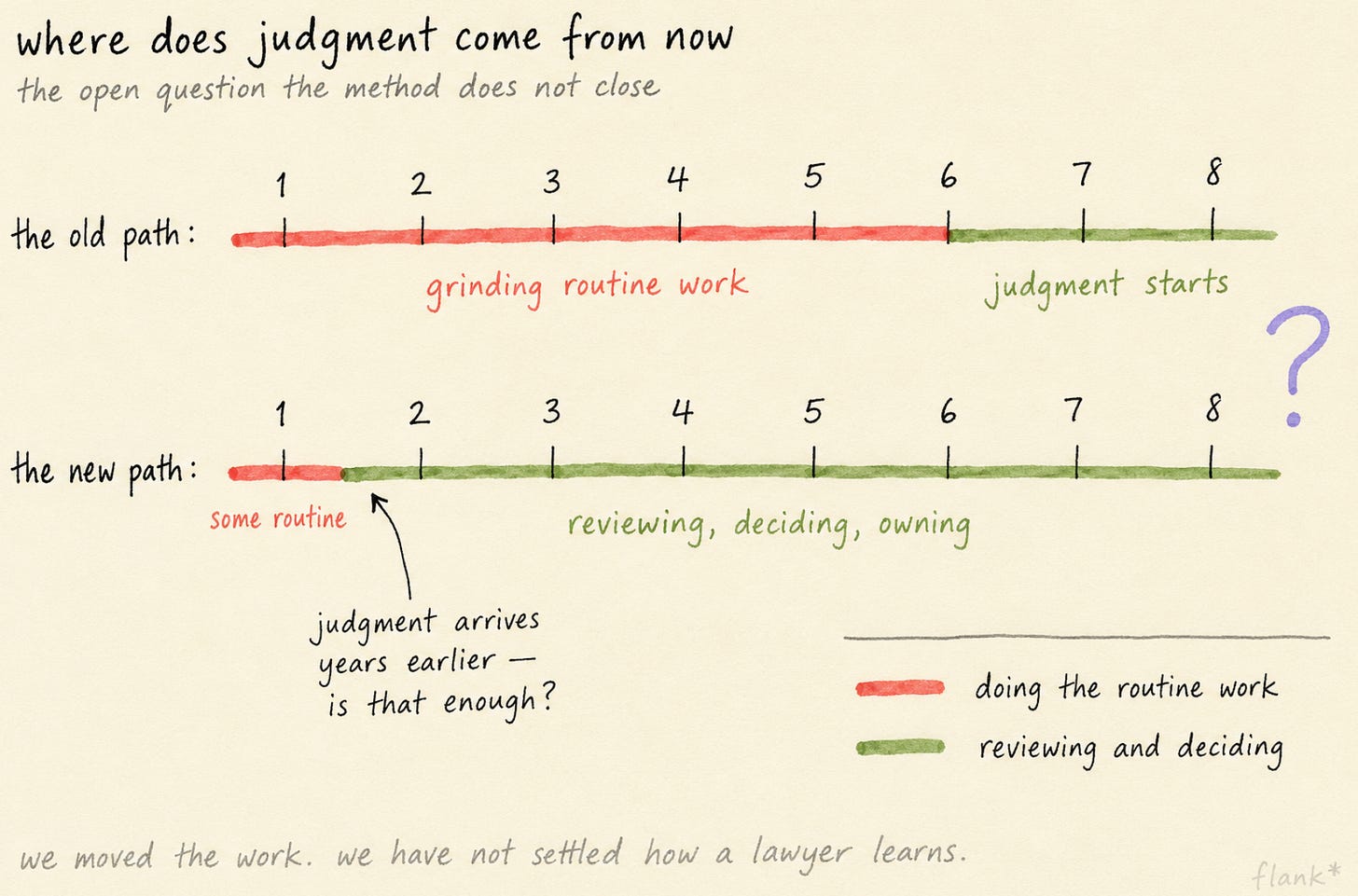
These are live arguments, and the document says so. Where the Method does not match your experience, we would rather hear it than smooth over it.
Where this leaves you
The end state the Method describes is not a smaller legal department. A request arrives and is handled the moment it lands, drafted to the team’s own standard, with the few genuine exceptions flagged for a lawyer to decide in minutes. Lawyers spend their time on the work that was always worth it. Capacity stops scaling with headcount, and cost stops scaling with volume.
None of that requires a reorg, because the budget for routine work already exists, wherever it currently sits. It requires deciding that the queue is a design flaw rather than a fact of nature.
The full guide, including the practical chapters on intake, supervision, observability and adoption, is at insights.flank.ai/method. It is a working document and it will change as the practice does. Tell us where it is wrong.