I'm a lawyer who played around with ChatGPT when it was released back in 2022, saw where things were heading, and moved into legal AI.
I’m a commercial/technology lawyer who played around with ChatGPT in 2022 and saw where the industry was going, so I started working in legal AI. I’d rather flag the bias than pretend I don’t have one. What I actually want to talk about is a line from Marcus Aurelius, and why it comes back to me every time I sit across from a legal team (sounds funny, but I promise I managed to make a link between a Roman emperor and agentic AI).
“Do not disturb yourself by imagining your whole life at once.” -
Marcus Aurelius
I read Meditations when I was nineteen. Most of it washed over me, the way philosophy tends to at that age. But I came across one line again recently and it stayed on my mind: do not disturb yourself by imagining your whole life at once. This time, instead of thinking about whether I was going to keep chasing a professional contract in football or a training contract in law, the quote connected differently. I realised I’d been hearing that exact anxiety in the room with senior lawyers the whole time, just dressed slightly different.

A different worry every night
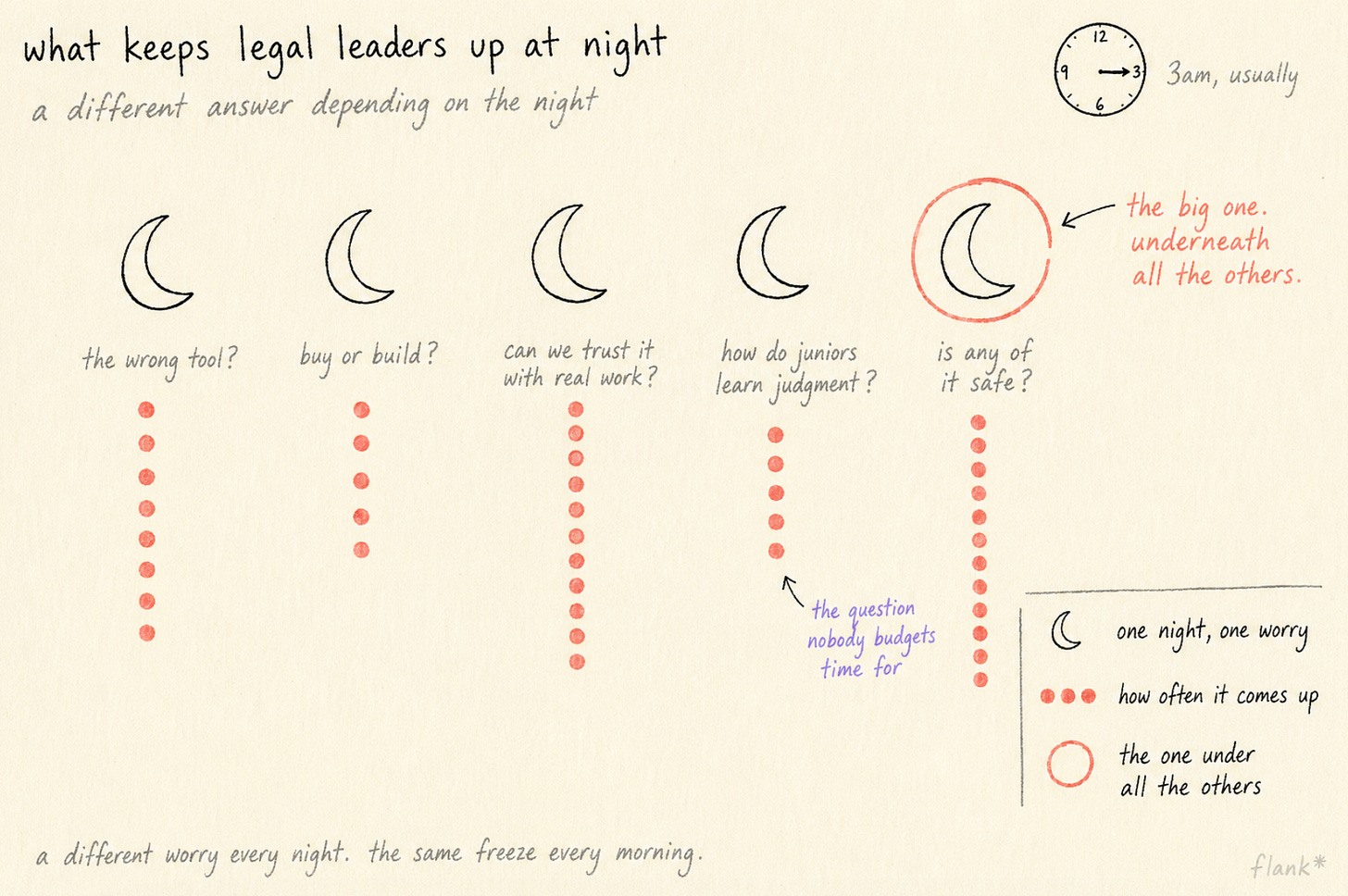
Ask a senior legal leader what keeps them up at night about AI and you’ll get a different answer depending on the night.
One night it’s whether they’re about to pick the wrong tool, or whether they should be buying at all, or building something in-house. Another night it’s whether an agentic system can be trusted with anything that actually matters. Another it’s the juniors: if AI absorbs the grunt work, how does anyone build judgment the way they did? And underneath all of it, the big one. Is it safe to hand real work to a ‘machine’?
These are not silly worries. They are warranted. Lawyers are the most careful people in any organisation about what they attach their name to. Even saying you opened a document means you’ll answer for it, never mind how many others opened it too, because as the lawyer, you are the one who’s meant to know better. That instinct is the job. So of course the thought of handing important work to an agent trips every alarm you own. I get it.
Foresight is the discipline. And the trap.
And yet the same people are often the most eager in the building to understand this stuff, because they can feel there’s real power in it. The problem isn’t reluctance. It’s that they’re trying to see the whole thing at once, every risk, every consequence, every endgame, before taking a single step. Which is exactly what lawyers are trained to do. Foreseeing the entire chain of consequences is the discipline. It’s also a terrible way to begin (sorry to be the bearer of not-so-good news).
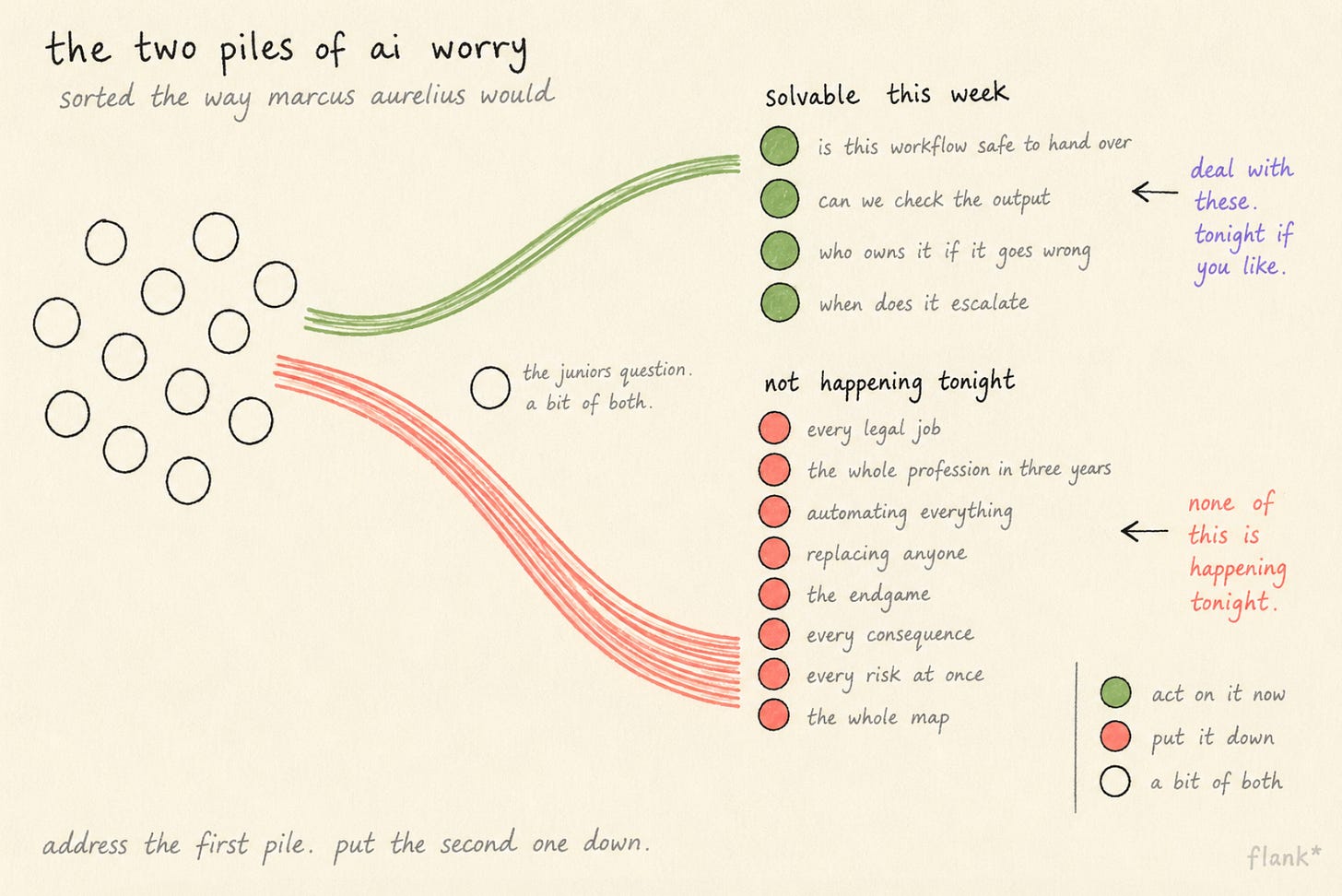
Which is where the emperor comes back, and yes, I’m aware how it sounds to quote Marcus Aurelius unprompted. What will I suggest next, a cold plunge? But his point is useful here. He isn’t saying ignore what’s in front of you. Some of those worries are real and you should deal with them: is this workflow safe to hand over, can we check the output, who owns it if it goes wrong. Address those. What he’s warning against is the other pile, the one that keeps you up at night for no reason: whether AI takes every job, whether you’ll have automated everything, whether the whole profession is unrecognisable in three years. You don’t have to solve any of that tonight, because none of it is happening tonight. You’re not automating everything today, and you’re not replacing anyone by end of week. The whole life is unknowable, and you can’t act on it anyway. What you can act on is the one step that’s actually ready.
Start with the inbox, not the roadmap
Here’s what that looks like in practice.
At Flank, before we do anything, we usually start with a workshop: a day or two sitting with an enterprise legal team, getting deep into how the work actually flows, and asking a question that sounds odd coming from a legal tech company. What here is even worth automating with an AI agent? Because not all of it is, at least not yet. That’s rather the point. We’re not trying to imagine the whole life at once.
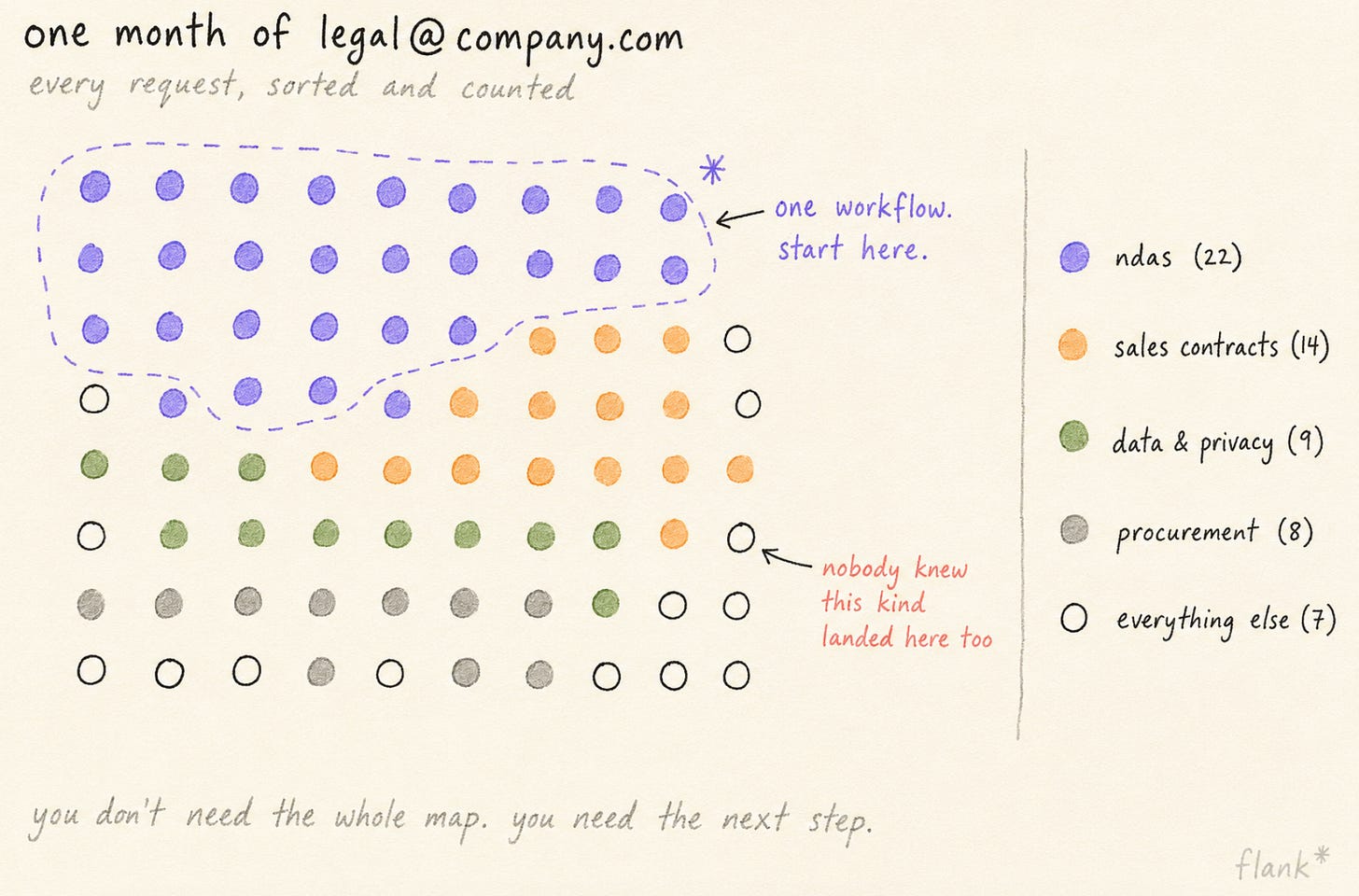
Often the honest answer to “what would we even hand to an agent?” is hidden, sitting in the team’s inbox, or wherever requests land. So the first thing we deploy isn’t always an agent from the get-go. It’s a Legal Front Door that sits on top of your legal inbox (e.g. legal@company.com) and perhaps the CLM (if applicable). At this stage nothing is necessarily automated. No contracts reviewed, drafted, or triaged.
The first thing we deploy isn’t an agent. It’s a clear view of your own demand.
Every request that lands in your inbox, sorted and counted: what’s coming in, how often, from which teams, from which regions, all read straight off the requests in natural language. For a lot of teams it’s the first time they’ve seen their own workload laid out in front of them. Only then do you pick one workflow. One. You build the playbooks, set up the agent, and dial it in until it reviews the way you review, escalates when you’d escalate, and leaves inline comments on every redline, the way you would (yes, redlining etiquette survives into the age of AI ;)). That’s one step. When it holds, you take the next.
You’re not automating everything today, and you’re not replacing anyone by end of week.
One workflow, then the next
None of this is really about legal, by the way. Agents are now good enough to take on specific, well-chosen workflows in any team, in any organisation. The mistake is the same everywhere: picturing a hundred of them at once and freezing. Pick the one that moves the needle now. Ship it. Then go after the next.
And here’s what you get, which is bigger than efficiency. A workflow is just a task a person used to do by hand. Take one high-volume, low-complexity task off a lawyer’s plate and you hand back the hours for the work that actually needs a human. The juniors everyone worries about build judgment faster this way, too: less time grinding volume, more time on the calls that actually teach it. Do that across a team and you don’t end up with a smaller team.
You end up with a sharper, more fulfilled one, spending its hours on the work that made them lawyers in the first place.
The next step is enough
So no, you don’t need the whole map. You need the next step. Aurelius worked that out alone, at night, two thousand years ago, and I’ve carried his line around since I was nineteen without knowing it would turn out to be advice about AI. I didn’t see that coming either.
Don’t disturb yourself imagining the whole life of it. Find the one thing in front of you that’s ready, and start there.
I’m a lawyer who saw where the industry was going in 2023 and moved into legal AI. At Flank I’ve worked in legal AI alignment, sitting alongside enterprise legal teams to tune agents until they review, escalate and redline the way the team’s own lawyers do.