Jake here, Co-founder and COO at Flank.
Most CLMs are not reliable. I’ve had that conversation more times than I expected to. The following conversation went further than others, and it changed what we decided to build.
📄 The legal ops leader who would rather use a folder
Just a few months ago I realised no one trusted their CLM.
We were onsite at a new client, working on mapping the contracting process for one of their lower risk contracts. The end goal, to implement an agent to run that process. Fun, “bleeding edge” stuff, right? But the regional head of legal ops kept interrupting the workshop to complain about how other regions ran their version of the process.
And you should see our CLM, she said. Only a fraction of our contracts even land there… I’m thinking of packing it in and moving everything to SharePoint.
Whatever I was drawing on the whiteboard in that moment, I stopped.
Trust was lacking because keeping the record honest is work. Expensive, human labour.
To SharePoint?, I asked, trying not to sound judgemental or aggrieved. But seriously, transitioning from a purpose built tool to a folder?
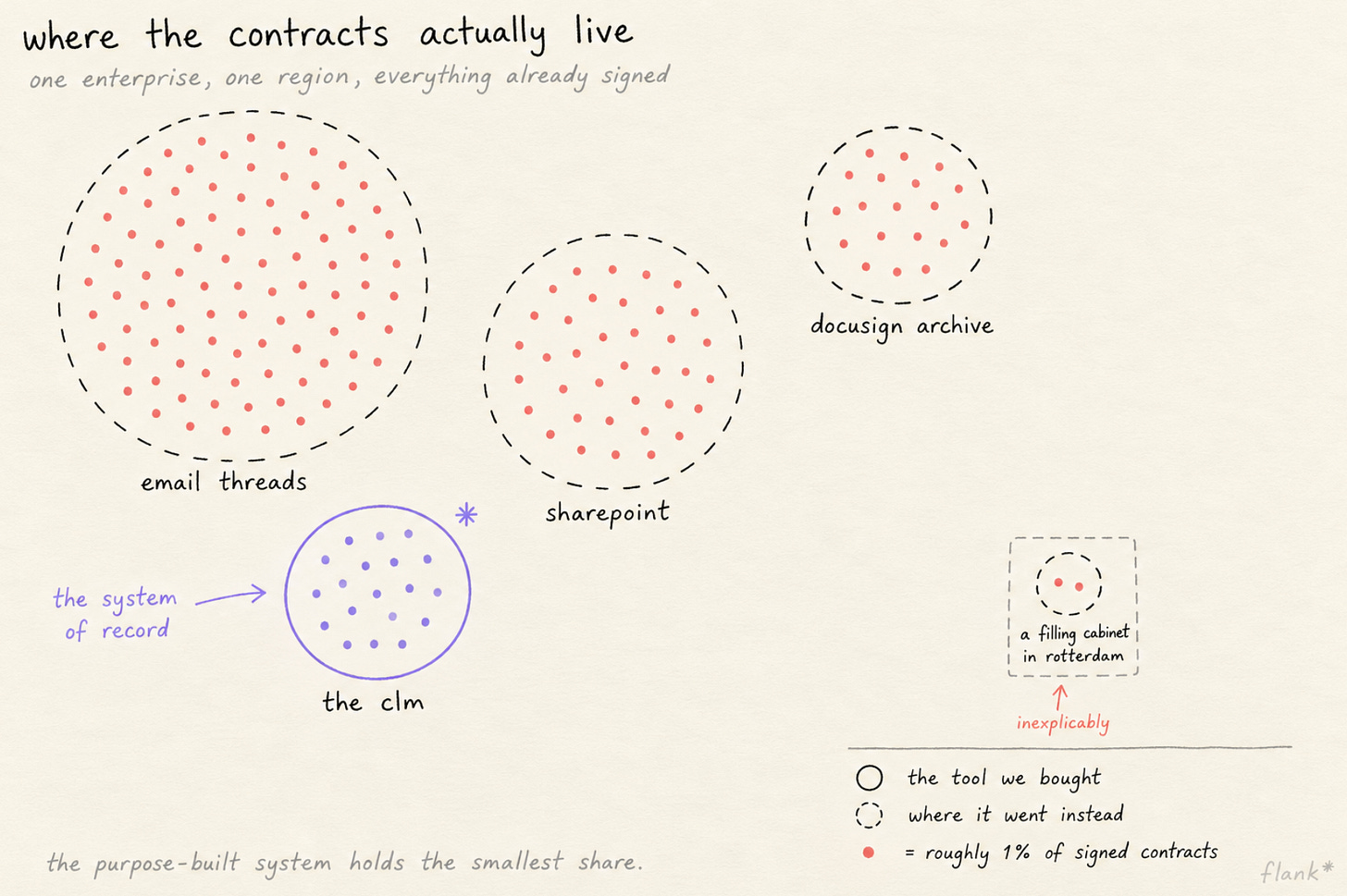
So she explained, and her reasoning was sound. The CLM was a legacy implementation only a handful of people knew how to use. And a decent share of the company’s contract never landed in it anyway. Each region had their own flow. Signed contracts lived across email, Agiloft, SharePoint, DocuSign, and—inexplicably—a filing cabinet in the Rotterdam office.
🔍 It turns out this is the norm
Later that night, back at my hotel, after a few drinks, I emailed another client who we’ve been working with for a couple of years.
T— A client today told me their [sic] CLM is functionally useless. No one using it. An entire team required to maintain/adminstrate. Legit?
I received a response a few moments later.
Yes.
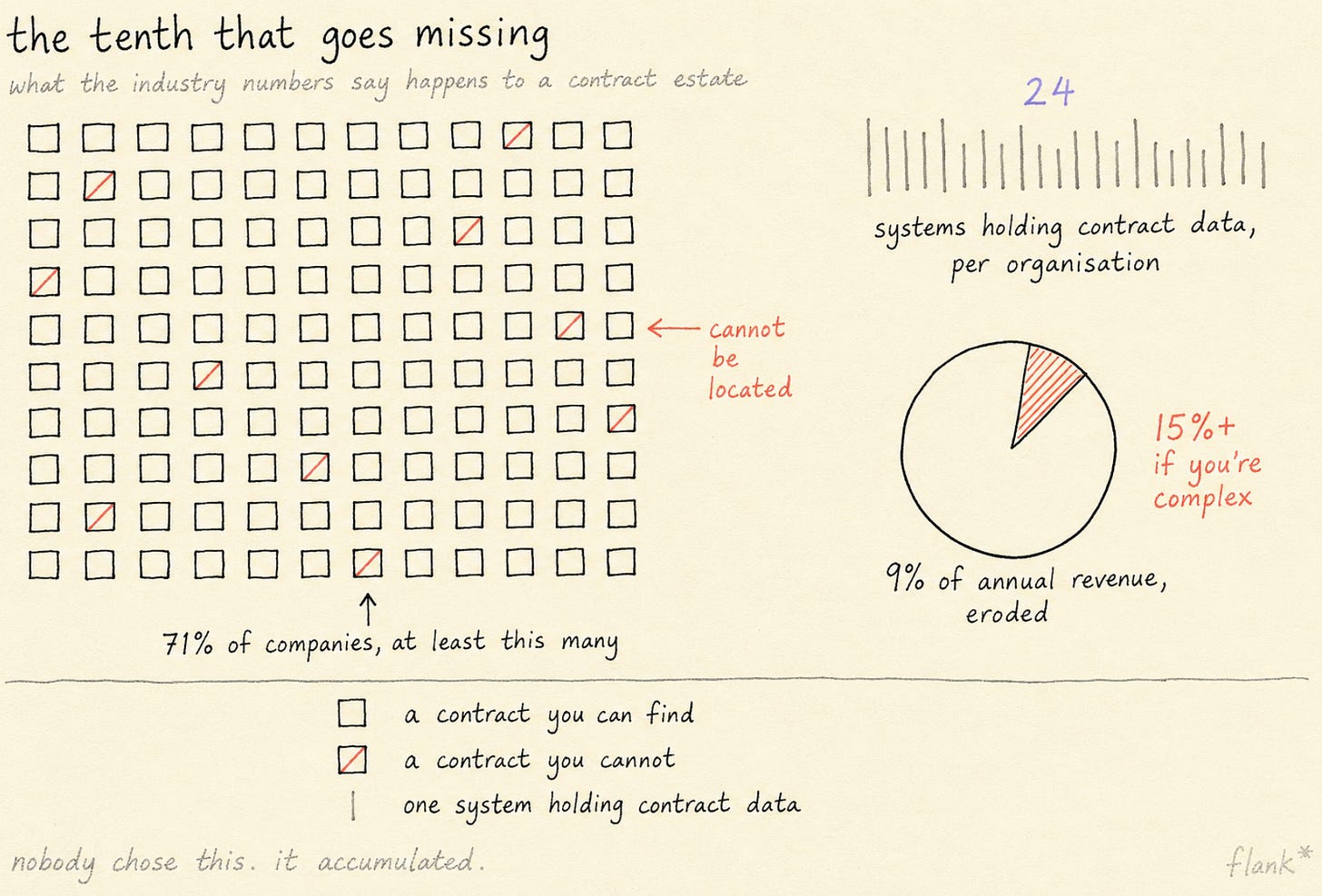
I feverishly continued to dig, and I found industry numbers that suggest this is indeed the norm. World Commerce & Contracting puts the cost of poor contract management at around 9% of annual revenue, rising to 15% or more in complex industries, and its 2025 research found contract-related data scattered across an average of 24 different systems per organisation. Then, a widely cited Journal of Contract Management figure has 71% of companies unable to locate at least a tenth of their contracts.
Signed contracts lived across email, Agiloft, SharePoint, DocuSign, and—inexplicably—a filing cabinet in the Rotterdam office.
A tenth of all contracts. Vanished. In a puff of smoke.
The next day, I was back at the whiteboard. But this time, I couldn’t get my mind off what M— had said the previous day, about her planned moved to SharePoint, and T—’s single word confirmation. I couldn’t shake it off.
Her CLM was not the problem
M— I said. Sorry, but that CLM issue you described yesterday…
She glanced up at me eagerly.
I said, Is your CLM really so bad? Did you try others before you committed to this?
She looked puzzled. Our CLM is great, she said. We just we can’t trust anyone to use it right, and we don’t want to hire a team of contract managers to administer the thing seven days a week. And even if we did, it’s a recipe for human error.
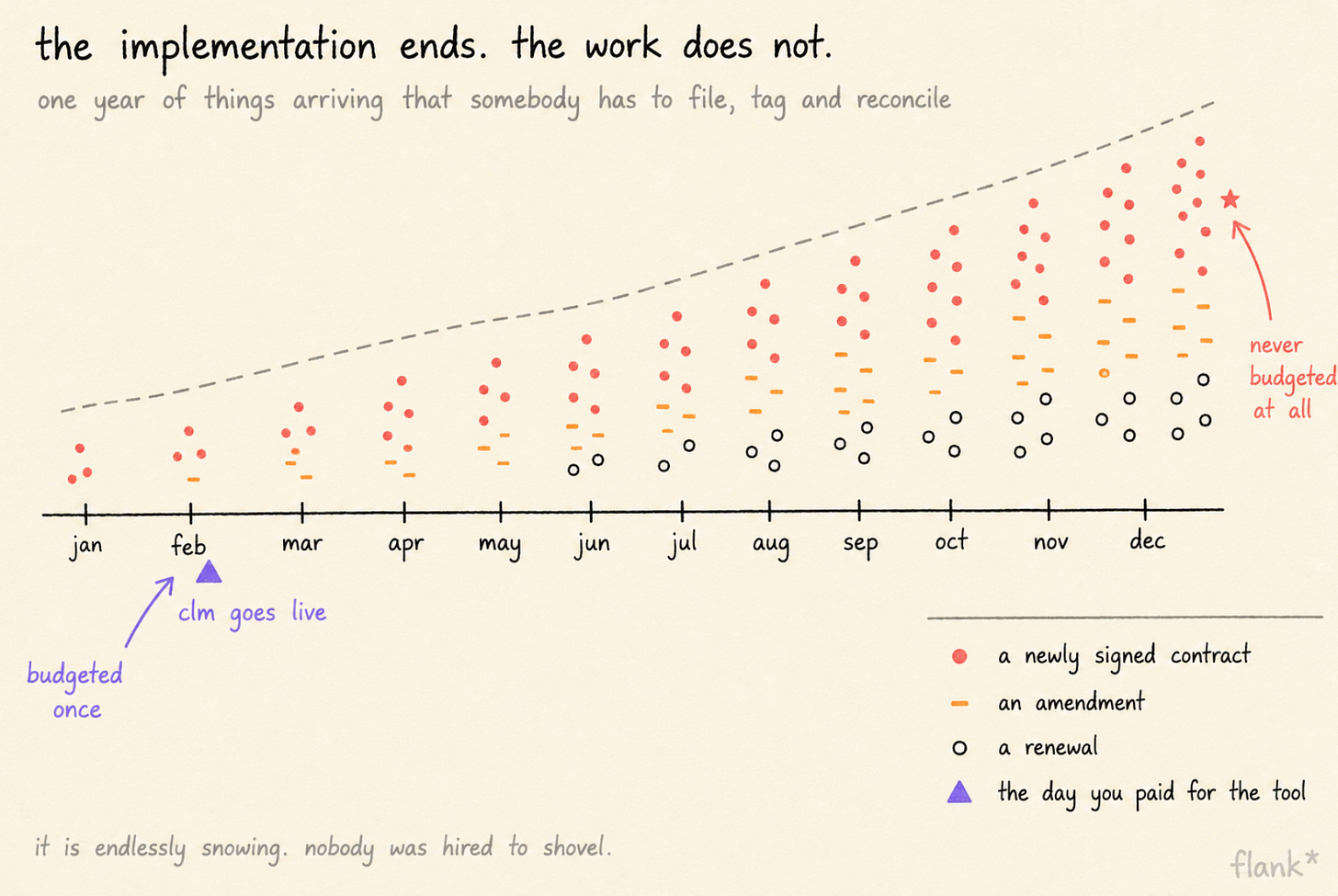
And the work never stops. It’s endlessly snowing new contracts and amendments. Renewals and renegotiations.
The problem wasn’t the software. The problem was that the CLM had arrived with an invisible line item that no one had budgeted for: a team to run the thing round the clock, flawlessly. We continued the discussion over lunch with one of her legal counsels who had joined the company mere weeks earlier. He described a similar situation at his previous employer. A well built CLM with no team to run it. There, they had flirted with the idea of a dedicated team of contract managers to administer the system; they had even experimented with three of the legal ops team taking on this exact job, but the endstate soon became obivous: an expensive team who the business would become overreliant on, running an expensive tool no one else would understand.
A few days later on the flight home, I sent a short note to my co-founder, Problem with CLMs is not the software. It’s the implicit human work required to make the CLM trustworthy
Keeping the record honest is a job nobody has
This is what it boiled down to. Throughout my research. In every discussion with every disillusioned customer of a legacy CLM. Trust was lacking because keeping the record honest is work. Expensive, human labour. Filing, tagging, updating, reconciling metadata against the actual reality of the negotiation, deduplicating, correcting typos. And the work never stops. It’s endlessly snowing new contracts and amendments. Renewals and renegotiations. And hardly any of this is legal work. It’s administrative. Often mind-numbing, inane, repetitive administrative work that is either done by well trained (and expensive) legal folk or else by no one at all.
Two bad options
Enterprises are left choosing between two bad options.
Hire a dedicated contract management team to run the CLM, and to ensure all signed agreements actually land in the CLM
Live with the CLM being untrustworthy, and watch that record creep further away from the truth each day until the system becomes unusable noise
So we built a third option.
Hire an agent to manage your contract record.
If you’d like to see it: flank.ai/flank-record
We’re ingesting everything. Even the filing cabinet in Rotterdam.
✳️
Images (but not text) are generated using ChatGPT.