Hi there,
I’m Paul, VP Product at Flank.
Today, I go into the depths of how Flank automated a 100-page franchise agreement pack for a global hospitality brand.
Too complicated?
“Our contracts are too complicated to trust AI to draft.”
I’ve heard this a few times, and it is both true and false. AI can do it, but not in the way you think. For the last year we have been working with a global hospitality brand, across their US and Europe teams of 300+ lawyers and contract specialists, automating the generation of their central franchising pack. A 100-page core paper with layered schedules and ancillary docs. They have just renewed on a much bigger contract to automate their entire contract estate. How did we make this work? Flank never actually writes the contract. I’ll explain.
Franchise agreements are complicated. Every hotel franchise deal produces paper. Rarely one document, usually a pack. A new deal might have a technology joinder and a financing letter attached. A renewal may have terminations and change-of-ownership/restructuring papers included. With an estate of hundreds of hotels, there is a continuous stream of small changes coming in pre- and post-signature: room counts, facilities, key dates, fees, obligations, ownership structure, and management requirements. Layered on top of this are various regional addenda and regulations. When I first looked at the scope of the project, I’ll admit I was overwhelmed.
The complexity is in the interactions, not the clauses
Each item and variable, on its own, is simple. It is how they interact that sends the complexity through the roof. You are probably familiar with this from your own business-critical contracting. For a franchise company, the contract is the business. Nothing could be higher stakes. This is why legally trained people have always done this kind of work. Not because any single decision requires legal judgement, but because holding dozens of interacting conditions in your head across multiple large documents is cognitively brutal. You need to be smart just to follow it. But herein lies the problem. People are great at judgement, but poor at mechanical repeatability and efficiency. Drafting a franchise deck requires little of the former and a tonne of the latter.
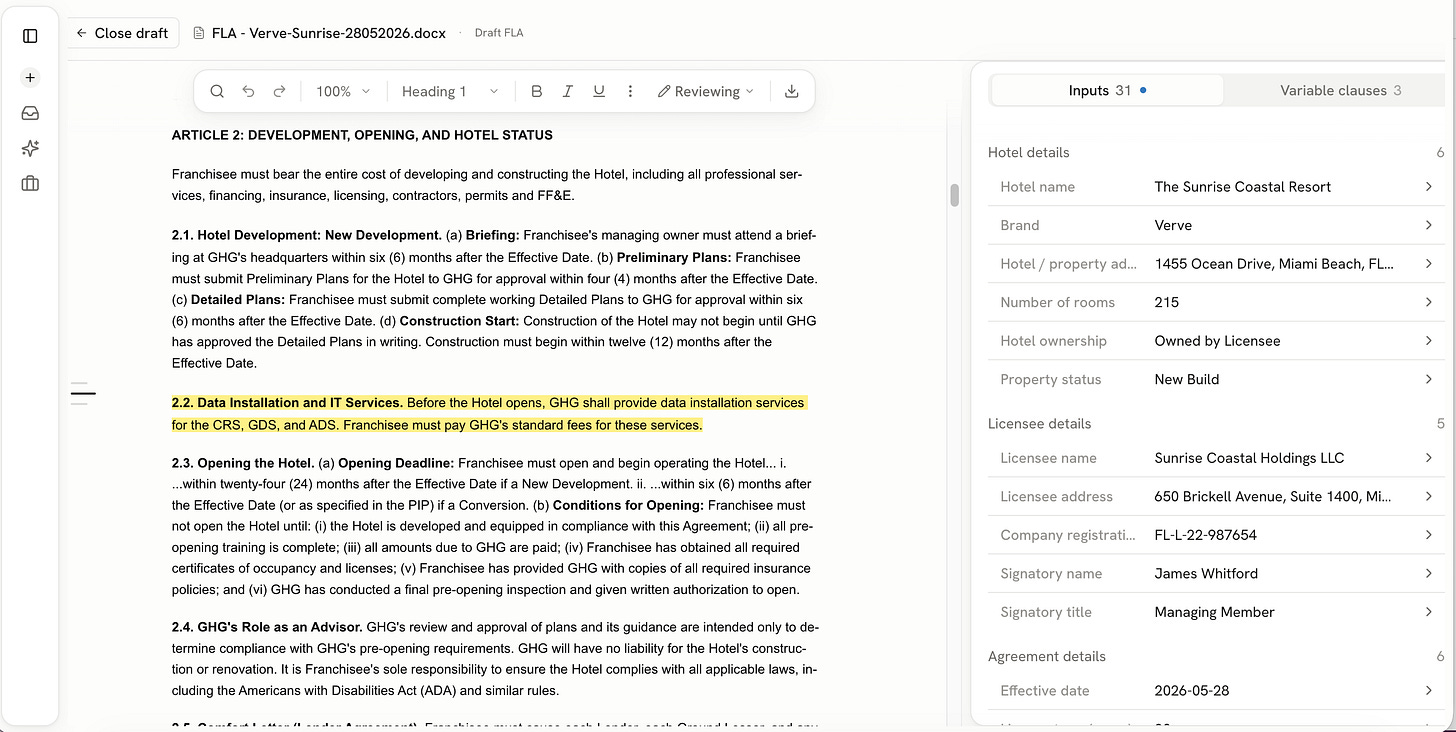
The customer was not starting from scratch when we met them. They had an existing programmatic document automation tool sitting in their CRM. This had two major limitations: firstly, anything outside of its system was invisible to it, and a lot of deal making happens off system in docs and in email. Drafted contracts had to be constantly changed manually. This meant documents soon diverged from the system, and there were a lot of mistakes. In fact, there was an entire team established in each region to spot these mistakes. The customer was paying twice for drafting. Secondly, using old-school nested if/then statements meant the complex logic became impossible to update without bugs in any sensible time frame.
Join us for a live webinar September 16th to learn more about what it takes to deploy AI agents successfully into enterprise legal teams. Register here.
Drafting is two problems, not one
Flank breaks the problem of drafting a complex agreement into two distinct sub-problems:
Problem one is a reading problem, establishing the deal facts. Flank plugs into the customer’s CRM (Salesforce) to gather basic deal data, but can also handle the messy extra-curriculars. MOUs, committee memos, emails and a stack of corporate structure docs that reflect the complex ownership structure of the deals. The Flank agent ingests this all at once, holds it without fatigue, and reconciles the deal facts. If any data conflicts or is unclear, it flags it for the user to check. The output of this is a structured deal object that perfectly describes the deal. This is where Flank’s AI orchestrations earn their keep. Redundancy is built into the system. It fires several runs in parallel. If any of them deviate, it investigates.
Problem two is assembling the agreement from the deal facts. Flank agents ingest existing template libraries, logic, and playbooks. This is usually already well documented in organisations - a decision tree that was written down before Flank even arrived. This is the deterministic layer that takes the deal facts and constructs the documents using known document templating patterns, and gives Flank customers the best of both worlds. Give Flank the exact same deal facts 20 times, and you get the same contract 20 times. Give it something ambiguous, and it works the ambiguity through with the user before establishing the facts.
Why handing a model a template does not work
When people imagine using AI to draft a contract, they often imagine simply handing a model a bunch of deal facts and an example template, and letting it loose. That, I can tell you, won’t work, no matter how much you prompt beg it. What makes Flank work is that we have actually built something much closer to the old drafting tools that the customer was already using, now with an intelligent reader layer in front of it that can finally cope when reality lands, rather than requiring reality to be manually edited back into the drafted contract. It is in the grey areas where Flank excels, and it means there is finally a workable solution to complex drafting. If the deal facts are unclear, it asks the user. If something is missing, it leaves a highlighted placeholder and prompts the user to fill it in directly or via an agent-generated form. The lawyer now just has to sign off a short list of gaps and issues, not the whole contract. A draft that declares what it doesn’t know is a different order of risk than one that is confidently wrong.
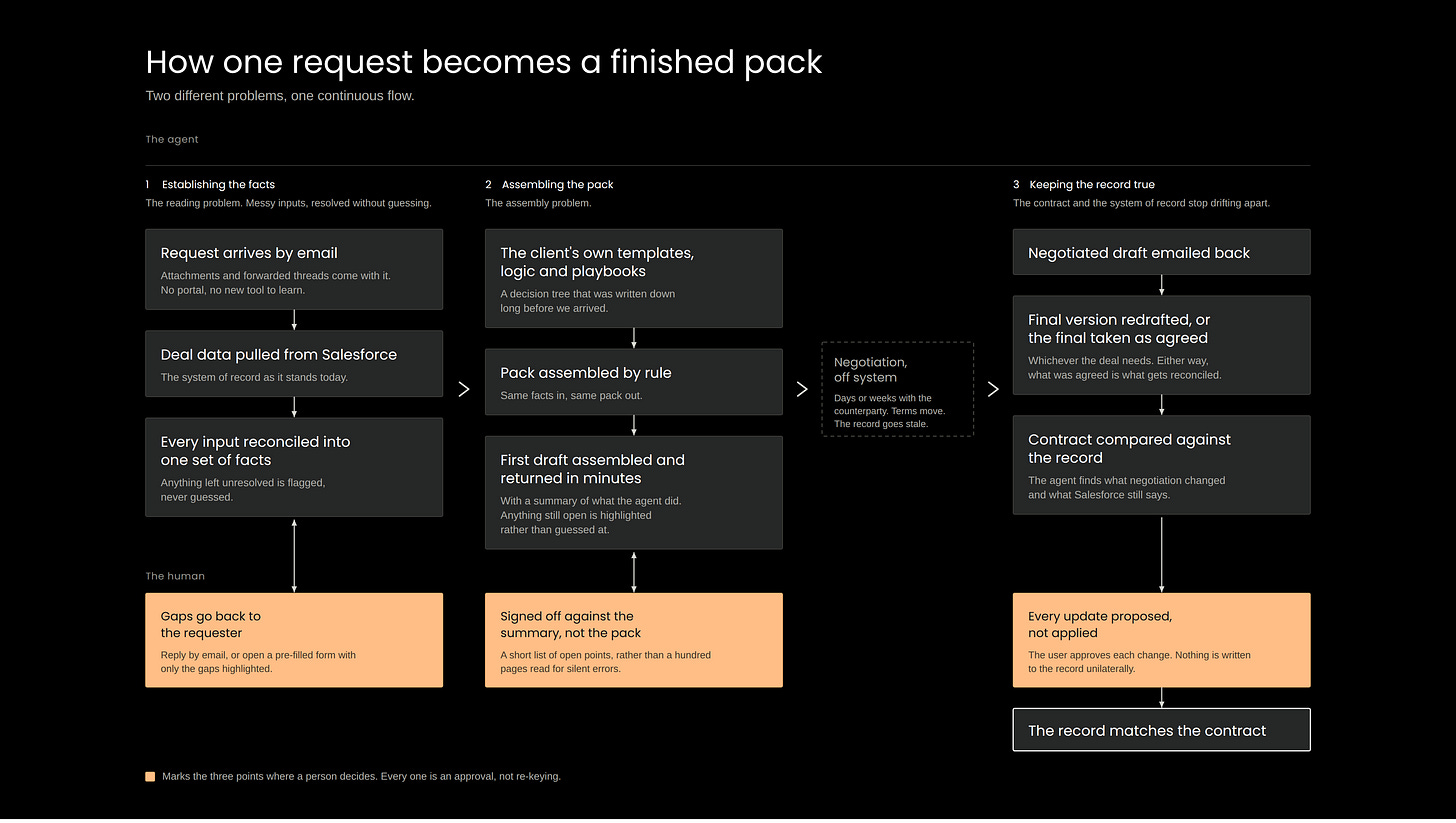
The final piece of the puzzle we solved was perhaps the biggest pain of all, and one we didn’t hear about until the agents were drafting at scale after a few months. With the team taking the doc offline to negotiate with the counterparty, the deal facts and contract soon moved on, and the CRM record went stale. Rekeying updated data took up a huge number of hours and, like all manual data work, was plagued by mistakes. Now, once the team has finished negotiating off the Flank agent’s initial draft, they simply email the draft back to Flank, and the agent compares it with the Salesforce record and updates any stale data.
When this project landed, it was our most complicated drafting use case by a mile. There was a lot of learning on our end as we re-engineered the drafting skill to deal with the kind of messy human complexity we saw in problem one. Lots of requirements only surfaced once we had a version in the customer’s hands. But that was also the personal joy of this project, working hand-in-glove with the customer, and Jason, our forward-deployed engineer on the project, achieving something that most thought not possible. I have a weird knowledge of hotel franchising now.
We learned that the impossibility was actually a category error. The reading problem and the assembly problem are different problems. Models have become remarkable at the first, the second was solved decades ago, and supervision is what lets the two run together on documents that matter.
The proof for me as a product person was in the big renewal. That was a great moment. Not just the financial signal, but the trust the customer showed us by expanding to all of their business-critical contract estate.
No change management
The customer team didn’t get new tools or workflows. They work where they always have worked - email and Salesforce. What has changed is that the manual drafting and data reconciliation are done for them. They only have to check where the agent is uncertain. The deal teams get their docs back the same day. The default manual repetitive work is gone from core contracting. The CRM data reconciliation is still in its early stages, so we have no concrete data yet, but the early signs are very promising.
Hotel franchising was a great use case for us - high volume, heavy templating, drafting logic that is complex but rule-based, a deal system that holds the data, and expensive people doing the assembly. This combination happens by default in franchise businesses, but many others too. I haven’t found the capability ceiling yet, and the two deployments we are now onboarding, one of them nowhere near hospitality, will tell me more about where it sits. If you think your drafting needs are too complex for agents, it probably means you haven’t decomposed the problem.