A confession to open with. In this article I am going to talk about Flank. It is the company I founded, and the product I have steered for the last eight years. As a rule I try not to talk too much about what we build, because I do not want this blog to become a sales channel pushing a single agenda too hard.
But this week's piece is about the next stage of legal AI, and clear examples of what that stage looks like are still few and far between. To illustrate what I mean, and to challenge the current paradigm, I need to talk just a little about Flank. I will try to be fair about what I am arguing against, because most of it is genuinely good.
The current paradigm
The current paradigm has a name, and it is the legal intelligence platform. If you run legal operations or sit as a general counsel, it is almost certainly what is being demoed to you this quarter. The two names that define it are Harvey, which raised this spring at an eleven billion dollar valuation, and Legora, which raised at five and a half billion a year after arriving in the US. These are not toys, and the money is not foolish.
What they do is real and good. Research, review, drafting, all of it brought into the places lawyers already sit, down to add-ins for Word and Outlook. If what you want is for your lawyers to be faster, these products will make your lawyers faster. And the companies are admirably clear about the model underneath. Harvey's chief executive says AI is becoming the system through which legal work gets done, and describes Harvey as the operating system for legal. Legora describes itself as the platform where legal work happens. That is the paradigm, stated plainly by the people who built it. The work moves onto the platform, and your team moves with it.
I think this is a waypoint, not the destination. A legal intelligence platform is, in the end, a better place to do the work. The next stage, the one I find myself more convinced by every month, is not a better place to do the work at all. It is the work simply getting done, and coming back as a finished outcome, with nobody in legal having had to go anywhere to produce it. Before I describe what that looks like, it is worth being clear about why the better place, on its own, does not get you there.
The quiet trouble with relocation
Every legal operations leader already knows this in their bones, including the ones who are halfway through a rollout. You buy the platform. You run the training and the change programme. And a year later, if you are honest with yourself, most of the work is still happening in email.
This is nobody's failure, and it is not a knock on the software. It is a fact about behaviour. More than three quarters of lawyers still say email is their primary tool for managing their work. The business that legal exists to support does not relocate just because legal did. Sales fires the NDA into the same inbox it always used. Procurement stays inside its own system. The request lands where requests have always landed, and the beautiful new platform sits to one side, opened by the keen few and quietly ignored by everyone else.
The rest of the software world has begun to admit this out loud. Even Salesforce, the largest enterprise software company on earth, is now asking why anyone should ever have to log in to get their work done. The instinct behind that question is right. People do not want to travel to software. The platform's answer is to make the destination so good that people finally move to it. In legal, in my experience, they mostly do not.
So you are left holding a faster lawyer. That is a real and good thing. It is not the thing you actually needed. The bottleneck was never how quickly a lawyer could draft an NDA. It was that an expensive person was drafting NDAs at all. Speed does not touch that. The work is still on the desk. It just leaves a little quicker once it gets there.
What a headless agent does instead
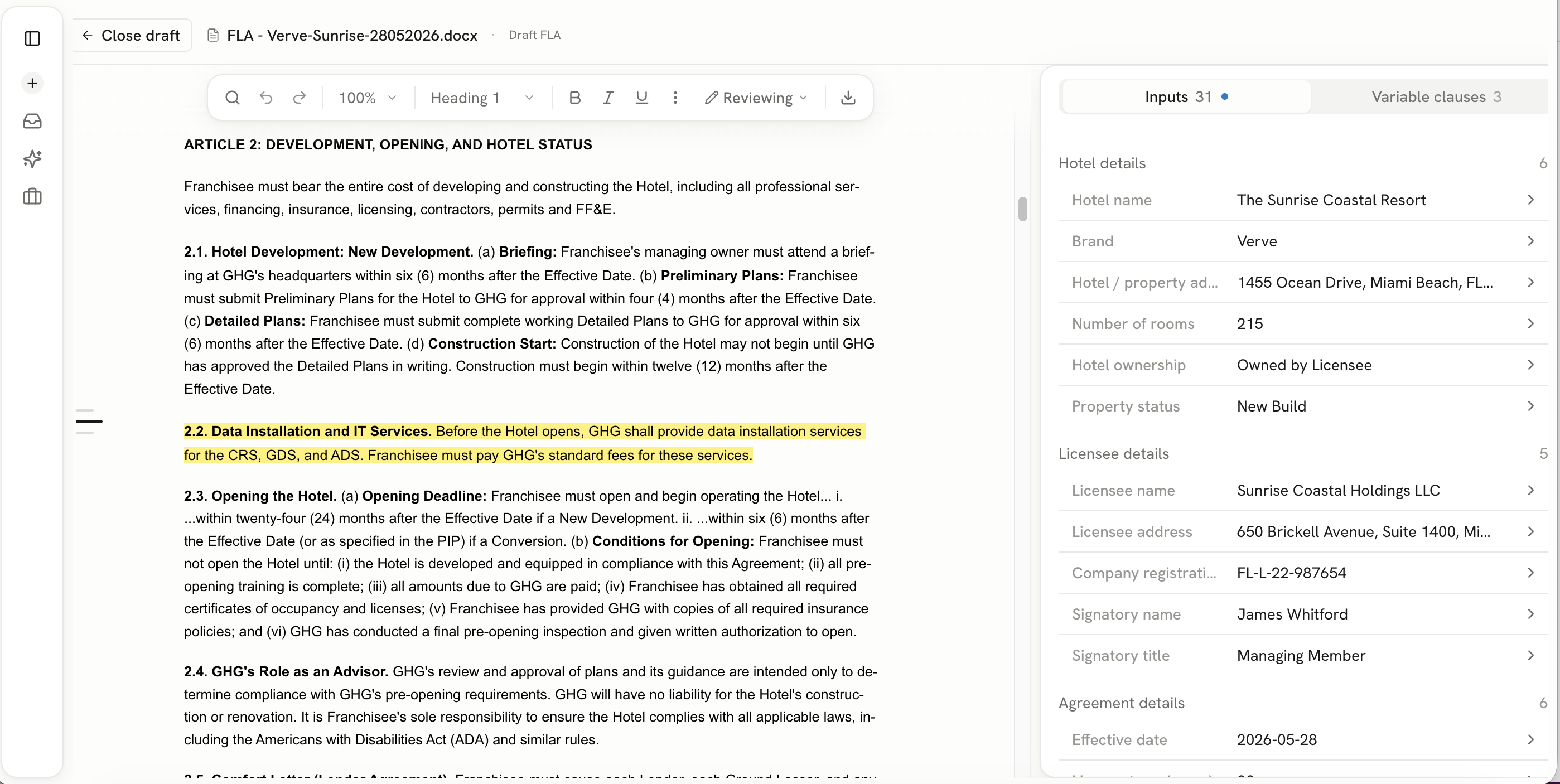
A headless agent starts from the other end entirely. There is no platform to move into, because the product is not a place to do the work. The product is the work, done. This is the part where I have to talk about Flank, so here it is plainly: this is the thing we have spent the last eight years building, and it is why we describe our agents as headless rather than as a platform.
In practice it looks like this. The request arrives exactly where it always has. An NDA in the inbox, a supplier form, a question dropped into Teams. The agent is already there, trained on your team's own templates, fallback positions, and the escalation rules that normally live only in a senior lawyer's head and nowhere on paper. It reads the request, does the work inside the guardrails you have set, and sends the answer back. The person who asked receives a complete response from legal, quickly. They never learn that an agent was involved, because nothing about their day changed. No portal, no login, no new place to be.
A platform makes the work faster to do. A headless agent means the work leaves the desk and comes back finished. Faster and gone are not the same outcome.
Your team does still get a screen, but a different one, and they open it for a different reason. Not to do the work. To supervise it. A short queue of the handful of things the agent flagged overnight, reviewed in minutes, with the standard held by your own counsel rather than by hope. The lawyer's day shifts from grinding through routine work to setting the rules and watching the edges. I will be honest that this shift is the real cost of the model. It asks something of the legal team, and a good deployment handles that with patience. But it asks nothing of the hundreds of people across the business who send the requests in, which is precisely the population a platform has to convert and almost never fully does.
Faster, or gone
This is the distinction I would put in front of any general counsel weighing the two options.
A legal intelligence platform sells your team a better way to do the work. A headless agent sells you the outcome, with the work taken off the queue. Both are legitimate. They are different purchases, priced and bought differently, and they should be. One is a tool your lawyers operate. The other is a worker your lawyers supervise.
I think the tooling is becoming a commodity, in the way that good tools always do in the end. There will be several excellent platforms, they will compete hard on features and price, and your lawyers will be glad to have one of them. The outcome is not a commodity. Nobody else can hand your business a finished, on-policy NDA at the moment it is needed without anyone in legal lifting the work off a pile. That is the part worth paying for. It is also the part a platform structurally cannot sell you, however good it is, because its model depends on your team being the ones who do the work.
It is worth saying that the platforms hear this too, and both Harvey and Legora are now building agents that run a workflow end to end. Good. But the agent still lives on the platform you have adopted and your team operates within. The destination did not go anywhere. It simply learned to do more once you arrive. Headless removes the arriving.
Where I am less sure
I do not think the headless model is right for everything, and I would be misleading you if I pretended otherwise. Genuinely novel work, a hard negotiation, the matter that could reshape the company, that still wants a lawyer with a good tool and a long afternoon. For that kind of work, a platform like Harvey is a fine thing to reach for, and I would not argue otherwise. Headless is for the routine volume, the inexpensive work that has quietly been filling the calendars of expensive people. By volume that is most of the work, which is the entire point. It is also the work that nobody became a lawyer to do.
I am also aware that "no platform" can sound like "no control", and to a general counsel that is the opposite of reassuring. It is not no control. The control moves to where it should have been all along, into the rules and the supervision, rather than into a dashboard nobody opens. That is a thing you have to feel before you trust it, and I will not pretend a paragraph manages it.
What I actually believe
So this is where I land, for now. The market is about to spend a great deal of money making the destination nicer, and some of those products are genuinely superb at what they do. But for routine legal work I do not think the answer is a better place to do it. I think the answer is not having to do it at all. A worker that turns up where the work already is, handles it under your rules, and hands it back before anyone has had to ask twice.
That is the bet, and I have now made it in writing, as promised. Next week I will go back to writing about everyone else.